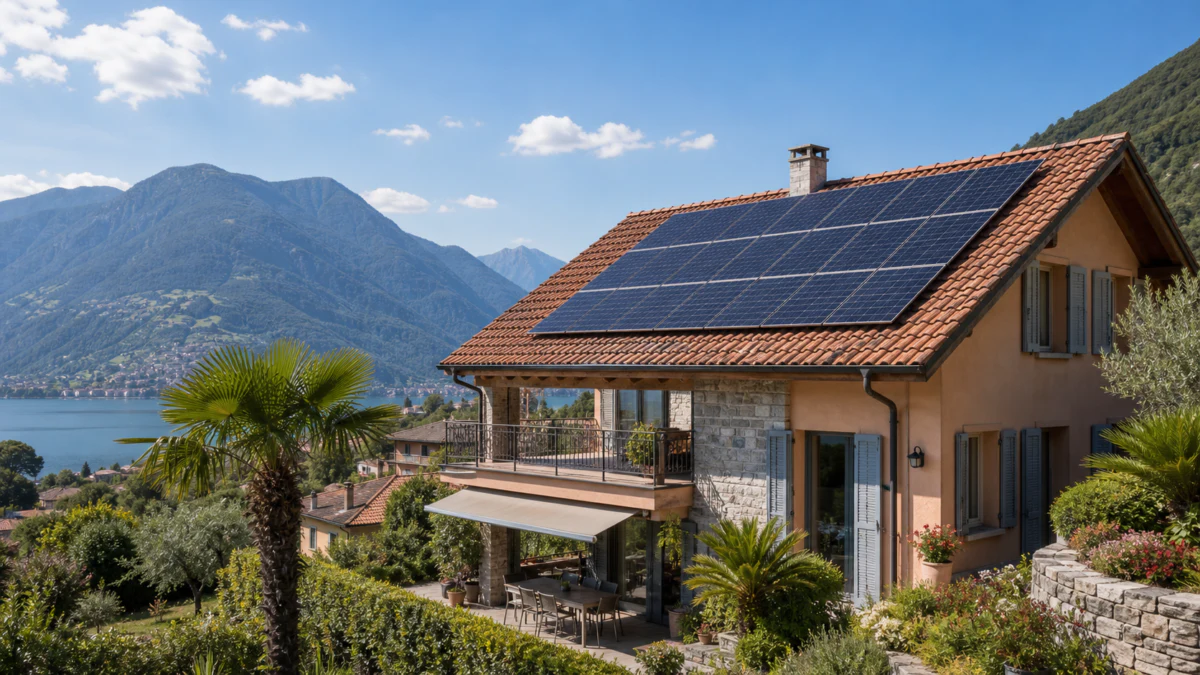
Ticino belongs, thanks to its location on the south side of the Alps, to the sunny regions of Switzerland. Second homes and holiday houses are an important part of the building stock. This page explains which subsidies apply in the canton of Ticino for photovoltaics in 2026 – from the federal level through canton and municipalities to the tax deduction – and what you should pay attention to during planning.
Key points at a glance
For the subsidy in this canton, three levels are particularly important: federal subsidy, local additional programs, and tax treatment:
- Pronovo is the national subsidy basis – also in the canton of Ticino.
- Cantonal and municipal programs differ significantly and are regularly adjusted; they should be checked on a location-specific basis.
- The tax deduction is an important lever for existing buildings; cantonal practice may differ in details.
- Feed-in tariffs paid by the grid operator are not uniform across cantons and depend on the local grid operator.
- Important: The canton does not have a mandatory cantonal building insurance (GUSTAVO canton). PV systems must be insured privately.
- A good quote takes into account subsidies, self-consumption, storage, and the specific building situation.
This makes the direction clear: The specific subsidy always depends on address, system size, building type and grid operator.
- As of 11.07.2026
Federal subsidy 2026 at a glance
New photovoltaic systems are subsidised nationwide through the one-off payment from Pronovo:
- KLEIV – One-off payment for systems with less than 100 kW output (typical for single-family homes).
- GREIV – One-off payment for systems of 100 kW or more.
- HEIV – High one-off payment for systems without self-consumption from 2 kW to 149.99 kW.
- PV auctions / sliding market premium – check separately for larger systems without self-consumption.
- Winter electricity bonus (new from 1.1.2026): Supplements the one-off payment for systems of 100 kW or more with a winter yield of more than 500 kWh per kW of installed capacity. Replaces the previous altitude bonus.
Details on the programmes: Pronovo subsidy and Photovoltaic subsidies in Switzerland.
Cantonal subsidies in the canton of Ticino
In Ticino, in addition to the Pronovo subsidy, the cantonal FER subsidy is also important. For grid-connected photovoltaic systems, federal and cantonal contributions can be combined. The cantonal FER application is submitted after commissioning and must be filed within the deadline applicable in the canton.
Note: No flat-rate pre-registration before the start of construction needs to be scheduled for the cantonal Ticino FER subsidy for photovoltaic systems. Other subsidy programmes may have different deadlines; therefore, FER, Pronovo and municipal programmes should be checked separately.
Municipal and energy supplier subsidies
In addition to the federal government and the canton, municipalities, cities or energy suppliers may also offer their own subsidy programmes. Therefore, the subsidy should always be checked based on the specific address. In the canton of Ticino, AIL, AET, AEM and local utilities are the most relevant grid operators; feed-in tariffs paid by the grid operator and any additional programmes vary depending on the network area.
Tax notes in the canton of Ticino
For existing buildings, the investment costs of a photovoltaic system can generally be deducted from taxable income as an energy-saving measure. Subsidies received (one-off payment, municipal contributions) are offset against the deductible amount.
For new builds, cantons differ in their treatment – in some cases the system is still considered part of the construction cost, while in others a deduction may be possible. The cantonal tax office provides binding information.
Income from fed-in solar electricity is fundamentally subject to tax review. There is no uniform 10-kWp threshold across Switzerland. Individual cantons have simplification rules or de minimis limits; the respective cantonal tax practice is decisive.
Feed-in remuneration and feed-in tariffs in the canton of Ticino
Feed-in tariffs paid by the grid operator are not uniform across cantons; the grid operator is decisive. From 2026 onwards, if there is no agreement between the grid operator and the system operator, the quarterly calculated reference market price of the Federal Council serves as the basis. Minimum remuneration applies to photovoltaic systems under 150 kW; for systems up to 30 kW, this amount is 6 Rp./kWh. Guarantees of origin and local green electricity models should be checked separately. Details on the page Feed-in Remuneration Switzerland.
For systems with cantonal FER subsidy, additional feed-in and acceptance conditions apply in Ticino. Depending on the subsidy configuration, an AET purchase agreement or a local grid operator tariff may be relevant.
For systems with cantonal FER subsidy, additional feed-in and acceptance conditions apply in Ticino. Depending on the subsidy configuration, an AET purchase agreement or a local grid operator tariff may be relevant.
Economically, self-consumption is the decisive lever. Whether a storage system is worthwhile is clarified on the page PV system with storage; for apartment buildings and areas, association for self-consumption (ZEV), vZEV and from 2026 also local electricity communities (LEG) should be considered.
Who benefits most from photovoltaics in the canton of Ticino?
Typical situations can be categorised for this canton as follows:
| Situation | Assessment |
|---|---|
| Single-family home with a good roof | Often worth checking, EIV + tax deduction have a strong effect |
| Heat pump present or planned | Self-consumption particularly valuable |
| E-car present or planned | Charging times matter, EMS is worthwhile |
| Apartment building / condominium ownership | Check ZEV, vZEV and LEG from 2026 onwards |
| Commercial / Agriculture | Daily consumption often matches well with solar production |
| Small or shaded roof | Get an exact calculation |
What remains decisive is how well roof area, self-consumption, subsidies, and feed-in tariff paid by the grid operator work together.
Checklist before the quote
Before requesting a quote, this information should be available so that the subsidy and cost-effectiveness can be checked properly:
- Address and municipality
- Roof area, orientation, slope, shading
- System size in kWp
- Current electricity consumption and future outlook (heat pump, electric car)
- Storage yes/no
- Solar thermal additionally?
- Tax deduction: Is it sensible to spread it over several years?
- Grid operator and feed-in tariff paid by the grid operator
- Cantonal programmes and municipality contributions (Energiefranken)
- Check the subsidy process early: KLEIV is generally paid after commissioning; for GREIV, HEIV, as well as cantonal or municipal programmes, different deadlines may apply.
With this information, the specialist installer can assess subsidy, self-consumption and technical design significantly more robustly.
solar-guide.ch recommends: For secondary residences in Ticino, it is worth looking at self-consumption when present versus feed-in when absent – the appropriate battery storage and ZEV question is decided individually. Ticino is also a GUSTAVO canton (private insurance required).
Conclusion
In the canton of Ticino, several levels interact in 2026: a one-off payment from the federal government, cantonal or municipal contributions, feed-in tariff paid by the grid operator, self-consumption and tax deduction. Check specific amounts and deadlines based on your location; depending on the programme, the application is submitted either before construction begins or after commissioning.
Would you like to know which subsidy is available for your solar system in the canton of Ticino? Through solar-guide.ch, you can submit your request free of charge and without obligation. Your request will be forwarded to a maximum of three suitable specialist installers from your region.
Request quotes free of charge and without obligation
Frequently asked questions and answers
What subsidies for solar systems are available in the canton of Ticino in 2026?
Nationally, the one-off payment via Pronovo (KLEIV/GREIV/HEIV) and from 2026 the winter electricity bonus for larger systems. Cantonal programmes focus on building renovation, heating replacement and consulting – specific contributions should be checked based on location.
Are there cantonal contributions in addition to the Pronovo subsidy?
This depends on the current programme. The main contribution for standard PV usually comes via the one-off payment; cantonal and municipal additional contributions are possible in specific cases. Overview: Energiefranken.
Is battery storage subsidised in the canton of Ticino?
There is no comprehensive federal or cantonal subsidy for battery storage in 2026. Individual municipalities or energy suppliers may provide contributions – check via Energiefranken.
Are there municipal contributions for photovoltaics?
In some municipalities yes, with very different rates. Amounts and deadlines change; overview on Energiefranken.
Can I deduct a solar system for tax purposes?
For existing buildings, generally yes, as property maintenance. Subsidies received are deducted from the deductible amount. The cantonal tax office provides binding information.
Who helps with the subsidy application?
Your specialist installer usually handles the application to Pronovo on your behalf. Cantonal and municipal applications should be submitted by you or your installer in good time – before construction begins.