The single-family home is the classic application case for photovoltaics: its own roof, manageable consumption, often already a heat pump or an electric car in mind. Before looking at costs and subsidies, practical orientation pays off – which system suits your house, how large should it be and how does implementation proceed? That is what this page is about.
Key points at a glance
The key points of this section can be summarised compactly:
- The appropriate system size is determined by the roof area, electricity consumption and future consumers such as a heat pump or electric car.
- It is usually not the maximum-sized system, but the one matching your consumption, that is the most economical.
- Battery storage is not mandatory, but it can increase self-consumption.
- You should have a rough idea of costs and subsidies; the individual quote determines the details.
- Those who have roof data and annual consumption figures ready receive more comparable quotes from the outset.
This makes the direction clear: Only roof area, consumption and future consumers show which system size is sensible.
- As of 13.07.2026
Which roof surfaces are suitable?
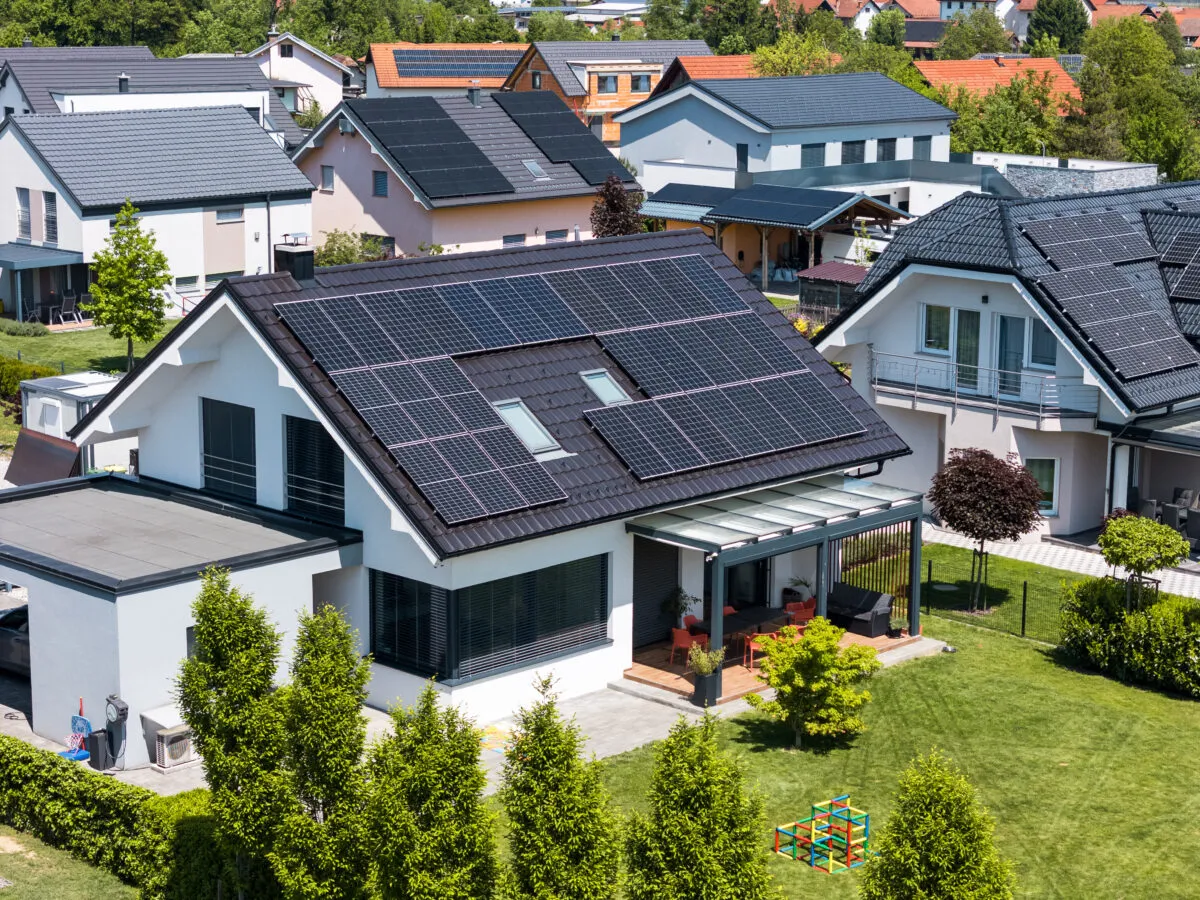
Most roofs are suitable for a single-family home – the key factors are area, orientation, slope and shading. South-facing roofs deliver the highest yield, but east-west roofs are also well suited and distribute production over the course of the day, which benefits self-consumption. Shading from trees, chimneys or neighbouring buildings reduces the yield and should be taken into account during planning. The condition of the roof and its statics also play a role: if a roof renovation is already planned, it may make sense to coordinate this with the installation.
How large should the solar system be?
The system size is determined not only by the available roof area but also by your consumption – today and in the future. As a rule of thumb: The more electricity you can use yourself, the more likely a larger system will be worthwhile. Those who operate a heat pump or charge an electric vehicle have a higher demand and can consume more solar power themselves.
An oversized system, whose electricity is mostly fed into the grid, is less economically attractive because the feed-in remuneration is lower than the purchase price. Conversely, an undersized system leaves potential unused. The appropriate size lies in between and depends on your individual profile.
How do electricity consumption and daily profile affect self-consumption?
Not only the quantity, but also the temporal pattern of consumption matters. Solar power is generated during the day. Those who consume a lot during the day – for example through home office work, a heat pump or controlled household appliances – achieve a high level of self-consumption without battery storage. If the main consumption is in the evening, however, a battery storage system shifts the electricity generated during the day to the evening hours.
For a first estimate of yield and self-consumption, you can use the Solar Calculator from EnergieSchweiz and follow the logic behind it on the page Calculate solar system.
How can battery storage, heat pump and electric car be combined effectively?
Photovoltaics, heat pump and electric car complement each other well: they increase self-consumption and thus the economic efficiency. A heat pump can be operated during the day with solar power, and an electric car ideally charges when the sun is shining. An energy management system controls these consumers automatically.
Whether an additional battery storage system is worthwhile depends on the consumption profile. You will find a detailed decision-making aid on the page PV system with storage.
Welche Kosten und Förderungen sollten Sie früh einordnen?
The investment consists of modules, inverter, substructure, scaffolding, electrical work, and planning; a battery storage increases the total. The one-off payment from Pronovo and any cantonal programs reduce the costs. A detailed overview of cost factors can be found on the page What does a solar system for a single-family home cost. Here, specific figures are only provided by the individual quote.
How is a solar system implemented?
The following list summarises the key points on How is the implementation of a solar system carried out?:
- Erste Orientierung – Dach, Verbrauch und Ziele klären.
- Request – contact suitable specialist installers for free and without obligation.
- Quotes – obtain and compare individual offers.
- Order and planning – detailed planning, registration with the grid operator.
- Installation and commissioning – assembly, connection, inspection.
- Subsidy – Apply for a one-off payment.
The process shows where decisions, documents and specialist consultations are required.
What information does a specialist installer need?
To enable a specialist installer to create a reliable quote, the following details are helpful:
- Address and year of construction of the house
- Roof area, roof shape, orientation and pitch
- Roof condition and covering
- Annual electricity consumption (kWh)
- Existing or planned consumers (heat pump, electric car, wallbox)
- Interest in storage or backup power
The more complete these data are, the more precisely the specialist installer can estimate the system size, effort, and price.
solar-guide.ch recommends: When designing your system, think about the coming years – a planned heat pump or electric vehicle will noticeably increase consumption and influence the sensible system size. Have your roof data and annual consumption ready before you request quotes. This ensures that the offers are comparable from the start.
How can quotes be compared sensibly?
Because the roof, consumption, and desired equipment differ from house to house, the recommendations also vary. A comparison of multiple quotes shows which system size, components, and price are realistic for your building. What matters in a quote can be read on the page Photovoltaic System Quote. All quote options can be found under Quotes.
Conclusion
For a single-family home, the appropriate sizing is most important: a system that fits the roof, consumption and future consumers. You should have a rough idea of costs and subsidies; the specific recommendation is provided by the individual quote. A comparison of several offers creates the best basis.
Especially for single-family homes, recommendations vary depending on the roof, consumption, and desired storage solution. With solar-guide.ch, you receive free and non-binding individual assessments from up to three suitable specialist installers in your region.
Request quotes free of charge and without obligation
Frequently asked questions and answers
How large should a solar system for a single-family home be?
This depends on roof area, electricity consumption and future consumers such as a heat pump or electric car. The most economical option is usually the system whose electricity you can use yourself to a large extent.
Do I definitely need a battery storage system?
No. A battery storage system is optional. It increases self-consumption but is mainly worthwhile if evening and night consumption is high. If daytime consumption is high, a system without storage can also be sensible.
Can I add a battery later?
In many cases, yes. If the system is planned accordingly from the start, it facilitates a later retrofit. Discuss this with your specialist installer.
Is every roof suitable?
Most roofs are suitable, provided that the area, orientation, pitch and shading are appropriate and the structural integrity allows it. A reliable assessment is carried out on site.
How long does the installation take?
The actual installation often takes only a few days. From the request through quotes and permits to commissioning, several weeks to months pass depending on the provider.
Average: 5 out of 5 stars (1 rating)