Many Swiss homeowners first think of the question: How much electricity can my roof produce? when considering a photovoltaic system. However, a second question is often decisive: How much of this solar electricity can I actually use in my own home?
This is exactly where a solar system with battery storage becomes interesting. It not only generates electricity on the roof but makes this electricity more available in everyday life – in the evening, at night and whenever energy is needed in the household. A classic photovoltaic system thus becomes its own small energy system: clean, predictable and significantly more independent from the grid.
Especially for single-family homes in Switzerland, this solution is often a very good fit. Many households consume less electricity during the day because residents are at work, on the go, or the largest appliances only run later. At the same time, electricity needs are rising: heat pump, water heater, electric car, home office, smart devices and charging station change the energy consumption in the house. A battery storage system helps to better manage this development.
However, it is important to note: a battery storage system is not a universal solution. It is particularly worthwhile when the solar system is carefully planned, the storage capacity matches your consumption, and subsidies, feed-in tariffs paid by the grid operator, as well as future expansions are considered from the outset. This guide shows what you should pay attention to as a homeowner – and why a comparison of multiple solar providers is particularly important for a solar system with battery storage.
1. Why self-consumption is the most important lever
A solar system usually generates its highest yield when many households consume very little electricity: during the day. In the evening, consumption rises again: lighting, kitchen appliances, washing machine, entertainment, heat pump or charging station require electricity, while hardly any energy is coming from the roof.
Without storage, surplus solar electricity is fed into the grid. This is generally sensible, but economically it is more attractive for many homeowners to use as much electricity as possible themselves. After all, every kilowatt-hour consumed directly in their own home does not have to be bought from the energy supplier.
A battery storage closes exactly this temporal gap. It absorbs the surplus from the day and makes it available again later. This makes the difference between a system that mainly produces electricity and one that actively supplies the household.
This is particularly interesting for Swiss single-family homes because feed-in tariffs vary depending on the energy supplier and electricity prices can change in the long term. Those who use more of their own solar power become less dependent on these developments and get more out of their own roof area.
2. How a solar system with battery storage works in everyday life
In everyday use, a solar system with battery storage runs largely automatically. The solar modules on the roof generate electricity from sunlight. The inverter makes this electricity usable in the house. First, the system supplies the current consumers: refrigerator, lighting, household appliances, heat pump or charging station.
If the system produces more electricity than is currently needed, the surplus flows into the battery. Only when the storage is full is the remaining electricity fed into the grid. When electricity is needed again later, the house first draws on the storage. Only when the storage is empty or does not provide sufficient power is additional electricity drawn from the grid.
This sounds technical, but is very comfortable for residents. Modern systems regulate the energy flows themselves. An app usually allows you to see at any time how much electricity the system produces, how full the storage is and how much energy is currently being drawn from the grid.
The system becomes particularly interesting when an energy manager is integrated. Then consumers can be controlled more precisely. The heat pump can, for example, preferably run when a lot of solar power is available. The electric car does not simply charge at some point, but as much as possible when the sun is working. This creates a system that not only generates electricity but intelligently organises energy consumption in the house.
3. Which battery storage size is suitable for a single-family home?
The appropriate storage size depends not only on the size of the solar system, but also on electricity consumption, the daily rhythm of the residents and additional consumers in the house. A household with a heat pump or electric car, for example, requires significantly more energy than a household without these consumers.
As a guide for many Swiss single-family homes: For every installed kW of PV output, approximately 1 kWh of storage capacity can be planned. Depending on the goal, consumption, and budget, a slightly larger battery storage unit may also make sense. However, it is crucial that the storage unit is not simply as large as possible, but appropriately sized.
Example for a typical single-family home:
A 4-person household with a well-suited roof is planning a photovoltaic system with around 10 kWp of output. A storage system with a capacity of about 8 to 12 kWh can be a sensible addition. If a heat pump is also in operation or an electric car is to be charged regularly with solar power, the optimal sizing may look different. In such cases, an exact simulation with consumption data, roof orientation and the desired share of self-consumption is worthwhile.
Advantages of an appropriate battery storage size:
- Better cost-effectiveness: The battery storage is regularly charged and discharged.
- No overdimensioning: Oversized storage systems cause unnecessary additional costs.
- Greater practicality: The capacity matches the actual consumption in a single-family home.
- Future-proofing: Expandable storage systems can be adapted later on.
- Professional planning: A specialist installer can calculate which combination of PV output, storage, inverter and energy management is sensible.
Especially for single-family homes, individual planning is particularly important. Two houses with the same roof area can have completely different consumption profiles. Therefore, storage size and system size should always be considered together.
4. When a battery storage system is particularly worthwhile – and when it is not
A battery storage system is particularly worthwhile when there is regularly surplus solar power during the day and a significant electricity demand later in the household. This is the case for many single-family homes: The sun produces energy while no one is at home – and in the evening, the kitchen, appliances, hot water, heating or entertainment systems are running.
A battery storage system is very interesting for families, working professionals, households with a heat pump, owners of an electric car and houses where electricity consumption will increase in the coming years. Anyone who wants to use as much of their own solar power as possible and be less dependent on feed-in tariffs paid by the grid operator should also seriously consider a battery storage system.
A large battery storage unit may be less sensible if the PV system is very small, produces hardly any surplus, or if the electricity is already consumed directly during the day. Accurate calculations should also be made in cases of unfavourable roof orientation, heavy shading or very low evening consumption.
A reputable provider will therefore not simply recommend the largest storage unit. They will explain which capacity suits your consumption, what additional costs arise, and how the system can be expanded with future consumers. It is precisely at this point that good advice is separated from a quick standard quote.
5. Costs, subsidy and feed-in tariff paid by the grid operator in Switzerland
The costs of a solar system with storage depend on many factors: roof size, roof shape, scaffolding, module type, inverter, storage size, electrical installation, grid connection, energy manager, and desired additional features. The question of whether the storage is installed directly with the PV system or retrofitted later also influences planning.
In Switzerland, the photovoltaic system is subsidised through the one-off payment. For many single-family homes, the subsidy for small photovoltaic systems is relevant. In addition, further programmes may exist depending on the canton, municipality or energy supplier. That is exactly why the subsidy should not only be checked after the quote, but already during planning.
Equally important are the feed-in tariffs paid by the grid operator. Surplus solar electricity is remunerated, but the amount of remuneration varies depending on the grid area and energy supplier. As a result, the economic viability of two similar systems can differ significantly depending on their location.
For homeowners, this means: A good quote should not only list modules and battery storage. It should explain which subsidy is possible, how self-consumption is improved, what feed-in conditions apply at the location, and what assumptions underlie the cost-effectiveness calculation.
Those who compare several providers here often get a much clearer picture. Not only in terms of price, but also regarding warranty, storage strategy, emergency power option, energy management, service and scalability, the differences can be significant.
6. Subsidy check: What homeowners should consider depending on the canton
The federal subsidy applies nationwide, but many interesting differences arise locally: with municipalities, cities, energy suppliers, tax issues and feed-in tariffs paid by the grid operator. Therefore, it is not enough to just search for “subsidy Switzerland”. The specific address of the single-family home is decisive.
The basic subsidy for photovoltaics runs through Pronovo across Switzerland. For many single-family homes, KLEIV is primarily relevant, while GREIV or HEIV apply to larger systems. However, it often becomes interesting on site: cantons, municipalities, cities, and energy suppliers can offer additional contributions, consultations, or bonuses.
The following overview is intended as a practical location check. It does not replace a binding subsidy assessment, but it shows what homeowners in the individual cantons should pay particular attention to.
| Canton | What is specifically important in the subsidy and quote check |
|---|---|
| Aargau (AG) | In Aargau, it is worth looking beyond the Pronovo subsidy. The canton supports the preliminary consultation on self-generated electricity with 350 Fr.; the customer contribution starts at 150 Fr. If the building envelope is renovated and PV is installed at the same time, a PV bonus may be added: +20 Fr./m2 for flat roofs with greenery, +30 Fr./m2 for pitched roof-mounted systems, and +100 Fr./m2 for integrated or facade systems. In Aarau, there are additional local PV contributions: 500 Fr. base contribution + 100 Fr./kWp, for integrated systems 600 Fr. + 110 Fr./kWp, and for facade PV 600 Fr. + 120 Fr./kWp, each up to a maximum of 15’000 Fr. per system. Solar thermal energy is also subsidised at the cantonal level. |
| Appenzell Innerrhoden (AI) | In Appenzell Innerrhoden, Pronovo is primarily in the foreground when it comes to PV. Nevertheless, solar consulting should not be overlooked: The canton supports consultations on active solar energy use, among other things with a contribution of 100 Fr. or an impulse consultation with 100 Fr. customer participation. Those who want to combine hot water or heating with solar thermal should also check the contributions for solar collectors: up to 70 kW 1200 Fr. + 500 Fr./kWth, above that 2400 Fr. + 1000 Fr./kWth. |
| Appenzell Ausserrhoden (AR) | Appenzell Ausserrhoden is particularly interesting for PV because the canton provides an additional subsidy on top of the Pronovo one-off payment. For systems commissioned between 1.1.2022 and 31.8.2025, a maximum doubling of the federal subsidy was possible; from 1.9.2025 onwards, it is a maximum of 50 % of the Pronovo one-off payment, in each case minus the mandatory share for new buildings. In addition, there is solar consulting with a contribution of 300 Fr., solar thermal subsidy and 400 Fr. per developed parking space for basic charging infrastructure in existing apartment buildings. |
| Bern (BE) | In the canton of Bern, the quote should consider not only the PV system but also battery storage and charging infrastructure. The canton subsidises bidirectional DC charging stations with 3000 Fr. per installed charging station and basic installations for charging infrastructure with 250 Fr. per developed parking space. In the city of Bern, Energie Wasser Bern additionally supports PV systems: up to 30 kWp with 80 Fr./kW, and from 31 kWp onwards with a lump sum of 2400 Fr. Battery storage in conjunction with PV is subsidised in the city of Bern with 100 Fr./kWh for 4 to 50 kWh, and with a lump sum of 5000 Fr. from 50 kWh onwards. |
| Basel-Country (BL) | In Basel-Landschaft, PV becomes particularly interesting when the roof or facade is being renovated anyway. The cantonal PV bonus amounts to +40 Fr./m2 of module area on the roof and +120 Fr./m2 of module area on the facade. This is precisely why a quote here should always check whether PV and building envelope can be planned together. In addition, there are contributions for solar thermal energy and borehole regeneration as well as 500 Fr. per charging point for charging infrastructure in existing apartment buildings with three or more residential units. |
| Basel-Stadt (BS) | Basel-City particularly rewards the combination of energy renovation and photovoltaics. Under the Solarkraftwerk Basel campaign, the contribution increases when PV modules are installed on renovated roof or facade surfaces: for roofs from 50 to 100 Fr./m2, and for facades from 70 to 140 Fr./m2. Thermal solar systems receive a basic contribution of 2400 Fr. plus 1000 Fr./kW. For charging infrastructure, up to 60 % of the approved costs can be covered depending on access, with maximum contributions ranging from 1300 to 7500 Fr. per charging point. |
| Fribourg (FR) | In Fribourg, municipal subsidies are particularly relevant for homeowners. The city of Fribourg supports photovoltaic modules with 25 % of the federal contribution, up to a maximum of 4000 Fr., and fully covers the costs of solar consulting. The canton subsidises solar collector systems on existing buildings: up to 70 kW with 1200 Fr. + 500 Fr./kWth, and over 70 kW with 20’000 Fr. + 1000 Fr./kWth. In addition, municipal contributions can be added to cantonal subsidies, for example for thermal insulation, solar collectors or GEAK improvements. |
| Geneva (GE) | For Geneva, Energiefranken does not show a separate cantonal PV flat rate beyond Pronovo. However, this does not mean that the location check is unimportant. In Geneva, grid connection, self-consumption, feed-in tariffs paid by the grid operator, and possible SIG or municipality programmes must be examined particularly closely. In addition, the canton subsidises the electrification of collective residential car parks: up to 50 % of the actual costs, a maximum of 20’000 Fr. per car park, with degressive contributions of 500, 300 or 250 Fr. per electrified parking space. |
| Glarus (GL) | In the canton of Glarus, it is worthwhile to look at steep, winter-robust systems. PV systems with a tilt angle of 75 degrees or more receive a tilt angle bonus of 250 Fr./kWp after a legally binding Pronovo subsidy decision. Those who implement PV and a thermal solar system simultaneously can receive an additional 2000 Fr. Solar thermal energy is also supported: up to 70 kW with 4000 Fr. + 500 Fr./kW rated output, plus 500 Fr. for the heat meter and a maximum of 15’000 Fr.; from 70 kW with 2400 Fr. + 1000 Fr./kW. |
| Graubünden (GR) | In Graubünden, winter electricity is a central topic. The canton subsidises suitable photovoltaic systems for winter electricity at locations with global radiation exceeding 1250 kWh/m2*a with 300 Fr./kWp. In addition, photovoltaic systems on residential buildings can be subsidised if they utilise the area potential and generate significantly more power than just their self-consumption. Charging infrastructure is also relevant: 400 Fr. per parking space at commercial enterprises and apartment buildings, 2000 Fr. per publicly accessible parking space with a charging station, and 2000 Fr. per bidirectional DC charging station on residential buildings. |
| Jura (JU) | For Delémont, Energiefranken shows no additional cantonal PV subsidy besides Pronovo. Therefore, the quote in Jura should be calculated particularly carefully with feed-in tariff paid by the grid operator, self-consumption and possible municipality or utility offers. Locally relevant is, for example, the “Borne Smotion” offer from Services industriels de Delémont for charging infrastructure. Anyone who wants to combine PV with e-mobility should include this point in the planning at an early stage. |
| Lucerne (LU) | In the city of Lucerne, a good planning phase ideally begins with the Solar-Impuls: free advice with a written advisory protocol. For photovoltaic systems, the city of Lucerne pays an additional 20 % of the Pronovo one-off payment. Further surcharges are possible, for example for PV with roof greening, steep installations, facade installations, low-glare modules or other special cases. Plug-and-play PV systems are also subsidised. Canton Lucerne supports solar thermal energy with 4000 Fr. + 1000 Fr./kW rated output. In apartment buildings, it is also worth looking at charging infrastructure and bidirectional charging stations. |
| Neuchâtel (NE) | Neuchâtel is particularly interesting when PV is combined with storage or larger roof areas. From 1 March 2026, the canton will support home batteries for storing PV electricity. Large PV roof systems over 90 kW can be supported at cantonal level in addition to Pronovo; Energiefranken lists 11’000 Fr. here. The city of Neuchâtel supports PV systems with 500 Fr. per installed kW. For charging infrastructure, a cantonal incentive of 800 Fr. per charging station is listed. |
| Nidwalden (NW) | In Nidwalden, consulting is an important starting point. Standard PV mainly runs through Pronovo, but the canton subsidises energy consultations with up to 50 % of the costs. For a solar energy consultation, 600 Fr. are possible, for GEAK Plus or building analysis 1500 Fr. Those who additionally check solar thermal find cantonal contributions from 2 kW: 3000 Fr. + 1000 Fr./kW. For homeowners, this means: first compare variants, then request quotes. |
| Obwalden (OW) | In Obwalden, winter-optimised PV systems are specifically supported. For an inclination angle of 75 to 90 degrees, there is a basic contribution of 1000 Fr. plus 750 Fr./kW from 2 kW onwards, with a maximum of 8000 Fr. This can be particularly interesting for steep roofs. In addition, the canton subsidises charging infrastructure for electric vehicles with a flat rate of 2000 Fr. per house connection. For standard roof PV, Pronovo is the central basic subsidy. |
| St. Gallen (SG) | In St. Gallen, the city subsidy is particularly worth noting. The city of St. Gallen supports PV systems up to 100 kWp in addition to Pronovo. The contribution corresponds to 50 % of the Pronovo performance contribution for KLEIV if the system is not only optimised for self-consumption but also makes the best possible use of the roof area. PV with biodiversity-valuable roof greening can receive additional funding. Canton SG supports charging infrastructure in car parks with 300 Fr. per connection line, 800 Fr. per operational charging station and a 5000 Fr. additional contribution if a PV system is installed. |
| Schaffhausen (SH) | Schaffhausen is strong in storage, charging infrastructure, and special projects. Stationary battery storage for grid-connected solar power systems is subsidised with 1000 Fr. per system. A bidirectional charging station with a coupled solar power system receives 2000 Fr. per system. For the development of charging infrastructure in apartment buildings, industry, commercial, and office buildings, up to 25 % of investment costs are possible. Building envelope renovations with a solar power system receive an additional 30 Fr./m2 for insulation material; special projects such as Agri-PV or customer parking lots with a solar roof are assessed individually, with a maximum of 25 % of total costs. |
| Solothurn (SO) | For standard PV, Energiefranken in Solothurn shows no additional cantonal PV flat rate beyond Pronovo. It is all the more important to clearly separate Pronovo, tax deduction, feed-in tariff paid by the grid operator and possible municipality programmes in the quote. Solar thermal systems can, however, be subsidized at cantonal level: up to 70 kWth with 1800 Fr. + 750 Fr./kWth, over 70 kWth with 3600 Fr. + 1500 Fr./kWth. |
| Schwyz (SZ) | In the canton of Schwyz, Pronovo is the most important PV subsidy. Additionally, it should be checked whether solar thermal fits the building. The canton subsidizes thermal solar collector systems according to Energiefranken with 2400 Fr. + 1000 Fr./kWth, both up to and above 70 kWth. For single-family homes, the comparison between pure PV, PV with storage, solar thermal and a later e-mobility solution can be decisive. |
| Thurgau (TG) | Thurgau offers several good starting points for a thorough site assessment. The 90-minute impulse consultation “Energie vom Dach” is free of charge. Feasibility studies, for example for large solar power systems with high self-consumption, can be subsidised with 40% of the study costs and a maximum of 20’000 Fr. Stationary battery storage systems receive 1000 Fr. per system, and bidirectional charging stations coupled with a solar power system receive 2000 Fr. per charging station. For the development of charging infrastructure, 15% of the investment costs may be covered. For building envelopes with a solar power system, there is an additional contribution of 20 Fr./m2; in Frauenfeld, 30% of the cantonal contributions are added, without additional contributions. |
| Ticino (TI) | In Ticino, standard photovoltaics are mainly handled through Pronovo. However, the cantonal additional check should include solar thermal energy and e-mobility. Solar thermal energy is supported with 2400 Fr. + 1000 Fr./kWth. For charging stations for employers, Energiefranken lists 500 Fr. for unidirectional and 4000 Fr. for bidirectional stations. Systems with central load management can receive 1200 Fr. per installed station, and 4000 Fr. for bidirectional stations as well. Locally, contributions for hot water or heating using solar energy or wood are also listed in Paradiso. |
| Uri (UR) | Uri is placing a strong emphasis on winter electricity. New PV systems installed on existing buildings with a tilt of 60 to 90 degrees receive a lump-sum contribution of 1000 Fr. plus 250 Fr. for each additional kWp from 2 kWp onwards. The combination with a renovation of the building envelope can be even more attractive: 60 Fr./m2 for a renovated building envelope, but 400 Fr./m2 for facade- or roof-integrated PV with a tilt of 60 to 90 degrees. Bidirectional DC charging stations in private buildings are subsidised with a lump sum of 2000 Fr.; charging infrastructure for at least 10 parking spaces in residential buildings is subsidised with 2000 Fr. per house connection. |
| Vaud (VD) | For standard PV, Pronovo is also the basis in the canton of Vaud. Additional contributions arise mainly for the building envelope and charging infrastructure. For a renovation with a U-value ≤ 0.15 plus solar PV, Energiefranken lists 100 Fr./m2 for the facade, roof or relevant components. Public charging points can be supported with 2000 Fr. for electrical supply and 2000 Fr. for the charging station. Private charging infrastructure in collective residential buildings is between 200 and 400 Fr. per spot depending on the number of spots. In Lausanne, offers from Services industriels Lausanne should also be checked. |
| Valais (VS) | For Sion, Energiefranken shows no additional cantonal PV flat rate beyond Pronovo. Especially in Valais, the quote should therefore calculate particularly precisely with altitude, winter yield, feed-in tariff paid by the grid operator and possible municipality support. The canton does, however, subsidise thermal solar collector systems on buildings from before 31.12.2015: 1200 Fr. + 650 Fr./kW; when replacing an existing system, 50 % of this amount is paid out. |
| Zug (ZG) | The city of Zug offers very specific additional contributions. PV on roofs and facades from 2 kWp receives an additional contribution to the federal EIV: roof systems analogous to EIV up to a maximum of 5000 Fr., facade systems up to a maximum of 10’000 Fr. For new buildings with a permit from 1.2.2024, 50 % of the EIV is possible. PV with green roofs is subsidised at 200 Fr./kWp, up to a maximum of 5000 Fr. Storage systems in combination with PV from 6 kWh receive 20 % of planning, installation or construction costs, up to a maximum of 10’000 Fr. For building technology to increase PV self-consumption, 20 % is possible, up to a maximum of 2000 Fr. In addition, the canton of Zug has a PV bonus of +60 Fr./m2 for full-area PV on an insulated roof or insulated facade. |
| Zurich (ZH) | In Zurich, the combination of city, cantonal and federal subsidies is particularly worthwhile. The canton subsidises solar thermal systems on existing buildings with non-fossil heating with 2400 Fr. + 1000 Fr./kWth. For building envelope measures combined with simultaneous PV, there is an additional 20 Fr./m2 of module area. Charging infrastructure is supported with 500 Fr. per parking space, and from the 16th parking space onwards with 300 Fr.; bidirectional DC charging stations are subsidised with 2000 Fr. per station. The City of Zurich/ewz supplements the federal subsidy for solar systems, supports plug-and-play solar systems with 200 Fr. per panel à 250 W and a maximum of 30 % of the purchase price, and mentions additional contributions for static reinforcement, asbestos removal or grid connection reinforcement. Important: From 1 August 2026, new subsidy rates will apply to solar systems; according to the City of Zurich, applications for battery storage are also possible from this date. |
Status of the research: June 2026. Subsidy programmes, budgets, contribution rates and submission deadlines may change at short notice. The current information provided by the respective funding body is always binding. Important for planning: Many applications must be submitted before construction or installation begins.
- Energy francs: Swiss subsidy programmes - Overview of federal, cantonal, municipal, and energy supplier programmes.
- Energy francs: Search for funding programmes by canton - cantonal and local location queries for the examples listed in the table.
- Pronovo: One-off payment for photovoltaic systems - nationwide basic subsidy KLEIV, GREIV and HEIV.
- Energie Wasser Bern: Photovoltaic system subsidy programme and battery storage subsidy programme.
- City of Zurich: Energy subsidies - solar systems, battery storage, building renovation and electric vehicle charging stations.
- City of Zug: Energy subsidy programme electricity - photovoltaics, PV roof greening, battery storage and PV self-consumption.
The most important tip: Always check subsidy options before placing a final order. Some programmes have conditions, deadlines or requirements that may already be relevant before construction begins. An experienced provider knows these processes and can help to register the system correctly.
7. Consider heat pump, electric car and energy manager
Many single-family homes in Switzerland face a similar development: The heating system is being renewed, an electric car is added, the water heater should run more efficiently, or electricity consumption increases due to home office and smart technology. Anyone planning a solar system with storage today should therefore not only consider current consumption, but also the coming years.
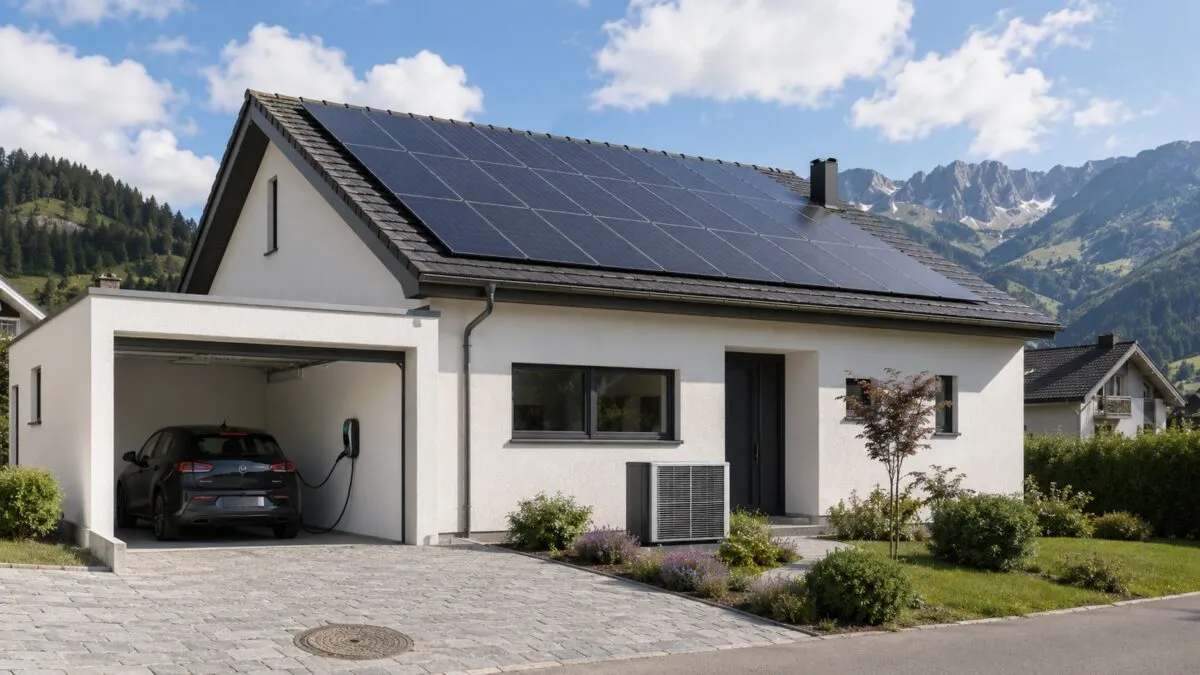
A heat pump can cover part of its electricity demand with solar power. A charging station allows you to charge your electric car with electricity from your own roof. An energy manager ensures that consumers run preferentially when the PV system is producing a lot or when the storage can be used effectively.
This makes the single-family home increasingly independent, step by step. Not because it is completely disconnected from the grid, but because it covers a larger part of its energy needs itself. This makes the investment not only more sustainable, but also more future-proof.
Extensibility is particularly important in this regard. Can the battery storage be expanded later? Is the inverter appropriately selected? Is a wallbox planned? Can a heat pump be integrated? These questions take little time during planning but can save a lot of money and effort later on.
8. Emergency power: an important extra, but not automatically included
Many homeowners assume that a battery storage automatically supplies the entire house with power during an outage. However, this is not always the case. Whether a PV system with storage continues to supply power during a grid failure depends on the technical implementation.
A backup or emergency power function requires suitable components, for example a suitable inverter, a changeover device and a clear definition of which consumers are to be supplied in an emergency. Some systems can only supply individual sockets or circuits, while others are designed for larger parts of the house.
Those who want backup power should mention this function in the quote already. A later retrofit is not always straightforward and can incur additional costs. For many single-family homes, backup power is not a must, but a sensible additional topic that should at least be briefly considered with an investment of this size.
9. Why comparing providers and quotes is worthwhile
With a solar system without storage, quotes are often already difficult to compare. With storage, it becomes even more important. Because not every quote means the same thing, even if similar figures appear at first glance.
An example: Some providers state the gross capacity of the storage, others the actually usable capacity. There can also be significant differences regarding the inverter, energy manager, emergency power function, warranty, installation, scaffolding, electrical work, app integration, and service. In addition, there is the question of whether the provider supports the subsidy processing and handles the registration with the grid operator properly.
A good comparison therefore protects not only against excessive costs. It also helps find a solution that truly fits the house. Especially for single-family homes with a heat pump, electric car, or future expansion plans, the right planning can make a difference.
In the end, it is not about installing just any solar system with storage. It is about choosing a system that makes good use of your roof area, increases self-consumption, takes subsidy opportunities into account, and provides long-term satisfaction.
Conclusion
A solar system with storage can be a very strong solution for Swiss single-family homes. It makes better use of the solar power from your own roof, increases self-consumption, and brings more independence to everyday life. It becomes particularly interesting for households with high evening consumption, a heat pump, an electric car, or the desire to modernize their home energetically step by step.
However, planning is decisive. The right storage size, suitable components, sensible self-consumption, local subsidy opportunities, and transparent quotes turn a good idea into an investment that convinces in the long term.
Those who want to know which solar system with storage suits their own single-family home should not just obtain a single quote. A comparison quickly shows which providers plan cleanly, which solution fits technically and where costs, subsidy and performance can be combined best.
Compare solar system with battery storage for free
Average: 4.4 out of 5 stars (31 ratings)