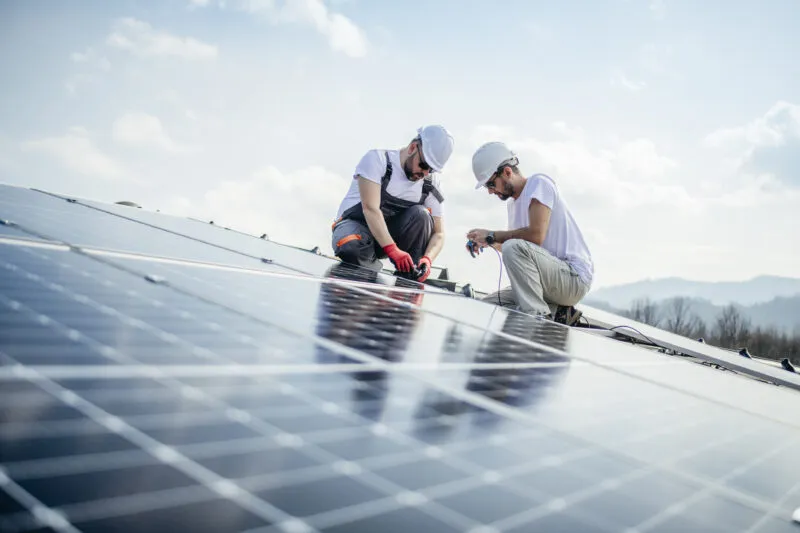
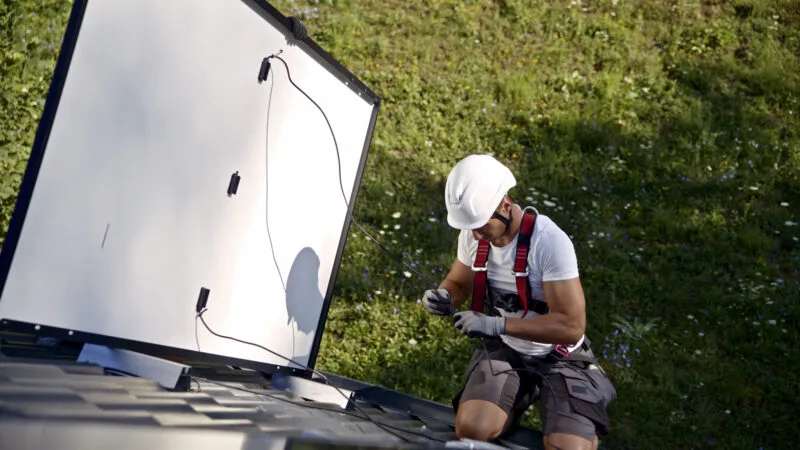
As a guideline value, a 10 kWp solar installation for a detached house in Switzerland costs CHF 19’100–34’600 incl. VAT. After deducting the federal one-off remuneration of CHF 3’600, you are left with costs from CHF 15’500. For most owners, a turnkey installation from a specialist installer is the simpler route, because only a licensed professional may make the electrical connection.
Key points at a glance
- As a guideline value, a turnkey on-roof installation without storage costs CHF 12’400–19’500 for 5 kWp, CHF 19’100–34’600 for 10 kWp and CHF 32’600–56’200 for 20 kWp, each incl. VAT.
- With small installations, most of what you pay for is labour and scaffolding, not the modules.
- You may mount the modules yourself and plug together pre-assembled module connectors on the mounting structure. All other connections are made by a specialist installer with an installation licence.
- The one-off remuneration is CHF 360 per kW (2026 rate, attached installation under 30 kW). For installations under 100 kW, you submit the application after commissioning.
- Compare several quotes covering the same scope of work before you sign.
- As of 03.11.2026
- Sources at the end of the article
Complete system from a specialist installer or kit?
For almost all detached houses, a complete installation from a specialist installer is the simpler route. You have one point of contact for planning, installation, connection, notifications and test reports. A kit saves part of the labour costs, but the effort and the risk are yours.
| Complete system from a specialist installer | Kit for self-installation | |
|---|---|---|
| Planning and design | by the specialist installer | by you |
| Installation on the roof | by the specialist installer | by you, with fall protection and scaffolding |
| Electrical connection | by the specialist installer with a permit | by a licensed professional you commission |
| Notifications to the municipality and grid operator | usually by the specialist installer | by you |
| Documents for the one-off payment | usually by the specialist installer | by you and the specialist |
| Warranty | Specialist installer as contractual partner for the agreed overall service | Materials and installation separately |
Manufacturer warranties apply in addition in both cases, under their own terms.
What can you do yourself?
What you can do yourself is the module work: mounting the modules and plugging together the pre-assembled connectors on the mounting structure. This applies only as long as no electrical installation work is needed. This is how the Federal Inspectorate for Heavy Current Installations (ESTI) regulates it.
Everything else requires a permit:
- Cables running beyond the mounting structure and connections without a ready-made plug, for example at the inverter, count as electrical installation work. This requires an installation licence. For the direct current section between the modules and the inverter, a restricted licence is sufficient.
- From the installation switch towards the household wiring, only someone with a general installation licence may carry out work.
- Before handover, the installation is tested. If a company works with a general licence, a qualified person or a person authorised to carry out inspections records the final check in the safety certificate. With a restricted licence, you first receive the test report. The safety certificate and the measurement and test reports are separate documents.
So even with a kit, you need an electrical specialist installer. Before ordering, clarify who makes the connection and who is liable for the material.
What does a solar installation for a detached house cost?
As a guideline value, a turnkey on-roof installation of 5 to 20 kWp costs CHF 12’400 to 56’200 incl. VAT, without storage and before subsidies.
| System | Guideline value incl. VAT | One-off payment 2026 | After one-off remuneration |
|---|---|---|---|
| 5 kWp | CHF 12’400–19’500 | CHF 1’800 | CHF 10’600–17’700 |
| 10 kWp | CHF 19’100–34’600 | CHF 3’600 | CHF 15’500–31’000 |
| 20 kWp | CHF 32’600–56’200 | CHF 7’200 | CHF 25’400–49’000 |
Source: solar-guide.ch, guide “Photovoltaic costs per m²”, as of 05.11.2026, and quotes from specialist installers in the solar-guide.ch partner network; one-off remuneration under the EnFV, version of 01.07.2026, own calculation
As a private individual, you pay VAT on the full price of the installation; the one-off remuneration comes afterwards. For 10 kWp, the lower guideline value is CHF 19’100 incl. VAT. After CHF 3’600 of one-off remuneration, CHF 15’500 remains, before any tax deductions. Storage, wallbox and roof work are not included.
Quotes in the second half of 2025 were at the level of the first half or slightly above. Further cost factors are explained in the guides What does a photovoltaic system cost? and Photovoltaic costs per m².
What do you pay for with a small system?
With small installations, most of what you pay for is labour. Labour accounts for a median of 37 % of total costs, the modules for only 10 %.
| Value | |
|---|---|
| Labour costs | CHF 821 |
| Site safety | CHF 371 |
| Inverter | CHF 270 |
| Mounting system | CHF 247 |
| Modules | CHF 235 |
| Administration and planning | CHF 195 |
| Electrical materials | CHF 130 |
| Logistics and transport | CHF 65 |
For a small on-roof installation, labour and scaffolding cost considerably more than the modules, inverter and mounting system combined. The values are medians per category excl. VAT and do not add up exactly to the total price.
Source: EnergieSchweiz, Price Monitoring Study 2025, figure 22, report of 03.08.20262
Specialist installers differ more on labour, scaffolding and planning than on materials. With one request, you receive up to three quotes from specialist installers in your region: Compare quotes.
How does the process from purchase to commissioning work?
There are nine steps from the first conversation to the subsidy being paid out; with a complete installation, the specialist installer takes care of most of them.
- Clarify the basics: annual consumption, roof area, planned heat pump or electric car. The guide Solar installation for a detached house can help.
- Obtain quotes: from several specialist installers, with the same scope of work.
- Sign the contract: in writing, with the scope of work, deadlines and payment schedule.
- Inform the municipality: A sufficiently adapted roof installation in a building or agricultural zone does not need planning permission, only a notification before construction starts.
- Inform the grid operator: The specialist installer submits the technical connection request and the installation notice. Clarify the connection and the condition of the roof before the material is ordered.
- Installation and testing: After installation and connection, the mandatory tests follow. Depending on the specialist installer’s licence, you receive the safety certificate or first the test report, together with the measurement documents.
- Commissioning: From now on, the installation produces electricity.
- Acceptance inspection: Within six months, an independent inspection body that you commission checks the installation. If the direct current section was built under a restricted licence, an accredited inspection body is responsible. The safety certificate goes to the grid operator.
- Apply for the one-off remuneration: For installations under 100 kW, you submit the application to Pronovo after commissioning.
When is a building permit still required?
An installation on a pitched roof counts as sufficiently adapted if it protrudes no more than 20 cm above the roof surface and, seen from above, does not extend beyond the roof. It must also be low-reflection and compactly arranged. On cultural and natural monuments of cantonal or national importance, planning permission is always required. In certain protected zones, the cantons can also require it. The canton sets the deadline and the documents for the notification.
What should you pay attention to when comparing quotes?
Quotes can only be compared if they describe the same scope. Go through these points item by item:
- Output and components: output in kWp, number and type of modules, inverter, mounting system.
- Scaffolding and safety measures: included or separate? For small installations, they account for a median of 14 % of costs.
- Electrical work: adjustments to the distribution board, meter cabinet, cables.
- Notifications and reports: notification to the municipality, connection request, safety certificate, acceptance inspection, certification of the installation data.
- Subsidies: Who submits the application to Pronovo? The quote states the one-off remuneration as an amount, not as a discount on the price.
- Warranties: duration and terms of the product and performance warranty, contact person for faults.
- Price: total amount incl. VAT, validity of the quote, payment schedule.
solar-guide.ch recommends: Compare the price with the guideline values above. If a quote is well above them, ask why. Often it is down to scaffolding, roof work or a new distribution board.
You will find a detailed checklist in the guide Photovoltaic system quote: What you should look for in a quote. Specialist installers in your region are listed in the directory of solar companies.
What applies in terms of warranty and acceptance?
Four things are often confused. Record them separately in the quote and the contract:
- Acceptance of the work: You accept the installation from the specialist installer. Acceptance matters, among other things, for the limitation period. Report defects in good time; for hidden defects, the deadline only starts when they are discovered.
- Electrical acceptance inspection: An independent inspection body checks the installation within six months.
- Equipment warranty: the manufacturer’s commitment for modules and inverter, under its own terms.
- Performance warranty: the manufacturer’s commitment on the output the modules will still deliver after a certain time.
Record the acceptance of the work in a report that lists open points and defects.
What deadlines apply in case of defects?
The deadlines are set by the Swiss Code of Obligations under the contract for work. For contracts from 01.01.2026, you have 60 days from delivery to report defects in immovable works, i.e. buildings and structures. So check the installation soon after handover. Report hidden defects within 60 days of discovering them. Shorter deadlines in the contract are invalid. For contracts concluded earlier, the previous rules generally apply.
Claims for defects in immovable works generally become time-barred five years after acceptance. This can also apply to built-in movable works if their defects make the building defective. These five years may not be shortened to your disadvantage. For other works, the period is generally two years. How a roof installation is classified depends on the individual case. So write the deadlines into the contract, and get the manufacturer’s warranties in writing in the quote, with duration, terms and contact person.
When is the subsidy available?
You only receive the one-off remuneration with a complete application. For small installations under 100 kW, you submit it after commissioning; for large ones, you can apply beforehand. The installation must have an output of at least 2 kW. The application for small installations includes, among other things:
- an extract from the land register and, if you are not the landowner yourself, the landowner’s consent,
- output, expected production and commissioning date,
- the acceptance report or the safety certificate with measurement and test reports,
- the certification of the system data.
| Capacity share | Attached system | Integrated system |
|---|---|---|
| below 30 kW | CHF 360 per kW | CHF 400 per kW |
| 30 to below 100 kW | CHF 300 per kW | CHF 330 per kW |
| Base contribution | CHF 0 | CHF 0 |
Source: Energy Funding Ordinance (EnFV), annex 2.1, version of 01.07.2026
The rates apply to installations commissioned from 01.04.2025. If reports or the certification are missing, payment is delayed. Cantons and municipalities sometimes require their applications before construction starts. Read more in Pronovo subsidy for photovoltaics and Subsidies for photovoltaic systems in Switzerland.
Would you like to know what your installation will cost? We pass your request on to up to three suitable specialist installers. Free of charge and without obligation: Compare quotes.
Frequently asked questions and answers
What does a solar system for a single-family home cost?
As a guideline value, CHF 19’100–34’600 incl. VAT for a turnkey 10 kWp on-roof installation without storage. After the one-off remuneration of CHF 3’600, costs start from CHF 15’500.
Can I install a solar system myself?
You may mount the modules yourself and plug together pre-assembled module connectors on the mounting structure. Cables beyond that and the connections to the inverter and the household wiring are made by a professional with an installation licence. The safety certificate and the acceptance inspection follow.
Do I need planning permission for a solar installation?
Usually not. You report sufficiently adapted installations on roofs in building and agricultural zones to the municipality before construction starts. On protected monuments, planning permission is always required.
How many quotes should I obtain?
Several, covering the same scope of work. Only a comparison shows whether price, components and warranties add up. Through solar-guide.ch, you receive up to three quotes from specialist installers in your region.
Who applies for the one-off payment from Pronovo?
The operator of the installation is entitled to apply, usually the owner. The specialist installer can submit the application with your power of attorney. For small installations under 100 kW, the application follows commissioning.
Is a kit from an online shop worth it?
A kit saves part of the labour costs. You still pay for scaffolding, connection by a professional, test reports and the acceptance inspection. On top of that, you bear the risk of installation errors yourself.