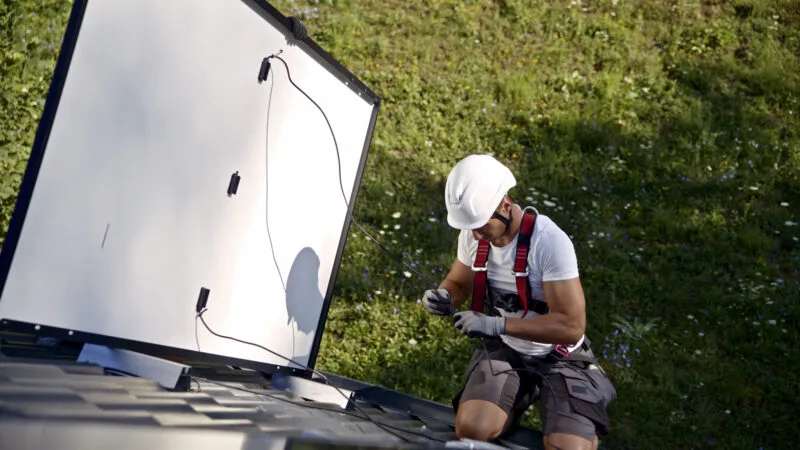
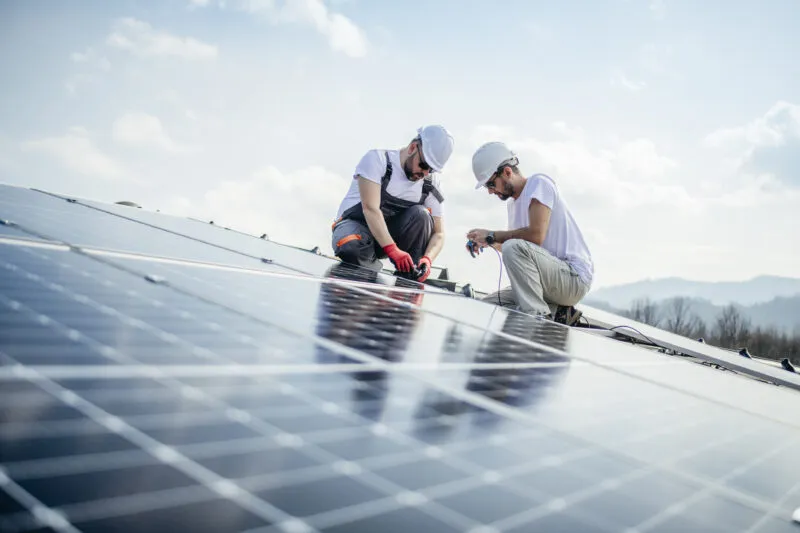
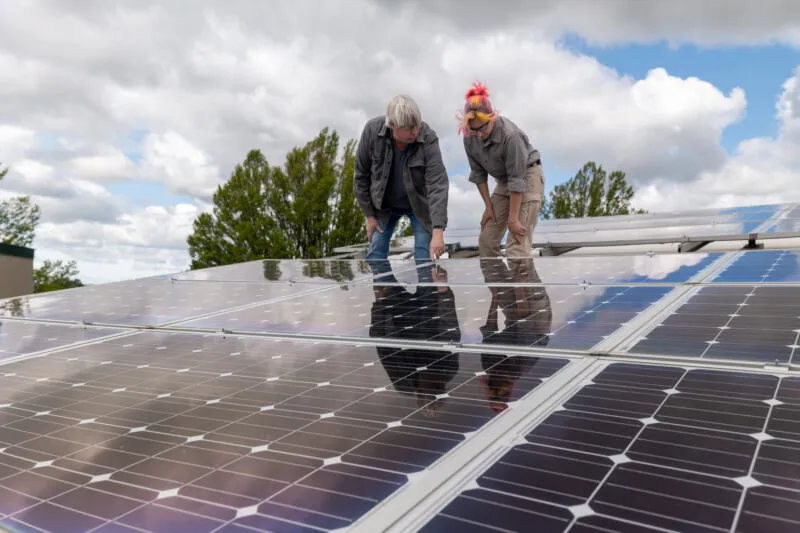
In Switzerland, a solar system is installed by a specialist installer. You may lay the modules on the roof yourself. However, only someone with an installation permit from the Federal Inspectorate for Heavy Current Installations (ESTI) may make the electrical connection from the module wiring onwards. Within six months of handover, you then arrange an independent acceptance inspection.
Key points at a glance
- Installation follows set steps, from the site visit through scaffolding, modules and electrical connection to acceptance.
- You may only mount modules yourself and connect pre-assembled plugs on the mounting structure. All electrical work from the module wiring onwards requires an installation permit from ESTI.
- Within six months of handover, an independent inspection body checks the system.
- On the roof, protective measures are required from a fall height of more than 2 m. If the work on a roof takes less than two person-days in total, the threshold is more than 3 m.
- Sufficiently adapted solar systems on roofs and, since 01.01.2026, on façades do not need a building permit. You notify the municipality of the system before construction starts.
- As of 03.11.2026
- Sources at the end of the article
How does the installation of a solar system work?
Installation starts long before the first module is on the roof: with the site visit and the notifications. For a typical on-roof system, you and the specialist installer go through these steps:
- Site visit: The specialist installer checks the roof, structure, shading and meter cabinet. Even climbing onto the roof to take measurements requires effective fall protection. If your house was built before 1990, you should expect asbestos.
- Notifications: Before the work begins, the specialist installer notifies the grid operator of the installation (installation notice). The connection application to the grid operator is a separate step. The municipality receives the notification of the solar system before construction starts.
- Scaffolding and fall protection: Façade scaffolding or edge protection along the roof edge prevents falls. Roof domes and skylights must be secured against falling through before installation.
- Substructure: Roof hooks or rails will later carry the modules. On flat roofs, depending on the system, the frames are weighted down (ballasted) or fixed to the load-bearing structure. The specialist installer checks wind loads and load-bearing capacity.
- Modules: They are placed on the rails and connected with pre-assembled cables.
- Inverter: It turns the direct current from the modules into alternating current for your home. Find out more in the guide Inverters for photovoltaics.
- Electrical connection: Professionals with an installation permit connect the system to the building's electrical installation. You may only operate the system in parallel with the grid once the grid operator has given its consent.
- Final inspection and acceptance: Before handover, the specialist installer checks the system and issues the safety certificate or the test report. Within six months of handover, a separate, independent inspection body carries out the acceptance inspection.
Check in every quote which of these steps are included and who handles the notifications. The guide Photovoltaic system: comparing quotes properly shows you how to compare quotes point by point.
What deadlines apply during installation?
Federal law and the cantons set fixed deadlines, above all for notifications, inspections and safety on the roof. How many days the work on the roof takes, on the other hand, depends on the roof, the size and the weather. The specialist installer will state this duration in the quote.
| Step | Deadline or rule |
|---|---|
| Notification to the municipality | before construction starts; in the canton of Zurich only after the local building authority has confirmed receipt and the processing period has expired |
| Installation notice to the grid operator | before the work is carried out |
| Connection request to the grid operator | operation in parallel with the grid only after the application and with the grid operator's consent |
| Fall protection at the roof edge | from a fall height of more than 2 m; for work totalling less than 2 person-days per roof, from more than 3 m, or from more than 2 m where there is a risk of sliding |
| Fall protection on flat roofs | continuous edge protection or an eaves walkway; with a fall height of more than 2 m, an eaves walkway lies no more than 1 m below the roof edge; special rules apply to small jobs |
| final inspection with safety certificate or test report | before handover to the owner |
| Acceptance inspection | within 6 months of handover; safety certificate to the grid operator |
| Application for the small one-off payment (KLEIV) | only after completion; land register extract no more than 1 year old |
Source: NIV, ESTI Directive No. 220, RPV, BauAV, canton of Zurich and Pronovo, as of 03.11.2026
The Low Voltage Installation Ordinance (NIV) governs the acceptance inspection: since 01.07.2024, the deadline has been six months. Older documents with a shorter deadline are out of date on this point.
In the canton of Zurich, after notifying you wait until the local building authority confirms receipt and states when the processing period expires. Only then may you start, unless otherwise ordered. The automatic confirmation from the form does not start this period.
Can you install a solar system yourself?
Only to a small extent: you may place the modules on the roof, but not connect the power. On top of that, strict rules apply to working at height.
What does electrical law allow?
A solar system counts as an electrical installation. Anyone who builds one therefore needs an installation permit from ESTI. ESTI draws the line as follows:
- Without a permit: mounting modules and plugging the module connections together with pre-assembled cables on the mounting structure, as long as no electrical installation work is required.
- With a limited or general permit: the installation from the module wiring up to the output terminals of the system switch.
- Only with a general permit: everything from the input terminals of the system switch onwards, i.e. the connection to the building's electrical installation.
As soon as a connection is not plug-ready, for example at the inverter, a permit is required. The same applies if cables run beyond the mounting structure through the building.
The exemption for laypeople does not help here either. In rooms you live in yourself, it only permits a few tasks, such as replacing sockets and switches. Conditions include an existing single-phase final circuit downstream of the overcurrent protection and a residual current device of up to 30 mA. Afterwards, a person with an inspection permit checks the work. The electrical installation of a solar system is not covered by this exemption.
Who issues which certificate?
Which documents you receive at the end depends on the specialist installer's permit. With a general permit, it issues the safety certificate after the final inspection; with a limited permit, it issues the test report. In both cases, the independent acceptance inspection is carried out by a separate inspection body. If the direct current part was installed under a limited permit, this must be an accredited inspection body.
What applies to work on the roof?
Roof work requires a suitable fall protection plan. Which measures are mandatory depends on factors such as the fall height, the roof and the duration of the work. Railings and scaffolding take priority over ropes and harnesses. Take care with corrugated fibre cement sheets and skylights: they can give way underfoot. Specialist installers must draw up a written health and safety plan before construction starts. So have any work on the roof carried out by trained professionals.
Why can building it yourself put warranty, insurance and subsidies at risk?
Without a specialist installer, you lack the evidence that the funding body and the grid operator require. You will notice this in three places:
- Subsidies: For the one-off remuneration, Pronovo requires an acceptance report or a safety certificate with a measurement and test report. None of these documents replaces the independent acceptance inspection. The guide Pronovo subsidies explains how the funding process works.
- Warranty: Under a contract for work, the specialist installer is liable for defects in its work. If you build it yourself, you have no contractual partner for your work. Whether the manufacturer's guarantee requires installation by professionals is set out in its guarantee terms.
- Insurance: If you cause damage through gross negligence, you should expect reductions. Private insurers may then reduce their payout according to the degree of fault. Cantonal building insurers are subject to their own laws. Ask your insurer before you build.
New deadlines apply to warranty claims. For contracts from 01.01.2026, for immovable works, i.e. work on your building, you have 60 days from delivery to report defects. You report hidden defects within 60 days of discovering them. Claims generally become time-barred five years after acceptance. This can also apply to installed movable parts if their defect makes the building defective. Shorter deadlines in the contract are invalid. For older contracts, the previous rules generally apply.
Do you need a building permit for the installation?
Usually not. Sufficiently adapted solar systems on roofs do not need a building permit in building and agricultural zones, and since 01.01.2026 the same applies to sufficiently adapted systems on façades. You notify the responsible authority of the system before construction starts. The canton sets the deadline and the documents required.
On a roof, a system counts as sufficiently adapted if it:
- protrudes no more than 20 cm from the roof surface at right angles,
- does not extend beyond the roof surface when viewed from above,
- is low-reflection and compactly arranged.
On flat roofs, the following is sufficient as an alternative: no more than 1 m above the top edge of the roof parapet and set back far enough that the system cannot be seen from below at a viewing angle of 45 degrees. Here, too, it must be low-reflection.
On façades, the system must meet at least one of the integration criteria, for example a continuous rectangular area. Further requirements also generally apply: the system does not cover any structural or decorative elements and does not protrude beyond the edges of the façade. It sits no more than 20 cm in front of the façade, parallel to it, is uniform in colour and material and is low-reflection. Clarify the cantonal requirements before planning.
Cultural and natural monuments of cantonal or national importance always require a building permit. In the canton of Zurich, the notification includes, among other things, a site plan, the product description and an orientation plan in accordance with the fire protection leaflet “Solaranlagen” of the Association of Cantonal Fire Insurers (VKF). Ask the specialist installer whether it will submit the notification for you.
How do you find an installation company nearby?
Start in the directory of solar companies in Switzerland. There you will find specialist installers by canton and town. Go straight to the large cantons:
- Solar companies in the canton of Zurich
- Solar companies in the canton of Bern
- Solar companies in the canton of Aargau
- Solar companies in the canton of St. Gallen
- Solar companies in the canton of Lucerne
- Solar companies in the canton of Vaud
But being nearby is not enough. Ask about the ESTI installation permit, references with similar roofs and the fall protection plan. The guide Photovoltaics nearby shows what to look for with regional firms. The guide Swissolar and “Die Solarprofis” explains what association membership and quality labels mean.
It is best to decide on the basis of several quotes. All specialist installers in our partner network are members of Swissolar or hold an installation permit from the Federal Inspectorate for Heavy Current Installations (ESTI). With one request, you receive up to three quotes from specialist installers in your region. Compare quotes
Frequently asked questions and answers
Am I allowed to connect my solar system myself?
No. Only someone with an ESTI installation permit may make the connection from the module wiring onwards. For the connection to the building's installation from the system switch onwards, a general installation permit is even required.
Am I allowed to install the modules on the roof myself?
Electrically, yes: mounting the modules and plugging in pre-assembled cables on the mounting structure does not require a permit. A specialist installer must do the rest. Clarify beforehand whether it will take on work on a system you have mounted yourself and issue the certificates.
Who registers the solar system with the grid operator?
The holder of the installation permit submits the installation notice before the work starts. The connection application is a separate step: the system only runs in parallel with the grid with the grid operator's consent. After the acceptance inspection, you as the owner send the safety certificate to the grid operator. Agree in the quote who makes these notifications and which documents you receive at handover.
What is a safety certificate?
It records the result of the inspection. After the final inspection, the specialist installer issues it if it holds a general installation permit; with a limited permit, a test report takes its place. None of these certificates replaces the independent acceptance inspection. The grid operator receives the required safety certificate. For the funding application, you submit the acceptance and test documents that Pronovo requires.
Does a solar system on a detached house need a building permit?
As a rule, no. You notify the municipality of sufficiently adapted systems on roofs before construction starts. A building permit is required for cultural and natural monuments of cantonal or national importance and where the canton requires one for protected zones.