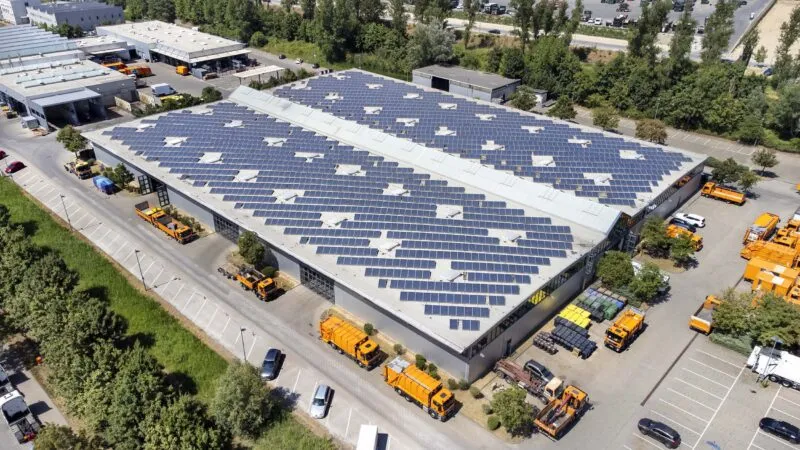
Solar power is most valuable where it is consumed directly. This is straightforward in a single-family home – but what if multiple parties are involved, for example in an apartment building, a condominium ownership, or on a site? That is exactly what the association for self-consumption (ZEV) is for. This page explains how ZEV, virtual ZEV (vZEV), and the local electricity community (LEG) work, who they are suitable for, and what to consider during implementation.

Key points at a glance
The key points of this section can be summarised compactly:
- A ZEV allows multiple parties to use solar electricity jointly and appear as a single customer to the energy supplier.
- ZEV increases self-consumption because different consumption profiles allow for better utilisation of solar power.
- Since 2018 there has been the classic ZEV, since 2025 the virtual ZEV (vZEV), and since early 2026 additionally the local electricity community (LEG).
- The topic is particularly interesting for apartment buildings, condominium ownership, rental properties and commercial areas.
- The measurement concept, billing and internal electricity prices should be clarified early on.
The benefit arises primarily when many tenants absorb the solar electricity well in terms of timing and billing and measurement are clearly regulated.
- As of 11.07.2026
What is a joint self-consumption association?
In a ZEV, multiple parties use the electricity from a shared solar system – for example, the tenants of an apartment building. The association appears as a single end customer to the energy supplier and receives a consolidated bill. The association organises the internal allocation and billing itself, often with the help of a billing service provider. A ZEV is established by the property owners; participation is voluntary for the individual parties.
EnergieSchweiz explicitly describes the ZEV as an option to jointly use solar power in apartment buildings. This option has existed since 2018; since then, it has established itself as a proven model.
Who is a ZEV suitable for?
The following list summarises the key points on who a ZEV is suitable for:
- Apartment buildings – several households share a large roof installation.
- Condominium ownership – joint investment and consumption allocation.
- Rental properties – Ownership provides local solar power.
- Commercial areas – daily consumption often matches solar production well.
- Neighbouring properties – depending on the model and grid situation.
What these cases have in common is that multiple consumers can make better use of the solar production than a single household.
How does a ZEV work technically?
In the classic ZEV, production and consumption are combined behind a common grid connection. The self-consumed electricity is distributed and measured internally; only the supply from the grid and the feed-in to the grid run through the common connection point. Important: In the classic ZEV, the self-consumed electricity must not flow through the public grid. Furthermore, the sum of the production capacity must be at least 10 percent of the grid connection capacity of the community.
What is the difference between ZEV, vZEV and LEG?
With the revision of energy law, two additional models have been added alongside the classic ZEV. They differ mainly in how far the circle of participants extends and how the public grid is used:
| Model | Briefly explained | Available since |
|---|---|---|
| Self-consumption single-family home | An ownership uses the solar power itself | The simplest case |
| ZEV | Multiple parties use solar electricity jointly and appear as a single customer to the energy supplier | 2018 |
| vZEV | Virtual aggregation: existing connection lines and smart meters of the grid operator can be used | 1 January 2025 |
| LEG | Local electricity community: local electricity trading via the public grid within a municipality | 1 January 2026 |
With the virtual ZEV (vZEV), the distribution network operator’s connection cables can be used since 2025, and multiple meters can be virtually combined. This allows properties across different plots of land to be connected, provided they are connected to the same distribution box and on the same low-voltage level. Existing smart meters from the grid operator can be used for billing – sometimes for a fee. Private meters do not need to be installed for this purpose. This particularly facilitates the connection of existing buildings, as no new cables are required.
The local electricity community (LEG) takes it one step further from the beginning of 2026: It allows locally generated electricity to be marketed via the public grid within a district or municipality. A reduced network usage fee applies to the shared electricity. Participants remain customers of their distribution network operator. The LEG is a separate model and should not be confused with the ZEV.
ZEV vs. vZEV vs. LEG at a glance
The following table provides an overview of the key points regarding ZEV vs. vZEV vs. LEG:
| Topic | ZEV | vZEV | LEG |
|---|---|---|---|
| Suitable for | buildings, sites, apartment buildings | Existing properties, more flexible perimeter | Neighbourhood, municipality |
| Grid usage | Classic, without a public grid | Use of certain connection lines is possible | Use of the public grid is possible |
| Measurement | Internally organised | Smart meter from the grid operator possible | Depending on the model |
| Complexity | Medium | Medium to high | High |
| role in the cluster | Main topic | Future topic | Distinction |
The overview helps with context; however, which model fits depends on connections, grid situation and organisation.
What prerequisites apply?
For a community, certain conditions must be met – among others a minimum production capacity in relation to the connection capacity (at least 10 percent) as well as a suitable metering and billing concept. In the classic ZEV, production and consumption are combined behind a common connection; in the vZEV, the extended rules for the use of the connection lines apply. The specific requirements depend on the grid operator and the local grid situation.
What are the advantages of a ZEV?
A ZEV can mainly bring benefits where multiple consumers use the solar electricity jointly:
- Higher self-consumption, because multiple parties use the solar power jointly.
- Better economic efficiency of the system due to less feed-in.
- Locally used electricity instead of feed-in at the lower feed-in tariff paid by the grid operator.
- Attractive for different consumption profiles – such as apartments, commercial use, common electricity, basement parking, or charging infrastructure.
These benefits only apply if measurement, billing and internal rules are organised transparently.
What obligations and risks are there?
A ZEV involves organisational effort: The association must organise internal metering and billing itself or outsource it to a service provider. The participants appear jointly as a single end consumer towards the grid operator. A transparent model for internal electricity prices is important; these must not exceed the tariff of the public grid. Entries and exits of parties – for example in the event of tenant or owner changes – should also be regulated from the outset.
How do billing, metering and internal electricity prices work?
The internal settlement is the responsibility of the association or its representation. In the classic ZEV, measurement is done internally; in the vZEV, the metering data from the grid operator’s smart meters can be used and virtually combined. For practical implementation, many companies offer complete settlement solutions. The internal prices should be transparent and comprehensible for all parties involved.
How can a ZEV be combined with battery storage, heat pump and e-mobility?
A ZEV delivers its benefits particularly when many consumers come together. A battery storage system can further increase collective self-consumption. Heat pumps and charging infrastructure for electric vehicles are large consumers that can effectively absorb locally generated electricity – charging points in an underground garage, in particular, can noticeably boost self-consumption. You can read how a battery storage system works in principle on the page PV system with battery storage.
When does a ZEV become economically viable?
Economic viability depends heavily on how well generation and consumption in the building match up:
| Situation | Is ZEV worthwhile? | Why |
|---|---|---|
| Apartment building with a large roof | Yes | More consumers increase self-consumption |
| Condominium ownership | Often yes | Joint investment and consumption distribution |
| Businesses with daytime consumption | very interesting | Consumption matches solar production well |
| Single-family home alone | Rather no | No association required |
| Site with multiple buildings | Yes, check | Billing and metering concept are crucial |
Economically, a ZEV pays off mainly because more solar power is used locally instead of being fed in at the lower feed-in tariff paid by the grid operator. You can read how the feed-in remuneration works on the page Feed-in remuneration Switzerland.
How does it go from the ZEV idea to implementation?
The following list summarises the key points on How does the ZEV idea lead to implementation?:
- Determine participants and properties.
- Check model: classic ZEV, vZEV or LEG.
- Clarify system size and prerequisites.
- Define the metering and billing concept.
- Regulate internal electricity prices transparently.
- Organise operation (management, owners' association or service provider).
- Request quotes and implement.
This turns the idea into a solid project with clear responsibility, billing and technical planning.
solar-guide.ch recommends: Clarify early which model suits your property – classic ZEV, virtual ZEV or LEG. For existing buildings with multiple connections, vZEV is often interesting because no new lines are needed. Involve a specialist installer or billing service provider for the metering concept and billing, and use neutral information platforms such as lokalerstrom.ch for the basics.
Which points should owners and management companies check?
Owners and property managers should primarily check the points that determine organisation, billing, and cost-effectiveness:
| Check question | Why it matters |
|---|---|
| Who are the participants? | Owners, tenants, commercial, general electricity |
| How large is the PV system? | Minimum output and cost-effectiveness |
| How is it measured? | Internal meters, smart meters, billing service providers |
| How is the electricity price determined? | Transparency and acceptance |
| Who operates the ZEV? | Management, owners' association, service provider |
| What happens when members join or leave? | Important in case of tenant or owner changes |
| Is there charging infrastructure? | E-mobility can significantly increase self-consumption |
This makes it easier to see quickly whether a quote is complete, comparable and plausibly structured.
Conclusion
The association for self-consumption makes solar power economically viable where multiple parties are involved. Whether a classic ZEV, a virtual ZEV, or LEG is the right model depends on the property, the grid situation, and the participants. Key factors are a well-thought-out metering concept, transparent internal prices, and clear organization.
Are you planning a photovoltaic system for an apartment building, a condominium ownership or an area? Then it is worth checking out a self-consumption association. Through solar-guide.ch, you can submit your request free of charge and without obligation. Your request will be forwarded to a maximum of three suitable specialist installers in your region.
Request quotes free of charge and without obligation
Frequently asked questions and answers
What is a joint self-consumption association?
A ZEV allows multiple parties to use the electricity from a shared solar system. Towards the energy supplier, the association appears as a single customer.
Who is a ZEV suitable for?
Especially for apartment buildings, condominium ownership, rental properties, and commercial areas – anywhere multiple parties can share solar power.
What is the difference between ZEV and vZEV?
In the classic ZEV, production and consumption are combined behind a common connection point. In the virtual ZEV (since 2025), the grid operator’s connection lines can be used and multiple meters can be virtually consolidated – ideal for existing buildings.
Can tenants participate in a ZEV?
Yes. Participation is voluntary for the individual parties. The association is established by the property ownership.
How is solar power billed in the ZEV?
The internal settlement is organized by the association itself or through a billing service provider. The internal electricity prices must not exceed the tariff of the public grid.
Is a ZEV also possible for condominium ownership?
Yes. Especially in the case of condominium ownership, a vZEV enables a joint investment and a fair distribution of consumption.
What is the difference between ZEV and LEG?
A ZEV uses electricity behind a common connection point or – as a vZEV – via specific connection lines. The local electricity community (from 2026) allows local electricity trading over the public grid within a municipality, with a reduced grid usage fee.
Does a ZEV need battery storage?
No, a battery storage is not mandatory. However, it can further increase communal self-consumption.
Average: 4.3 out of 5 stars (6 ratings)