Reduce dependencies and lower energy costs: photovoltaics can make a decisive contribution
When does a photovoltaic system pay off?
The use of renewable energies has become increasingly important for companies in today’s world. A photovoltaic system offers many advantages to commercial and industrial sectors in Switzerland. In this article, we would like to present these advantages to you in detail.
Reduce energy costs
First of all, companies can significantly reduce their energy costs by using photovoltaic systems. By generating their own electricity from renewable energy sources, the need for grid power is reduced, leading to savings in energy costs. In particular, for energy-intensive companies such as industry, this can mean a considerable financial relief.
CO2 emissions
In addition, installing a photovoltaic system also contributes to reducing CO2 emissions. Since the electricity generated comes from renewable energy sources, companies can improve their CO2 balance and thereby make a contribution to environmental protection. In today’s world, where sustainability is becoming increasingly important, this can be an important factor for a company’s reputation.
Feed-in to the public grid
Another advantage of a photovoltaic system for businesses is the ability to feed the generated energy into the public grid. By feeding in excess power, businesses can generate additional revenue and thus further increase the economic benefit of the photovoltaic system. In Switzerland, there are also various subsidy programs that support businesses in installing a photovoltaic system and offer them additional financial benefits.
Independence
In addition to the financial benefits, a photovoltaic system also offers the opportunity to make energy supply more independent from external factors. This can be particularly advantageous for companies that rely on a reliable electricity supply. The use of battery storage can also ensure an emergency power supply, which can play an important role in the event of a power outage.
Which businesses are large systems suitable for?
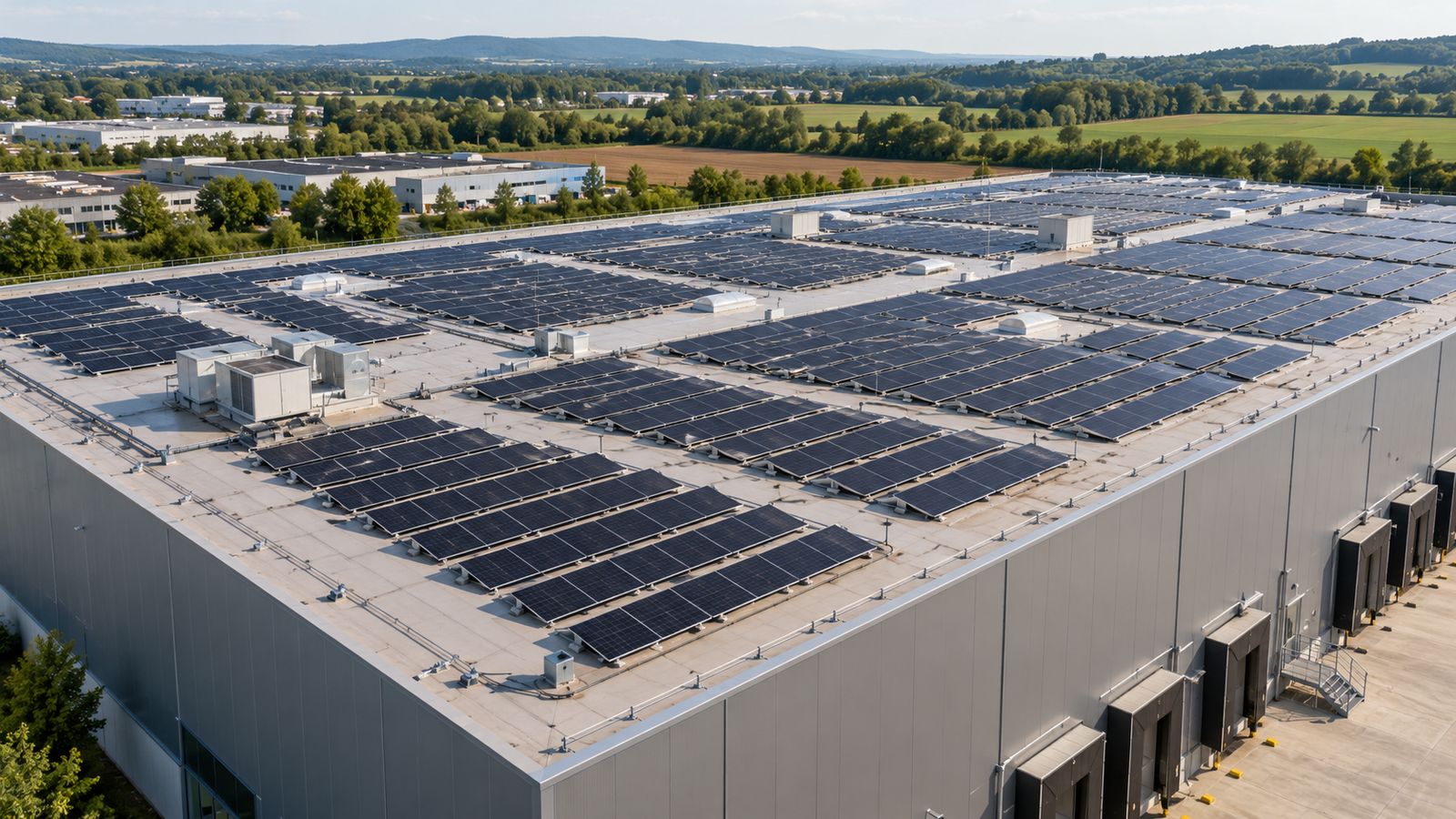
Large systems of 100 kW or more pay off for industrial, logistics and manufacturing businesses with large roofs and high daytime consumption. From 100 kW, a system counts as a large photovoltaic system and receives the large one-off payment (GREIV). On flat roofs, 1 kW needs around 7–10 m² of roof area, so 100 kW needs 700–1’000 m².
The price per kilowatt falls significantly with size. The federal price study shows these medians for rooftop systems in 2025, excluding VAT and before subsidies:
| Output | Median per kW | Middle half of systems |
|---|---|---|
| 30–100 kW | CHF 1’428 | CHF 1’125–1’751 |
| 100–300 kW | CHF 1’102 | CHF 907–1’597 |
| 300–1’000 kW | CHF 800 | CHF 705–1’010 |
| over 1’000 kW | CHF 660 | CHF 602–772 |
Businesses consuming 100 MWh or more a year may buy their electricity on the open market. For them, their own electricity price is what counts, not the basic supply tariff. An overview for businesses of all sizes is available at Solar panels for business.
What requirements must industrial roofs meet for a solar system?
An industrial roof must bear the additional load, last long enough and comply with fire safety rules. A specialist installer checks these three points before preparing the quote.
- Structural load: Lightweight industrial roofs often have little load reserve. A structural engineer checks snow and wind loads with the system in place. On flat roofs, the system is usually held down by ballast, which adds extra weight.
- Remaining service life: A photovoltaic system lasts 25–35 years. If the roof will need renovating within that time, it is better to renovate first.
- East-west mounting: Shallow module rows tilted towards each other need hardly any spacing. This fits more capacity onto the roof and spreads production more evenly over the day.
- Fire safety: The decisive document is the fire safety leaflet on solar systems issued by the Association of Cantonal Fire Insurers (VKF). The system must not obstruct smoke and heat vents and must keep its distance from fire walls.
- Asbestos: Roofs built before 1990 may contain asbestos, especially corrugated fibre cement sheets. Suva recommends replacing such roofs completely before installation.
Grid connection and transformer: what needs clarifying early?
Clarify the grid connection before requesting quotes. It determines how large the system may be and what the connection costs. If the capacity of the connection or transformer is insufficient, the grid will need reinforcing.
The purchase and remuneration obligation covers installations with a capacity of no more than 3 MW or annual net generation, after self-consumption, of no more than 5’000 MWh. An installation above 3 MW is therefore not automatically excluded. Since 2026, subject to the legal conditions, the network operator may curtail up to 3% of annual generation at the connection point without payment.
How much solar electricity can the business use itself?
Your business’s load profile shows this, i.e. consumption in quarter-hour intervals over a year. Compare it with the expected production. This shows how much solar electricity you use directly and how much you feed into the grid.
Self-consumption is the most important lever. For systems with self-consumption, there is no minimum remuneration for capacity above 30 kW. Without a separate agreement, surplus electricity is paid at the reference market price. For solar electricity, this ranged from 3.9 to 10.3 centimes (Rp.) per kWh in the first three quarters of 2026.
Cooling, compressed air, ventilation and charging stations for company vehicles can often be shifted to the middle of the day. A control system that does this automatically increases self-consumption without battery storage.
What subsidies are available for systems of 100 kW or more?
Systems with self-consumption of 100 kW or more receive GREIV via Pronovo. The contribution is calculated pro rata across the capacity bands. For mounted systems commissioned from 01.04.2025:
| System | Calculation | One-off payment (EIV) |
|---|---|---|
| 150 kW | 30 × CHF 360 + 70 × CHF 300 + 50 × CHF 250 | CHF 44’300 |
| 300 kW | 30 × CHF 360 + 70 × CHF 300 + 200 × CHF 250 | CHF 81’800 |
| 1’000 kW | 30 × CHF 360 + 70 × CHF 300 + 900 × CHF 250 | CHF 256’800 |
You can submit the application before construction. Pronovo then grants the remuneration in principle. After that, the system must generally be commissioned within 12 months. You report commissioning within 3 months.
Bonuses are available for steep systems with a tilt of 75 degrees or more, for example on façades (CHF 200 per kW, integrated CHF 400). Large systems above previously uncovered car parks receive CHF 250 per kW. Large systems in operation since 01.01.2026 that produce more than 500 kWh per kW in the winter half-year can receive a winter electricity bonus. Systems of 150 kW or more without self-consumption bid for their one-off payment in auctions. Details on the application and bonuses are available at One-off payment for large photovoltaic systems (GREIV).
Worked example: logistics hall with 300 kWp
Assumptions:
- Flat roof of around 3’000 m², east-west system with 300 kWp
- Electricity consumption 600’000 kWh per year, self-consumption 70%
- Yield 950 kWh per kWp per year
- Avoided variable grid purchase price 23.7 centimes/kWh and remuneration for surplus 7 centimes/kWh, both our own calculation assumptions; fixed tariff components not counted as savings
- Investment based on the 2025 median (CHF 1’100 per kW), operation and maintenance 2 centimes/kWh; inverter replacement excluded
- Service life 25 years, interest 3%
| Position | Amount |
|---|---|
| Investment (excl. VAT) | CHF 330’000 |
| One-off payment (GREIV) | CHF 81’800 |
| Investment after subsidy | CHF 248’200 |
| Solar electricity per year | 285’000 kWh |
| Grid electricity saved (199’500 kWh × 23.7 centimes) | CHF 47’280 per year |
| Remuneration for surplus (85’500 kWh × 7 centimes) | CHF 5’985 per year |
| Operation and maintenance | − CHF 5’700 per year |
| Benefit per year | around CHF 47’570 |
| Payback with subsidy | around 5.2 years |
| Levelised cost of solar electricity | around 7.0 centimes/kWh |
If the business buys its electricity more cheaply on the open market, the payback period is longer. If self-consumption falls to 50%, the benefit is still around CHF 38’050 a year. Without your own capital, solar contracting or roof leasing is an alternative.
How does a project run and how long does it take?
A typical project takes around 9 months from idea to first kilowatt hour. Grid reinforcement, roof renovation or auctions can make it take longer.
| Step | What you do | Deadline or duration |
|---|---|---|
| 1. Groundwork | Load profile, roof plans, structural analysis, asbestos check | before the quote |
| 2. Grid | Connection request to the grid operator | before the quote |
| 3. Quotes | Compare up to 3 quotes | before deciding |
| 4. Subsidy | GREIV application, followed by approval in principle | Commissioning within 12 months |
| 5. Notification | Notify the building authority of the rooftop system | before construction starts |
| 6. Commissioning | Acceptance, notification to Pronovo | within 3 months of commissioning |
Conclusion
In conclusion, it can be said that a photovoltaic system for commercial and industrial use in Switzerland offers many benefits. From reducing energy costs to improving the CO2 balance, to the possibility of generating additional revenue and making the energy supply more independent, companies can benefit from a photovoltaic system. If you are a company considering the use of a photovoltaic system, you should seek advice from a specialist and consider the various options and subsidy programmes.
The article What a solar system costs for your business shows the costs to expect.
Frequently asked questions and answers
How much roof area does a 1 MW system need?
On a flat roof, around 7’000–10’000 m². The exact figure depends on the modules, mounting, edge distances and maintenance walkways. Pitched roofs need less area, because the modules are laid without row spacing.
Does the roof need renovating before installation?
Not always, but the roof should last as long as the system, i.e. 25–35 years. If renovation is due within that time, it is cheaper to do it first. For fibre cement roofs built before 1990, Suva recommends complete replacement before installation.
Does a system without self-consumption pay off?
It can be profitable, but with a narrower margin. Installations without self-consumption below 150 kW receive HEIV of CHF 450 per kW. At 150 kW and above, one-time remuneration is determined by auction. The minimum payment of 6.2 centimes/kWh applies to installations without self-consumption from 30 to below 150 kW, not larger ones. Roof rental is an alternative if you do not want to invest your own capital.
Average: 4.4 out of 5 stars (11 ratings)