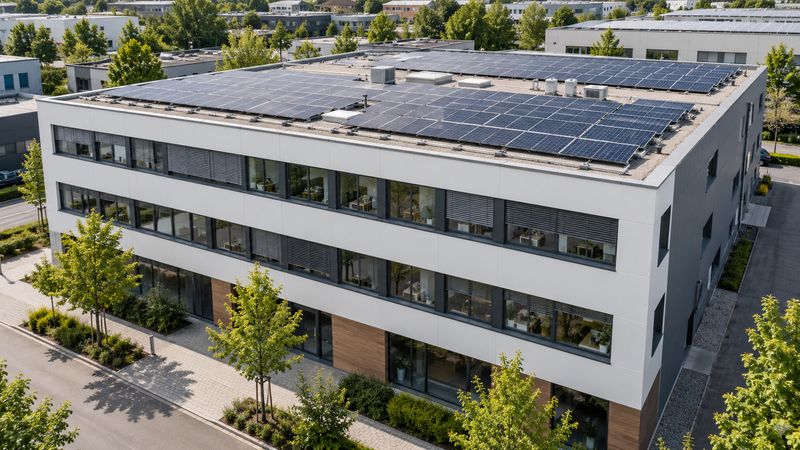
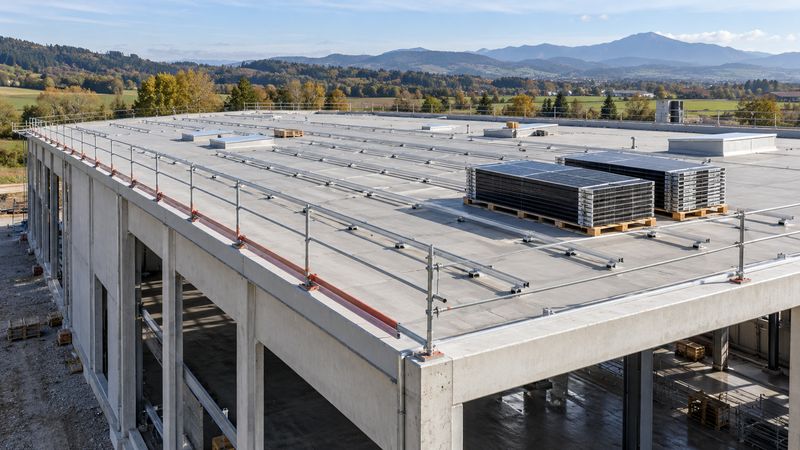
In Switzerland, a solar system for a business costs around CHF 54’000 for 30 kW, CHF 144’000 for 100 kW and CHF 281’000 for 300 kW. These prices exclude VAT and are before subsidies. After subsidies, solar electricity from your own roof costs 6–11 centimes (Rp.) per kWh. For a medium-sized business, grid electricity costs a median of 25 centimes per kWh in 2026.
Key points at a glance
- The larger the system, the lower the price per kW: from CHF 1’911 (10–30 kW) to CHF 800 (300–1’000 kW), median 2025.
- For company systems, the federal one-off payment covers around 20–30% of the investment.
- After subsidies, the examples assume solar electricity costs of 6–11 centimes/kWh and an avoided variable grid purchase price of 23.7–25.1 centimes/kWh. The grid prices are our own calculation assumptions.
- With 60% self-consumption, a 100 kW system pays for itself after around 7.5 years, or around 9.5 years without subsidies.
- As of 25.10.2026. System costs: SwissEnergy price monitoring study 2025. Electricity prices in the examples: our own calculation assumptions, not confirmed ElCom medians.
- As of 25.10.2026
- Sources at the end of the article
What does a solar system cost, by size?
The price per kW falls as size increases, because planning, scaffolding, administration and logistics are partly fixed costs. This is shown by the price monitoring study that SwissEnergy commissions every year. The 2025 edition analyses 1’686 systems from quotes and invoices.
| System | Investment (2025 cost curve) | Per kW | Median of the size class |
|---|---|---|---|
| 30 kW | around CHF 54’000 | around CHF 1’800 | 10–30 kW: CHF 1’911 |
| 100 kW | around CHF 144’000 | around CHF 1’440 | 30–100 kW: CHF 1’428 |
| 300 kW | around CHF 281’000 | around CHF 935 | 100–300 kW: CHF 1’102; 300–1’000 kW: CHF 800 |
All figures apply to rooftop systems without battery storage, excluding VAT and before subsidies. The investment is calculated using the study’s cost curve: the lower of 1’628 × kW + 5’278 and 681 × kW + 76’265 Swiss francs.
| Value | |
|---|---|
| 30 kW | around CHF 1’800 |
| 100 kW | around CHF 1’440 |
| 300 kW | around CHF 935 |
Per kW, a 300 kW system costs around half as much as a 30 kW system, because planning, scaffolding and administration are partly fixed costs. The figures follow the 2025 cost curve for rooftop systems without battery storage, excluding VAT and before subsidies.
Source: Swiss Federal Office of Energy SFOE and SwissEnergy, price monitoring study 2025, cost curve1
The spread is wide. Half of the systems of 100–300 kW cost between CHF 907 and CHF 1’597 per kW. In 2025, prices fell by 4–9% depending on size. For 2026, the study expects stable prices, as module prices have levelled off at around CHF 100 per kW.
How prices for residential buildings are made up is explained in the guide What does a photovoltaic system cost?. Why the price per square metre says little is shown in the article Photovoltaic costs per m².
What makes up the costs?
For company systems, labour and modules are the largest items. The study breaks down the costs of rooftop systems into eight categories (median 2025, excluding VAT):
| Cost category | 30–100 kW | 100–300 kW |
|---|---|---|
| Labour costs | CHF 296 per kW (23%) | CHF 257 per kW (23%) |
| Modules | CHF 211 per kW (16%) | CHF 206 per kW (20%) |
| Mounting system | CHF 196 per kW (13%) | CHF 146 per kW (11%) |
| Electrical materials | CHF 191 per kW (12%) | CHF 105 per kW (9%) |
| Site safety | CHF 158 per kW (11%) | CHF 126 per kW (9%) |
| Inverter | CHF 120 per kW (7%) | CHF 96 per kW (7%) |
| Administration and planning | CHF 94 per kW (6%) | CHF 55 per kW (5%) |
| Logistics and transport | CHF 41 per kW (3%) | CHF 38 per kW (4%) |
The figures are medians for each category, so together they do not add up exactly to the total price.
These prices do not include additional costs that often arise with commercial buildings:
- Grid connection and electrical room: According to the study, a new distribution board, an electrical room that is too small or a new supply line can account for up to 30% of the budget.
- Roof: renovation, structural reinforcement or green roof. For green roofs, the study assumes maintenance costs around 30% higher.
- Third-party planning: engineering firm, structural analysis, site management. For systems above 100 kW, this can add considerable costs.
- Optimisers: From 30 kW, systems with optimisers cost around 15% more than systems with string inverters.
- Battery storage: the 2025 study gives the formula 432 × kWh + 2’122 francs. The data mainly concern batteries below 30 kWh. The formula therefore does not establish reliable prices for commercial batteries of 50 or 100 kWh. Obtain a separate quote.
What are the operating costs?
Swissolar gives a maintenance range of 1–3 centimes per generated kWh. We use 2 centimes/kWh as a common assumption for comparable examples. This includes routine maintenance, cleaning, insurance, monitoring and minor repairs, but not inverter replacement. At 100 kW and 95’000 kWh, this amounts to CHF 1’900 per year.
You should also budget for replacing the inverters. According to the price study, they account for around 7% of the investment. The modules themselves last more than 30 years, according to Swissolar.
What does a kilowatt hour of solar electricity cost compared with grid electricity?
In the examples, the levelised cost is 6–11 centimes/kWh, depending on size and subsidies. It spreads the investment and operating costs over the yield across 25 years. For comparison, we use assumed variable grid purchase prices of 23.7–25.1 centimes/kWh. These are not confirmed current ElCom median values.
| System | Levelised cost with one-off payment | Without one-off payment |
|---|---|---|
| 30 kW | around 10.7 centimes/kWh | around 12.9 centimes/kWh |
| 100 kW | around 8.8 centimes/kWh | around 10.7 centimes/kWh |
| 300 kW | around 6.0 centimes/kWh | around 7.7 centimes/kWh |
Assumptions: investment based on the 2025 cost curve, yield of 950 kWh per kW per year, service life of 25 years, interest rate of 3%, operation and maintenance 2 centimes/kWh. DETEC’s explanatory report assumes around 1’000 kWh per kW; we use a more conservative figure.
Among other things, ElCom defines the consumption profiles C2, C3 and C4. The table assigns these profiles to our example prices. It does not show official median values. We do not use a tariff for 2027 without confirmed evidence.
| ElCom consumption profile | Annual consumption | Assumed variable purchase price in the example |
|---|---|---|
| C2, small business, up to 15 kW | 30’000 kWh | 25.1 centimes/kWh |
| C3, medium-sized business, up to 50 kW | 150’000 kWh | 25.0 centimes/kWh |
| C4, large business, up to 150 kW, low voltage | 500’000 kWh | 23.7 centimes/kWh |
Important: these prices only apply to the electricity you consume yourself. You receive much less for the surplus. Without a separate agreement with the grid operator, the quarterly reference market price has applied since 2026. For solar electricity in 2026, it was 10.3 centimes/kWh in the first quarter, 3.9 centimes/kWh in the second and 8.5 centimes/kWh in the third. For systems with self-consumption, there is no minimum remuneration for capacity above 30 kW. Many grid operators pay their own feed-in tariffs, so the remuneration for fed-in electricity may differ.
When does the system pay for itself, with and without subsidies?
With the one-off payment and 60% self-consumption, a company system pays for itself after around 5–10 years. Without subsidies, it takes around 2 years longer.
| System | Investment | One-off payment 2026 | Savings per year | Paid back with subsidy | Paid back without subsidy |
|---|---|---|---|---|---|
| 30 kW | CHF 54’000 | CHF 10’800 | CHF 4’520 | around 9.5 years | around 12 years |
| 100 kW | CHF 144’000 | CHF 31’800 | CHF 15’010 | around 7.5 years | around 9.5 years |
| 300 kW | CHF 281’000 | CHF 81’800 | CHF 42’810 | just under 5 years | around 6.5 years |
Assumptions: mounted system, yield of 950 kWh per kW, 60% self-consumption, surplus at 7 centimes/kWh, operation at 2 centimes/kWh. Variable grid purchase prices as our own assumptions: 25.1 centimes at 30 kW, 25.0 centimes at 100 kW and 23.7 centimes at 300 kW. Fixed standing and demand charges are not counted as savings across the board. No interest, no inflation, no tax effects. The one-off payment is calculated using the 2026 rates. How it is made up is explained under One-off payment for large photovoltaic systems (GREIV).
For tax purposes, businesses can depreciate the system. How the one-off payment and depreciation interact is regulated differently by each canton. Clarify this with your fiduciary or accountant.
Worked example: commercial business with 100 kW
A business consuming 150’000 kWh of electricity a year installs a 100 kW rooftop system on its flat roof. It operates during the day and consumes 60% of the solar electricity itself.
| Position | Amount |
|---|---|
| Investment excluding VAT (2025 cost curve) | CHF 144’000 |
| One-off payment (30 × 360 + 70 × 300) | − CHF 31’800 |
| Investment after subsidy | CHF 112’200 |
| Solar electricity per year (100 kW × 950 kWh) | 95’000 kWh |
| Grid electricity saved (57’000 kWh × 25 centimes) | CHF 14’250 per year |
| Remuneration for surplus (38’000 kWh × 7 centimes) | CHF 2’660 per year |
| Operation and maintenance (95’000 kWh × 2 centimes) | − CHF 1’900 per year |
| Savings per year | CHF 15’010 |
| Paid back after | around 7.5 years |
| Savings after 25 years, without interest and without replacing the inverters | around CHF 263’000 |
The installation covers 38% of the business’s electricity consumption. A battery could increase self-consumption. Its benefits and costs must be assessed using a load profile and a separate quote.
How does self-consumption change the calculation?
Self-consumption has a greater effect on the return than the price of the system. Each kilowatt hour consumed on site saves around 25 centimes; each one fed into the grid earns 7 centimes in this example.
| Self-consumption (100 kW system) | Savings per year | Paid back with subsidy | Paid back without subsidy |
|---|---|---|---|
| 30 % | CHF 9’880 | around 11.5 years | around 14.5 years |
| 60 % | CHF 15’010 | around 7.5 years | around 9.5 years |
| 80 % | CHF 18’430 | around 6 years | around 8 years |
- with one-off payment
- without subsidy
| with one-off payment | without subsidy | |
|---|---|---|
| 30% self-consumption | around 11.5 years (with one-off payment)around 14.5 years (without subsidy) | |
| 60% self-consumption | around 7.5 years (with one-off payment)around 9.5 years (without subsidy) | |
| 80% self-consumption | around 6 years (with one-off payment)around 8 years (without subsidy) |
The more solar electricity the business uses itself, the sooner the system pays for itself: with the one-off payment after around 6 years at 80% self-consumption, but only after around 11.5 years at 30%. Calculated with an investment of CHF 144’000, a one-off payment of CHF 31’800, 950 kWh per kW, 25 centimes per kWh used on site and 7 centimes per kWh fed in, plus 2 centimes per kWh for operation and maintenance.
Source: Own calculation by solar-guide.ch using the assumptions of the worked example; costs based on the price monitoring study 20251, one-off payment based on the Energy Promotion Ordinance5
How businesses increase their self-consumption:
- Plan the system around your load profile: Have your consumption analysed over 12 months before deciding on the size.
- Shift loads: Run cooling, compressed air, heat pumps and charging stations while the sun is shining.
- Include tenants: In a self-consumption association (ZEV), tenants use your solar electricity.
- East-west instead of south: Higher yields in the morning and evening often match operating hours better.
One caveat for larger businesses: if you pay a demand charge, a kilowatt hour of solar electricity saves less than the average price. In that case, calculate with your own electricity bill. At 20 instead of 25 centimes, the 100 kW system pays for itself after around 9 years instead of 7.5.
Don’t want to invest yourself? Then consider solar contracting or leasing out your roof. All the options are summarised on the page Solar panels for business.
Frequently asked questions and answers
What does a 100 kW solar system cost?
Around CHF 144’000 excluding VAT and before subsidies, according to the cost curve of SwissEnergy’s 2025 price monitoring study. The one-off payment for 2026 is CHF 31’800. Depending on the roof and grid connection, quotes can be well above or below this.
Why are German prices no use in Switzerland?
Wages, scaffolding, safety regulations and grid connection cost more in Switzerland. Only use Swiss figures, for example from the SwissEnergy price monitoring study or from quotes by Swiss specialist installers.
Does the system pay off with little daytime consumption?
With 30% self-consumption, a 100 kW system takes around 11.5 years to pay for itself. That can still be worthwhile, but the risk of low feed-in tariffs is greater. In that case, also consider leasing out the roof or a system without self-consumption with the high one-off payment.
Will prices keep falling in 2026?
The price study expects prices to stabilise. In the second half of 2025, quotes were at the level of the first half or slightly above. Supply chains for modules remain uncertain.
Is VAT part of the costs?
For businesses entitled to deduct input tax, generally not. That is why this guide gives all prices excluding VAT. Pronovo pays the one-off payment without VAT.