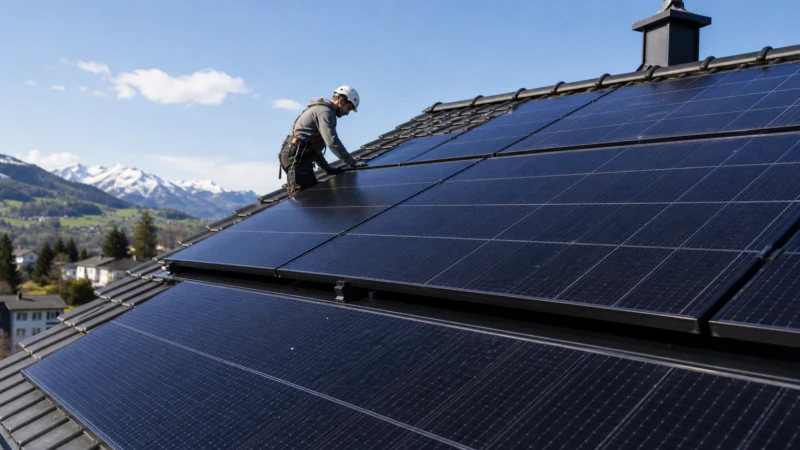
If your solar system sits on a pitched roof, you usually do not need to clean it: the rain washes off pollen and bird droppings by itself. Modules tilted at less than ten degrees, on farm buildings and in dusty surroundings need more care. Running costs are low too. The Swiss Federal Office of Energy (BFE) puts them at 4.0 Rp./kWh for a private 10 kW system, around CHF 380 as an annual average. This already includes later repairs and replacement equipment.
Key points at a glance
- On pitched roofs, the rain usually cleans the modules by itself. Flat roofs under ten degrees, farm buildings and dusty locations get dirtier.
- Cleaning is done with demineralised water or rainwater and soft brushes, without cleaning agents and without stepping on the modules. Cleaning only pays off if the extra yield covers the cost.
- Work on the roof belongs in the hands of a specialist installer with fall protection.
- The operating costs are a calculated annual average. Most of it goes on replacing and repairing the inverter, not on cleaning.
- The periodic safety inspection follows the building, usually every 20 years for residential buildings. The grid operator asks you in writing for the safety certificate.
- As of 03.11.2026
- Sources at the end of the article
Do you need to clean your solar system?
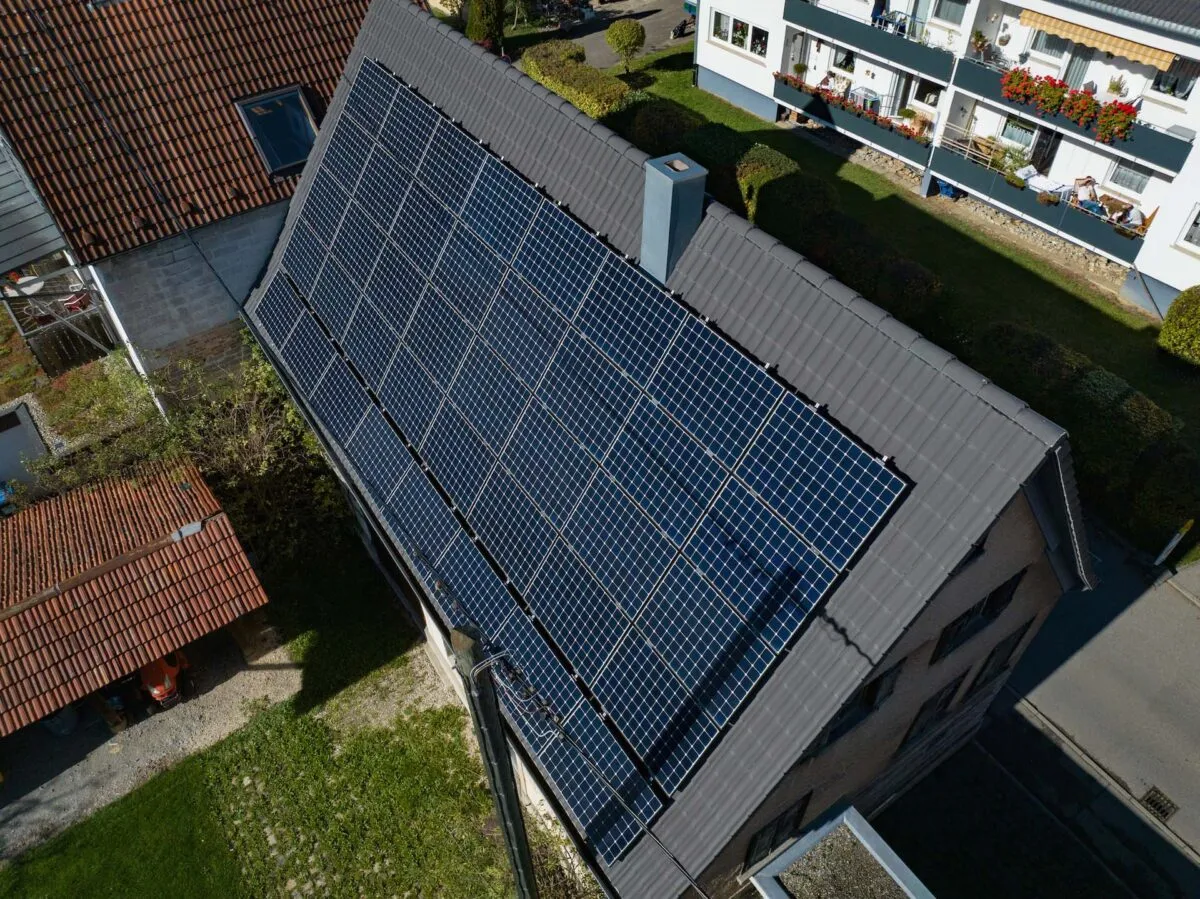
In most cases, no. Rain usually washes away pollen or bird droppings as long as the modules are tilted enough, which is the case for most systems on pitched roofs.
Things are different in these locations:
- Flat roofs: Below ten degrees of tilt, rainwater drains away poorly. Dirt collects along the lower edge of the module, and on framed modules moss grows there over time.
- Agriculture: There is more dust on farm buildings and next to cultivated fields. As a guideline value, the BFE assumes cleaning every two years for systems on agricultural land (agri-PV) and every five years for rooftop systems. This is not mandatory.
- Businesses near extraction sites: Dust from gravel pits and quarries makes the modules noticeably dirty.
- Trees and green roofs: Leaves stay on the modules, and growing trees and tall plants cast shade. On a green roof, the extra upkeep of a 100 kW system costs around 1.5 Rp./kWh.
You can read more for your farm in the guide Solar systems in agriculture.
How much yield does dirt cost?
There is no general figure. In Zurich, a flat-roof system with a tilt of only four degrees had not been cleaned for five years. When experts examined it in 2002, its output was calculated to be 6.75 % lower because of the dirt. Only two to three months after cleaning, a thin layer of dirt was already back on the glass. So this does not mean a yield loss of 6.75 % per year.
When is cleaning worthwhile?
When the extra yield covers the cost. Have unusual yield figures or stubborn deposits checked. But rule out other causes first: a weak month can also be down to the weather, new shade or a technical fault. The extra yield is worth as much as the electricity you additionally use yourself, plus the feed-in tariff for the rest.
How do you clean solar panels correctly?
With soft water, soft brushes and no chemicals:
- Only demineralised water or rainwater: Tap water leaves limescale marks on the glass.
- No cleaning agents: They can damage the surface and may cost you the manufacturer’s warranty. They also end up in watercourses.
- Soft brushes on telescopic poles or cleaning robots. The brushes must not scratch the glass.
- Never step on the modules: Point loads cause fine cracks, and small stones on your soles scratch the glass. Such micro-cracks reduce the yield and can lead to hot spots.
- Follow the manufacturer’s instructions: Your system documents include the maintenance and servicing instructions, plus the module manufacturer’s cleaning recommendations. The specialist bodies do not list a pressure washer as a suitable tool. Do not use one unless the manufacturer expressly allows it.
Are you allowed to go on the roof yourself?
Better not: cleaning on the roof belongs in the hands of a specialist installer. For specialist installers, the Construction Work Ordinance requires fall protection there:
- Collective protection, such as edge protection that secures everyone on the roof, takes priority.
- A simplified rule applies only to small jobs totalling less than two person-days per roof.
- Anyone working on a rope needs suitable anchor points, training and a rescue plan.
- Corrugated fibre-cement sheets will not bear a person’s weight. Buildings from before 1990 may contain asbestos.
You can find a specialist installer in your region in the directory of solar companies.
Do not clear snow from an unsecured roof yourself either. If the snow load is critical or paths and entrances are at risk, call in a specialist installer. If you let the snow melt, you still need protection against snow sliding off the roof, such as snow guards.
What do cleaning and maintenance cost in Switzerland?
For a single-family home, operating costs are low. The BFE recalculated them at the start of 2026, using quotes from eight cleaning companies among other things.
| System | Cleaning | Inspections, monitoring and subscription | Total operating costs |
|---|---|---|---|
| 10 kW, pitched roof, private | not included | by the owner | 4.0 Rp./kWh, around CHF 380 |
| 15 kW, private | not included | by the owner | 3.1 Rp./kWh, around CHF 440 |
| 100 kW, pitched roof, commercial | 0.45 Rp./kWh, around CHF 430 | 0.60 Rp./kWh, around CHF 570 | 3.8 Rp./kWh, around CHF 3’610 |
| 100 kW, flat roof with gravel | 0.50 Rp./kWh, around CHF 475 | 0.60 Rp./kWh, around CHF 570 | 3.9 Rp./kWh, around CHF 3’705 |
| 1 MW, flat roof with gravel | 0.20 Rp./kWh, around CHF 1’900 | 0.25 Rp./kWh, around CHF 2’375 | 2.3 Rp./kWh, around CHF 21’850 |
Source: Swiss Federal Office of Energy, Technology Monitoring Photovoltaics, Bern University of Applied Sciences and SUPSI, tables 13 and 14, version of 09.01.2026
The franc amounts are annual averages at 950 kWh per kW. Because later repairs and replacement equipment are spread over the years of operation, this is not an annual maintenance bill. Your own time and full dismantling are not included. The individual items are excl. VAT; the total costs include VAT and the later replacement of monitoring equipment. The figures assume cleaning every five years. A single cleaning of a 100 kW system on a pitched roof therefore costs around CHF 2’100 excl. VAT.
For small systems, neither cleaning nor inspection rounds are included, as owners usually do the monitoring themselves in the inverter’s portal. So only a quote will tell you what a maintenance contract costs for your single-family home.
| Value | |
|---|---|
| Replacement and repair of inverters | 2.53 Rp. |
| Replacement and repair of other materials | 1.00 Rp. |
| VAT | 0.29 Rp. |
| Natural hazards insurance | 0.18 Rp. |
| Cleaning | not included |
Almost two thirds of the operating costs of a small pitched-roof system go on replacing and repairing the inverter. Together, the items add up to 4.0 Rp./kWh.
Source: Swiss Federal Office of Energy, Technology Monitoring Photovoltaics, appendix 9.2, version of 09.01.20261
What should be included in a maintenance contract?
Define the scope precisely so that you can compare quotes:
- Monitoring and deadline for fixing faults
- Visual inspection, cleaning, check of the inverter’s error codes, report
- Term, notice period and payment, including for repairs outside the contract
A maintenance contract is voluntary. It does not replace the statutory safety inspection, and the inspection does not replace maintenance. Maintenance can be done by the specialist installer who built your system or by another one. You can read why being close by helps under Photovoltaics nearby. So that you can compare prices and services, we pass your request on to up to three suitable specialist installers: Compare quotes.
How often does a photovoltaic system require maintenance?
There is no general statutory maintenance interval for ordinary PV systems. Manufacturer warranties may have their own conditions. Mandatory inspections and any work needed after damage or faults apply regardless. For battery storage, some manufacturers require regular maintenance.
These checks are worthwhile:
- Ongoing monitoring: It reports yield losses caused by shade, dirt or faulty modules and inverters, as well as insulation faults and interruptions to the data connection. Keep the email address for it up to date. The guide Solar power explains what the curves show.
- Visual check from the ground: loose cables, new shade from trees or scaffolding, clear ventilation slots on the inverter.
- After storms and hail: Have the fixings of the modules and the mounting structure checked, even if there is no error message.
- Before the warranty period ends: Have the system checked by an independent company while defects are still covered. Many losses in module output only show up with measuring equipment.
You can read how to compare modules and their warranties in the guide Solar modules and solar panels.
How long does the inverter last?
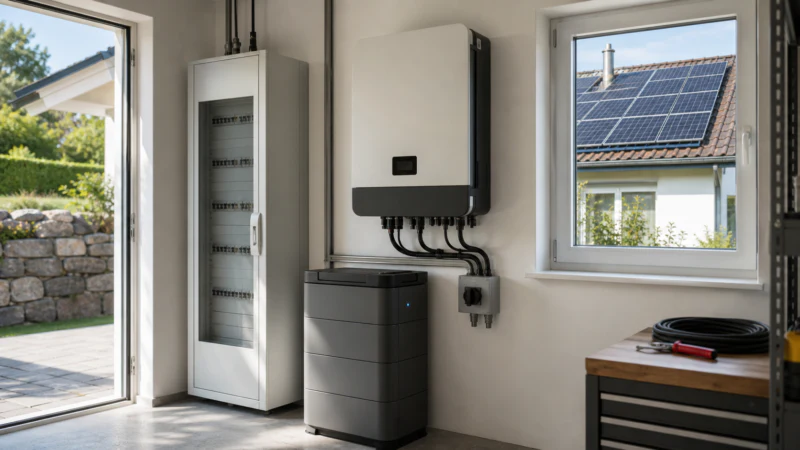
Expect to replace it once. That is what the BFE assumes for a system lifetime of 25 years. However, one evaluation shows that over 65 % of the devices still had no fault in their 15th year of operation. For the replacement, the BFE uses CHF 3’000 for 10 kW and CHF 9’000 for 100 kW. Adjustments to the installation may come on top. A cool, well-ventilated and low-dust location extends the time until the first repair. More on this in the guide Inverter for photovoltaics.
When is the safety certificate under the NIV due?
Together with the electrical installation of the building the system is connected to: both have the same inspection period under the Low Voltage Installation Ordinance (NIV). For ordinary building installations, the grid operator asks you in writing at least six months before the deadline to submit the safety certificate. This report is drawn up by an independent inspection body, meaning one that did not build your system.
| Building | Inspection period |
|---|---|
| Residential building | 20 years |
| Farm | 10 years |
| Office building, commercial workshop | 10 years |
| Operating premises of industry and large businesses | 5 years |
| Hotel, restaurant, school, care home | 5 years |
Source: NIV, appendix sections 2.5, 2.4.8, 2.4.3, 2.4.5, 2.3.6 and 2.3.8, as at 31.10.2025
These are the standard cases. For special installation parts or risks, the period can be shorter. For certain special installations and off-grid systems, the Federal Inspectorate for Heavy Current Installations (ESTI) is responsible.
If you sell your house, an additional rule applies: if the last inspection was more than five years ago, a new inspection is carried out for periods of 10 or 20 years. Every new grid-connected system also needs an acceptance inspection within six months of handover.
Is the solar system covered by buildings insurance?
Usually yes, but check. In 19 cantons, buildings must be insured with the cantonal buildings insurer. In Geneva, Uri, Schwyz, Ticino, Appenzell Innerrhoden, Valais and Obwalden, you generally insure them privately; of these, insurance is compulsory in Uri, Schwyz and Obwalden. One exception is the district of Oberegg in Appenzell Innerrhoden: it has its own public compulsory insurance, with a rule for solar systems since 01.01.2026.
Fire and natural hazards cover includes fire, lightning, storms, hail, high water and flooding, among other things. Other water damage may need separate cover. Theft, power surges or loss of yield are covered by voluntary all-risks insurance, depending on the policy. If you live in the property yourself, private liability insurance is usually enough.
Selected cantonal buildings insurers have premium rates of 0.16 to 1.2 ‰ of the insured value. You cannot work out your additional premium directly from this. So have the cover, insured value and liability for your system confirmed. Check your policy from time to time: for older systems, the sums insured are often too high because prices have fallen.
If you are planning a new system, ask about monitoring and maintenance in the quote straight away. We pass your request on to up to three suitable specialist installers, free of charge and with no obligation: Compare quotes.
Frequently asked questions and answers
Does a solar system need to be cleaned?
On pitched roofs, usually not: the rain removes pollen and bird droppings. Below ten degrees of tilt, on farm buildings and near sources of dust, modules get dirty more often. Cleaning pays off if the extra yield covers the cost.
How often should a photovoltaic system be cleaned?
Only when needed. As a guideline value, the BFE assumes cleaning every five years for rooftop systems and every two years for agri-PV. No interval is mandatory.
Can I clean solar panels myself?
Yes, if you can reach the modules safely from the ground. Then clean them with a soft brush and demineralised water. For work on the roof, we recommend a specialist installer with suitable fall protection.
How much does maintaining a solar system cost per year?
For a private 15 kW system, the BFE puts the operating costs at 3.1 Rp./kWh, around CHF 440 as an annual average. The biggest item is replacing and repairing the inverter, spread over the years of operation.
How often must a photovoltaic system be inspected?
The periodic inspection under the NIV follows the building: usually every 20 years for residential buildings and every 10 years for farms. If you sell, it may be due earlier.
Can I clear snow from the solar modules?
Not yourself on an unsecured roof. Brooms and shovels can also damage modules and cables. If the snow load is critical, call in a specialist installer.