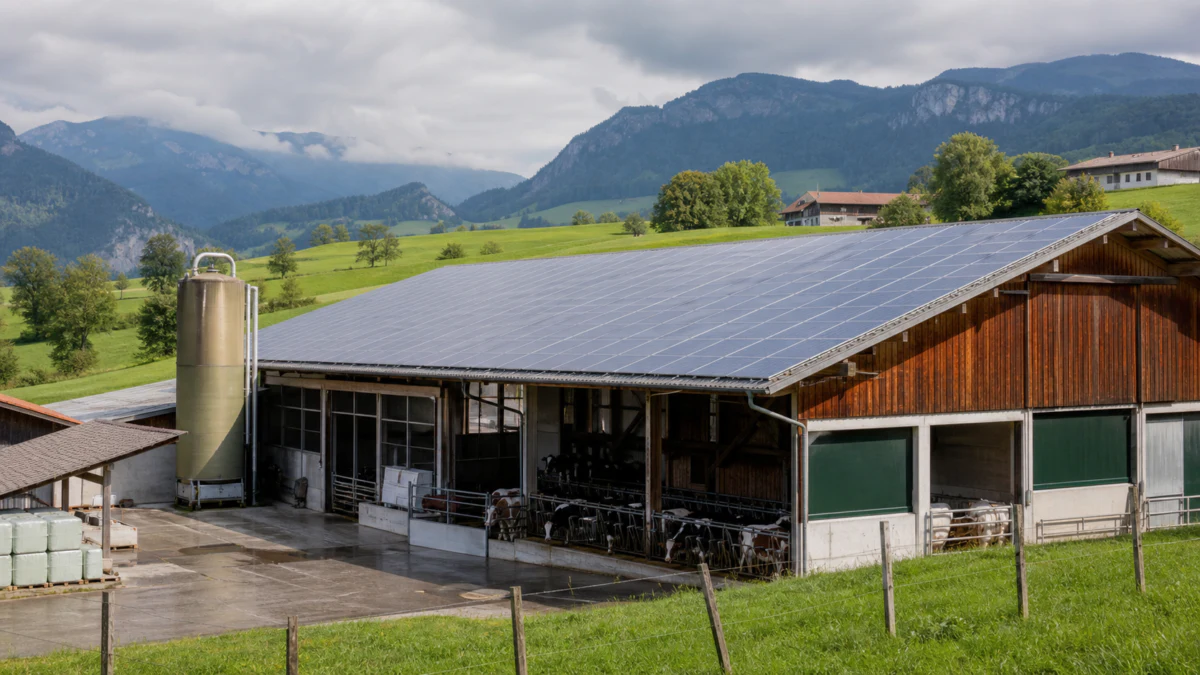
A solar system can be particularly interesting for agricultural businesses. Many farms have large roof areas on stables, barns, sheds or machine halls. At the same time, electricity consumption is high on many farms, for example for milking technology, cooling, ventilation, irrigation, farm shops, processing or heat pumps.
Whether photovoltaics are worthwhile in agriculture depends not only on the roof area. Key factors are roof condition, structural stability, grid connection, self-consumption, feed-in tariff paid by the grid operator, subsidy, tax issues and the quality of the quote.
Key points at a glance
For the subsidy in this canton, three levels are particularly important: federal subsidy, local additional programs, and tax treatment:
- Agricultural businesses often have large roof areas that are well suited for photovoltaics.
- Solar electricity is particularly interesting if part of it can be consumed directly on the farm.
- The most important subsidy is usually the national one-off payment via Pronovo in 2026.
- For systems with self-consumption under 100 kW, the KLEIV applies; for systems of 100 kW or more, the GREIV applies. Systems without self-consumption can be subsidised via the HEIV or through auctions, depending on their output.
- For new systems of 100 kW or more, the winter electricity bonus may be relevant in 2026 if the system achieves a high specific yield during the winter half-year.
- Agricultural businesses should additionally check whether battery storage can be supported as part of structural improvements.
- Cantonal, municipal and energy supplier-related subsidies must be checked based on the location.
- Agri-PV on agricultural land is a special case and should not be equated with a standard roof installation on a barn or shed.
This makes the direction clear: The specific subsidy always depends on address, system size, building type and grid operator.
- As of 25.10.2026
- Sources at the end of the article
Why is photovoltaics interesting for agricultural businesses?
Many agricultural businesses have good prerequisites for a photovoltaic system: large roofs, buildings used long-term, and often significant electricity consumption. While the available roof area is often limited in a single-family home, farms often have several buildings available.
Typical areas are:
- Barn roofs
- Barn roofs
- Carports
- Machine halls
- Warehouses
- Roofs of farm shops or processing rooms
In addition: On many farms, electricity consumption occurs not only in the evening but also during the day. This is precisely when a photovoltaic system produces particularly much electricity. The more solar power is used directly on the farm, the less electricity needs to be drawn from the grid.
This can be particularly interesting for businesses with cooling, milking technology, ventilation, irrigation, heat pump or farm shop. For an initial assessment of roof areas, the official tool Sonnendach can help; however, actual suitability must then be technically verified.
Which roof areas are suitable on a farm?
Not every large roof is automatically a good solar roof. The key factor is whether the area is technically, economically, and structurally suitable:
| Building type | Potential | What to look for? |
|---|---|---|
| Barn | often large roof area | Structure, roof condition, fire protection |
| Animal shed | Good self-consumption possible | Moisture, ventilation, fire protection |
| Shed | often simple installation | Orientation, shading |
| Machinery shed | Large area, good accessibility | Grid connection, cable routes |
| Farm shop or cold room | promising self-consumption potential | Load profile, cooling, metering concept |
The condition of the roof is particularly important. If a roof renovation is due within the next few years anyway, it should be coordinated with the photovoltaic planning. Installing a solar system on a roof that needs to be renovated shortly afterwards is usually not sensible.
The structural integrity is also central. Older barns, stables or asbestos cement roofs must be professionally inspected. For asbestos-containing materials, additional regulations and safety measures must be observed. Such points should be thoroughly clarified before the quote.
Cowsheds and barns: what about structural load and asbestos?
Before modules go on the roof, load-bearing capacity and materials must be clarified. The Swiss Farmers’ Union gives a rule of thumb: roof area divided by 4.5 gives the approximate capacity in kWp. A 300 m² barn roof therefore takes around 67 kWp.
- Structural load: Older cowsheds and barns often have little load reserve. Have it checked whether the roof can bear the system plus the snow load. The result belongs in the quote.
- Asbestos: Roofs built before 1990 may contain asbestos, especially corrugated fibre cement sheets. Drilling and cutting release fibres. Suva recommends replacing roofs containing asbestos completely before installation.
- Renovation and solar in one step: If the roof is being replaced anyway, use the same scaffolding for both jobs. If the modules replace the roof covering, the system counts as integrated. For this, the Confederation pays a higher one-off payment below 100 kW: CHF 400 instead of CHF 360 per kW for the share below 30 kW.
Include asbestos removal and roof renovation as a separate item in your cost-effectiveness calculation. This lets you compare quotes with and without renovation properly.
How important is self-consumption in agriculture?
Self-consumption is one of the most important levers for economic viability. Self-consumption means: The solar power produced on the farm is used directly in the operation, instead of being fed entirely into the grid.
In agriculture, there are often good opportunities for this:
| Consumers | Typical benefits of solar power |
|---|---|
| Milking robots | regular electricity consumption |
| Milk cooling | continuous consumption |
| Ventilation | often relevant during the day and seasonally |
| Irrigation | high summer consumption |
| Cold rooms | ongoing electricity demand |
| Farm shop | Daily consumption and cooling |
| Processing | Plannable electrical loads |
| Heat pump | Self-consumption optimisable |
| E-carport charger or E-car | Charging partially predictable |
A business with high daytime electricity consumption can often use solar power more effectively directly than a business that mainly needs electricity at night. Therefore, before planning, not only the annual consumption should be considered, but also the load profile: When is how much electricity needed?
For larger businesses, a detailed analysis is often worthwhile. This checks how much electricity can be used directly, stored, or fed in.
What subsidies are available in 2026 for solar systems in agriculture?
For agricultural businesses, there is currently no blanket nationwide special subsidy exclusively for farms in 2026. The relevant factors are mainly the general subsidy instruments for photovoltaic systems as well as possible cantonal, municipal or energy supplier-related programmes.
How does the Pronovo one-off payment work?
The most important national subsidy for photovoltaic systems is the one-off payment. It is administered through Pronovo. A detailed overview of the federal subsidy can also be found in the guide on Pronovo subsidy.
Pronovo distinguishes three central subsidy pathways:
| Funding instrument | For which systems? | Relevance for agriculture |
|---|---|---|
| KLEIV | PV systems with self-consumption and a capacity below 100 kW | many smaller farm systems |
| GREIV | PV systems with self-consumption and a capacity of 100 kW or more | larger barns, stables and halls |
| HEIV | Systems without self-consumption from 2 kW to 149.99 kW | possible option for full feed-in |
With the one-off payment, operators receive a one-time investment contribution. For agricultural businesses, this means: The subsidy does not depend on whether it is a farm, but on the system itself, i.e. output, execution, self-consumption situation and subsidy programme.
The timing is also important. KLEIV applications are usually submitted after commissioning. For GREIV, HEIV, auctions, cantonal programmes or municipal contributions, other deadlines may apply. Therefore, the conditions should be checked before ordering, starting construction and commissioning.
What does the winter electricity bonus 2026 bring?
For larger agricultural roofs, the winter electricity bonus may also be interesting in 2026. Swissolar describes the winter electricity bonus as an add-on for new photovoltaic systems of 100 kW or more, if the system achieves a high specific yield in the winter half-year.
This is not relevant for every system. The bonus may be particularly worth checking in the following cases:
- large systems from 100 kW
- steeper roof surfaces
- Facade systems
- alpine or winter-strong locations
- Systems with good orientation for winter yield
For many classic flat-roof or low-slope systems in the Swiss Plateau, the winter electricity bonus will not automatically play a role. However, it should be considered in the planning of larger farm installations of 100 kW or more.
Are there special agricultural subsidies?
An additional, truly agriculture-specific check concerns battery storage and structural improvements. The information sheet of the Swiss Farmers' Association on photovoltaic systems on agricultural economic buildings mentions a subsidy for battery storage under the Structural Improvements Ordinance: federal and canton with 100 CHF each per kWh of storage capacity.
This statement is important, but it does not replace an individual case review. Whether an operation meets the requirements, which cantonal authority is responsible, which technical conditions apply and whether the application must be submitted before implementation should be clarified directly with the cantonal agricultural office or the responsible structural improvement office.
For standard photovoltaic systems on barns, stables or machine halls, the national Pronovo subsidy usually is the most important basis. Additional contributions may be possible depending on the canton, municipality, energy supplier and specific project.
Which cantonal and local subsidies should farms check?
In addition to the national subsidy, cantons, municipalities, cities or energy suppliers may offer additional programmes. However, these are not uniform across Switzerland.
Depending on the location, subsidies or grants may be relevant for:
- Photovoltaics
- Battery storage
- Solar thermal energy
- Energy consulting
- GEAK or building analysis
- Charging infrastructure
- Energy efficiency
- Renovation measures
- Self-consumption optimisation or load management
Subsidies should therefore always be checked based on the specific address. A broader overview is provided by the guide to subsidies for photovoltaic systems in Switzerland. For agricultural businesses, it is additionally important whether the system belongs to private assets, business assets, or the agricultural operation itself. This point can influence the tax and accounting treatment.
How much one-off payment does a farm actually receive?
The one-off payment depends on the system’s capacity. For mounted systems commissioned from 01.04.2025, the Confederation pays CHF 360 per kW for the share below 30 kW, CHF 300 per kW for the share from 30 to under 100 kW, and CHF 250 from 100 kW.
| System on the farm | Programme | One-off payment (EIV) |
|---|---|---|
| 30 kWp | small one-off payment (KLEIV) | CHF 10’800 |
| 60 kWp | KLEIV | CHF 19’800 |
| 100 kWp | large one-off payment (GREIV) | CHF 31’800 |
| 150 kWp | GREIV | CHF 44’300 |
| 100 kWp without self-consumption | high one-off payment (HEIV), CHF 450 per kW | CHF 45’000 |
Check the feed-in tariff as well. The statutory minimum applies only to installations below 150 kW. With self-consumption, capacity-weighted rates apply from 30 kW: 6 centimes/kWh for the share below 30 kW and 0 for the remaining share. At 60 kWp, this gives 3 centimes/kWh for exported energy from the whole installation. Without self-consumption, the minimum from 30 to below 150 kW is 6.2 centimes/kWh. See One-time remuneration for large photovoltaic installations for applications and bonuses.
Rooftop PV or Agri-PV: What is the difference?
For solar systems in agriculture, a clear distinction must be made between:
- Photovoltaics on existing buildings
- Agri-PV on agricultural land
The classic and usually simpler option is a photovoltaic system on a barn, stable, shed or machine hall. This uses an existing roof area without directly encroaching on agricultural land.
Agri-PV is more complex. It combines agricultural production with electricity production on the same area. For Agri-PV, additional questions must be examined:
- Is the area still usable for agriculture?
- Will the management be impaired?
- What does this mean for direct payments?
- Is a permit possible?
- Are there impacts on the landscape or agricultural land?
- Is the agronomic benefit demonstrable?
The Swiss Farmers' Union points out that agricultural land with solar systems is generally not recognised as agricultural land and is not eligible for direct payments, except in the case of agri-photovoltaic systems.
For most businesses, a rooftop installation on existing buildings is therefore the more logical first step.
Agrivoltaics: what is permitted and which permit is needed?
Since 01.01.2026, Article 24ter of the Spatial Planning Act (RPG) has set new rules for solar systems outside the building zone. Agrivoltaics on agricultural land are possible if they do not impair agricultural interests and benefit production. Alternatively, they must serve agricultural trials and research.
The Swiss Farmers’ Union cites benefits such as higher yields or better quality, protection against severe weather, pests and diseases, and staggered harvests. Other free-standing solar systems that are not of national interest may not be built on crop rotation areas or on agricultural land.
| Location | Procedure | Direct payments |
|---|---|---|
| Sufficiently adapted system on a cowshed or barn roof | Notification to the building authority, no building permit | unchanged |
| Mounted system outside the building zone, for example on a shed | Building permit, possible if visually integrated with the building | unchanged |
| Agri-PV on agricultural land | Building permit outside the building zone with a comprehensive weighing of interests | remains eligible for direct payments |
| Other free-standing system on agricultural land, not of national interest | not permitted | not applicable |
For every system outside the building zone: if the conditions no longer apply or the system is permanently decommissioned, it must be dismantled. If there is a planning requirement, the planning basis must be created first. Discuss an agrivoltaics project early with the cantonal office responsible for building outside the building zone.
Which costs and economic factors are decisive?
The costs of a solar system in agriculture cannot be determined uniformly based on the roof area. Agricultural systems can vary widely: from smaller systems on a barn to large PV systems on multiple hall roofs.
Important cost factors are:
| Cost factor | Why is this relevant? |
|---|---|
| System size | determines output and investment volume |
| Roof condition | Renovation may be necessary |
| Structural stability | older buildings must be inspected |
| Scaffolding and access | affects installation costs |
| Grid connection | central for large systems |
| Electrical installation | often additional effort |
| Inverter | dependent on output and design |
| Fire protection | important for stables, barns and haylofts |
| Storage | increases investment, can improve self-consumption |
| Monitoring | important for operational control |
| Subsidies | reduce investment costs |
For larger systems, the grid connection is particularly important. Not every location can feed in unlimited amounts of electricity. If the grid connection is limited, this can affect the system size, cost-effectiveness or implementation.
The SBV leaflet recommends involving the local grid operator at an early stage. It also specifies a remuneration of 50 CHF per kW for grid reinforcements from the parcel boundary onwards from 2025. For the individual operation, however, it remains crucial which connection conditions, grid connection costs and feed-in options apply at the specific location.
Worked example: dairy farm with 60 kWp
Assumptions:
- Barn roof with around 270 m² of usable area, 60 kWp system
- Yield 950 kWh per kWp, i.e. 57’000 kWh per year
- Farm electricity consumption 35’000 kWh per year for milking, milk cooling and ventilation
- Investment CHF 85’700 (median 2025 for 30–100 kW), one-off payment CHF 19’800, investment after subsidy CHF 65’900
- Electricity price 25 centimes/kWh, feed-in tariff 7 centimes/kWh, operation and maintenance 2 centimes/kWh; inverter replacement excluded
- Variant with farmhouse and heat pump: an additional 12’000 kWh per year
| Position | Farm only | With farmhouse and heat pump |
|---|---|---|
| Self-consumption | 35% (19’950 kWh) | 45% (25’650 kWh) |
| Grid electricity saved | CHF 4’990 | CHF 6’410 |
| Remuneration for surplus | CHF 2’590 | CHF 2’190 |
| Operation and maintenance | − CHF 1’140 | − CHF 1’140 |
| Benefit per year | CHF 6’440 | CHF 7’470 |
| Payback after subsidy | around 10.2 years | around 8.8 years |
Milking and cooling take place mainly in the morning and evening. As a result, the farm’s own self-consumption tends to be low. With the farmhouse and a heat pump, it rises and the system pays for itself around 1.4 years earlier. Metering and billing costs for a ZEV are not included. If the market price for the surplus falls, every kilowatt hour consumed on site becomes more valuable. More options for businesses are shown in the overview Solar panels for business.
Is a battery storage system on the farm worthwhile?
A battery storage unit can increase self-consumption, but it is not automatically cost-effective. In agriculture, its usefulness depends heavily on the consumption profile:
| Situation | Is storage more sensible? | Note |
|---|---|---|
| high consumption in the evening or at night | rather yes | for example cooling, ventilation or technical systems |
| high daytime consumption | rather less | Solar power is used directly |
| low feed-in tariff paid by the grid operator | check | Self-consumption is becoming more important |
| Backup power requirement | only with a special solution | not every battery storage system can provide backup power |
| E-mobility on the farm | check | Charging times are decisive |
| very large PV system | Check individually | Grid connection and load management are important |
Important: Emergency power or backup power is not automatically included. Anyone who wants to continue operating certain consumers during a power outage needs a solution planned for this purpose. This should be explicitly stated in the quote.
If a battery storage system is planned, the possible structural improvement subsidy should be checked early on. However, a subsidy alone does not make a battery storage system economically viable; the consumption profile, electricity tariff, feed-in tariff paid by the grid operator, load management and technical design remain decisive. Find out more about the context in the guide to the PV system with battery storage.
ZEV with the farmhouse: when does it pay off?
A self-consumption association (ZEV) pays off if several households or businesses on the farm have their own electricity meters. Typical examples are the farm manager’s family home, the parents’ retirement cottage (Stöckli), a rented flat or a tenant farmer. The households’ evening consumption and a heat pump absorb solar electricity that the cowshed does not need.
- Same meter: If the farm and the farmhouse share one meter, the electricity already counts as self-consumption. You do not need a ZEV.
- Several meters on the farm: With a ZEV, everyone acts together as a single customer. The system must reach at least 10% of the community’s connection capacity.
- Tenants and tenant farmers: You may charge them a flat rate of at most 80% of the price they would pay without a ZEV.
- Neighbouring farm: If it is connected to the same connection line below 1 kV, a virtual ZEV (vZEV) is possible. Since 01.01.2026, supply via the public grid within the municipality has been possible with a local electricity community (LEG).
How billing and contracts work is explained in the guide Self-consumption association (ZEV).
What applies to grid feed-in, the feed-in tariff paid by the grid operator and grid connection?
Many agricultural roofs offer more space than the farm itself needs for self-consumption. Then the question arises: What happens to the surplus solar power?
Surplus electricity can be fed into the grid. The remuneration depends on the grid operator and the applicable rules. From 2026, new framework conditions will apply to feed-in tariffs paid by the grid operator and minimum remunerations. Minimum remunerations exist for systems up to 150 kW; for systems up to 30 kW, this amount is 6 Rp./kWh. Certificates of origin, local green electricity models, and specific grid operator tariffs must be checked separately.
For farms, the following is therefore important:
- Check the feed-in tariff paid by the grid operator with the local grid operator
- Check grid connection early
- Clarify possible feed-in power in writing
- Calculate self-consumption potential realistically
- Check storage or load management
- For large systems, consider direct marketing or special models
- Compare quotes based on more than just the total price
Those who rely solely on feed-in should calculate particularly carefully. Often, the combination of self-consumption, sensible system size and good subsidy is more stable than a pure full feed-in calculation. For the tariff side, the guide to feed-in remuneration in Switzerland is helpful.
How does the planning process work from the barn roof to the quote?
A solar system on a farm should be planned in a structured manner:
- Check electricity consumption over the past few years
- Analyse load profile: When is electricity consumed?
- Record roof areas
- Check roof condition and statics
- Check grid connection and possible feed-in capacity
- Calculate self-consumption potential
- Check subsidies and deadlines
- Assess battery storage, load management and e-mobility
- Obtain multiple quotes
- Clarify tax and business management issues with a fiduciary
The larger the system, the more important clean project planning becomes. For farms, it often involves not just a roof, but the entire operation.
What information should a farm prepare before the request?
Before contacting a specialist installer, specific details about the operation, buildings and consumption are helpful.
Important questions are:
- Which roofs are available?
- How old are the roofs?
- Is a roof renovation foreseeable?
- Is the structural engineering known?
- Is there asbestos or old Eternit roofing?
- What is the annual electricity consumption?
- When is electricity consumed?
- Which consumers run during the day?
- Is there cooling, ventilation, milking robots or irrigation?
- Is there a farm shop or processing room available?
- Is a heat pump planned?
- Should e-mobility on the farm be integrated?
- How large is the grid connection?
- Which feed-in tariff paid by the grid operator applies?
- What subsidy is possible?
- Is battery storage worthwhile?
- How is the system treated for tax purposes?
With this information, a specialist installer can design the system to be significantly more robust and better assess subsidy options.
When is a solar system particularly worthwhile in agriculture?
A solar system can be particularly interesting if several of these points apply:
| Situation | Assessment |
|---|---|
| large, intact roof area | very good prerequisite |
| high daytime consumption | Good for self-consumption |
| Cooling, ventilation, irrigation | often matching the solar production |
| System from 100 kW | Check GREIV and winter electricity bonus |
| Steep or winter-strong roof area | Check winter electricity bonus |
| ageing roof | clarify renovation and structure first |
| weak grid connection | Self-consumption and storage are more important |
| full feed-in | Check the economics carefully |
| Agri-PV on land | Special case with permit review |
Not every solar system needs to be as large as possible. What matters is which solution suits the farm. A smaller system well-tuned for self-consumption can be more economically sensible than a very large system with difficult feed-in.
What mistakes are frequently made with solar systems on farms?
Common errors are:
- only look at the roof area
- Check the grid connection too late
- Ignore roof condition and structural integrity
- Oversizing the battery storage
- Assume the feed-in tariff paid by the grid operator to be too optimistic
- Submit the subsidy application too late
- Do not clarify tax questions
- Underestimating fire protection and electrical installation
- Confusing agri-PV with rooftop PV
- Obtain only one quote
Especially for agricultural businesses, a careful comparison is worthwhile. Differences between quotes can be significant, for example in components, storage, grid connection, monitoring, warranties and subsidy assumptions.
How can quotes for solar systems in agriculture be compared?
A good quote should not only state the total price. It should clearly show how the system is planned and what assumptions underlie it.
Key points in the quote are:
- installed capacity in kWp
- planned module area
- Inverter
- Mounting system
- Roof areas and occupancy
- Grid connection and feed-in
- Self-consumption assumptions
- Storage optional
- Monitoring
- Fire protection concept, if relevant
- Subsidy assumptions
- Warranties
- Schedule
- Payment terms
You can submit your request via solar-guide.ch free of charge and without obligation. Your request will be forwarded to a maximum of three suitable specialist installers in your region. This allows you to receive individual quotes and compare costs, subsidy, self-consumption and technical recommendations. The guide on the photovoltaic system offer shows what you should look for in the documents.
Conclusion: When is photovoltaics sensible for farms in 2026?
Solar systems can be particularly attractive for agricultural businesses in 2026 if large, suitable roof areas and relevant self-consumption are available. The key points are roof condition, statics, grid connection, self-consumption, feed-in tariff paid by the grid operator, subsidy and tax classification.
The national subsidy through Pronovo is the most important foundation. For smaller systems with self-consumption, KLEIV may apply; for larger systems of 100 kW or more, GREIV applies. For systems without self-consumption, HEIV may be relevant. For new systems of 100 kW or more, it should also be checked whether the winter power bonus 2026 applies.
In addition, agricultural businesses should check whether battery storage can be supported through structural improvements and which cantonal or local programs apply at the specific location. Agri-PV on agricultural land is a separate topic and significantly more complex than a solar system on a barn, stable, or shed. For many businesses, the roof installation is therefore the more obvious entry point.
Anyone planning a solar system for a farm should compare several quotes and have the system designed not only based on maximum roof coverage, but also on economic viability, operational reliability, and self-consumption.
Get up to three quotes from specialist installers here: Quotes for your farm.
Frequently asked questions and answers
What subsidy is available in 2026 for solar systems in agriculture?
For agricultural businesses, the general photovoltaic subsidy instruments generally apply. The one-off payment via Pronovo is particularly important. Depending on the size of the system and self-consumption, KLEIV, GREIV, HEIV or auctions may be applicable. In addition, cantonal, municipal, energy supplier-related and, in the case of battery storage, structural improvement-related subsidy options should be checked.
Is there a special solar subsidy only for farmers?
As of now, there is no blanket nationwide special subsidy solely for farms. Agricultural businesses mainly benefit from the general PV subsidies. However, structural improvements must be specifically examined, especially if a battery storage system is part of the project.
Is photovoltaics worthwhile on a barn roof?
Often yes, if the roof is large, intact and well oriented. However, structural suitability, grid connection, self-consumption and feed-in tariff paid by the grid operator are also decisive. A concrete assessment is only possible with an individual quote.
What is the difference between rooftop PV and agri-PV?
Rooftop PV uses existing buildings such as barns, stables or halls. Agri-PV uses agricultural land dually: for production and power generation. Agri-PV requires more permits and planning and must be checked separately.
Can a farm consume its own solar power?
Yes. Many agricultural electricity uses are suitable for self-consumption, such as cooling, ventilation, milking technology, irrigation, farm shop, heat pump, or e-mobility. The higher the self-consumption, the more economically interesting the system can be.
Is a battery storage system worthwhile for agricultural businesses?
This depends on the consumption profile. With high daytime consumption, a storage system is often less important. With evening or night consumption, a low feed-in tariff paid by the grid operator, or a desire for backup power, a storage system can be sensible. Additionally, it should be checked whether support related to structural improvements is possible.
What needs to be considered for grid connection?
For larger systems, it must be checked early on how much power can be fed into the grid. The grid connection can influence the maximum system size or the economic viability. Therefore, this clarification should be carried out with the local grid operator before the final quote.
Who helps with the subsidy application?
Often, specialist installers assist in preparing or submitting the subsidy documents. However, the responsibility and exact procedures should be clearly regulated in the quote. For structural improvements, the responsible cantonal agricultural or structural improvement office must also be involved.
May I build an agrivoltaic system on my meadow?
Only if the system benefits agricultural production and does not impair agricultural interests, or if it serves research purposes. A building permit outside the building zone is required. The land then remains eligible for direct payments.
Do I have to replace an asbestos roof before installation?
Suva recommends it. Roofs built before 1990 may contain asbestos. Have the material tested before requesting quotes, and ideally plan the renovation and solar system together.
Do I need a ZEV for the farmhouse?
Only if the farmhouse and the farm have separate meters or third parties such as tenant farmers and tenants take part. If everything runs through one meter, the electricity already counts as self-consumption.
Average: 5 out of 5 stars (2 ratings)