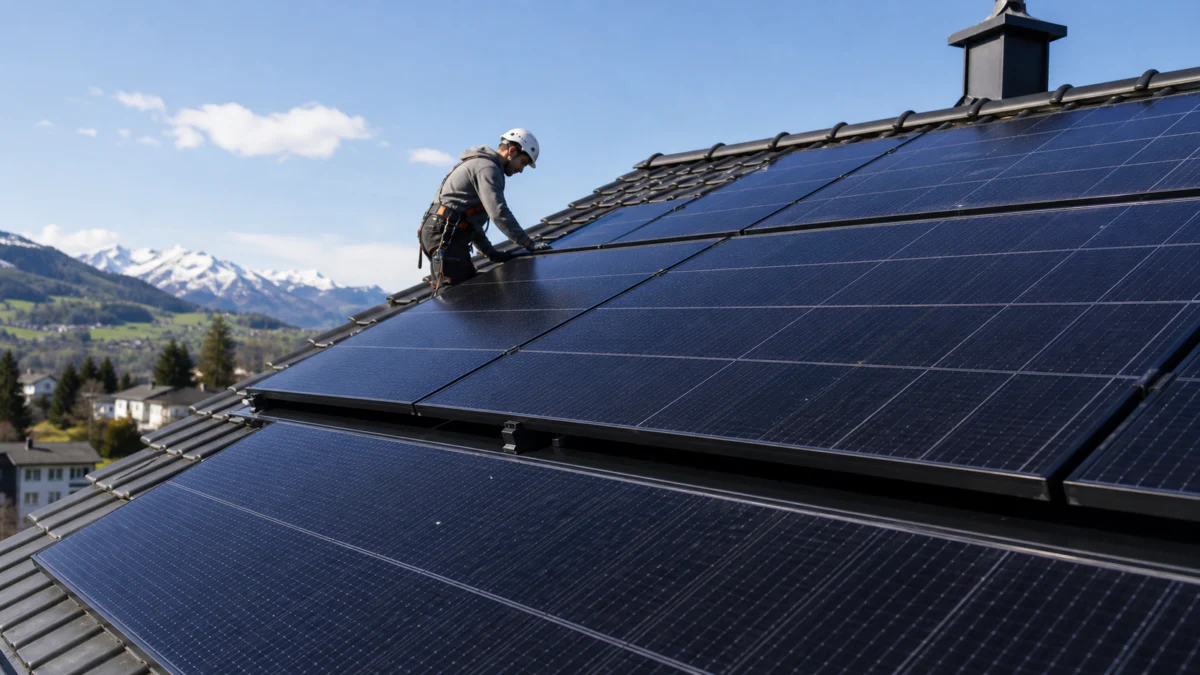
Solar modules are the face of every photovoltaic system – and the part that is most discussed in quotes. Yet it is rarely about the right question: It is not the 'best module' that counts, but the one that suits your roof, your consumption and your budget. This page explains terms, performance, module types, efficiency, quality and prices – so you can read quotes with confidence.
Key points at a glance
The following points summarize the most important information:
- Solar modules convert sunlight into direct current; 'solar panel' means the same thing.
- The output is given in Watt Peak (Wp) – measured under standard test conditions.
- As a rule of thumb, an optimally aligned system in the Swiss Mittelland delivers around 1’000 kWh per 1’000 Wp and year.
- Module size, efficiency and roof area determine the possible system output.
- Glass-glass modules are considered a long-lasting variant; bifacial modules use light from both sides, but are not sensible everywhere.
- The module price alone says little about the quality of the entire system.
This makes the direction clear: The specific subsidy always depends on address, system size, building type and grid operator.
- As of 11.07.2026
- Sources at the end of the article
Solar modules, solar panels, PV modules: What is meant?
The terms are used interchangeably in everyday language – they almost always mean the same thing:
- Solar cell: The smallest element that converts light into electricity.
- Solar module / solar panel / PV module: Many solar cells, connected and packaged in a weatherproof manner. This is the unit that goes on the roof.
- Module area: The physical area of a module – today usually around 2 m² per module.
- kWp (Kilowatt Peak): The rated output of the entire system; it results from module power multiplied by the number of modules.
To be distinguished are solar thermal collectors: they generate heat, not electricity. Details on the page solar thermal collectors.
How much power does a solar module have?
Modern modules for house roofs currently usually range from around 400 to 470 Watt Peak. 'Peak' means: measured under standard test conditions (defined irradiance and temperature in the laboratory). The actual performance in operation depends on weather, season, orientation, tilt, temperature, and shading – on a cool, clear spring day, a module can temporarily even deliver more than in summer heat.
For the annual balance, the Swiss rule of thumb applies: an optimally positioned system in the Swiss Plateau produces around 1’000 kWh per 1’000 Wp and year. The details for your location are shown in a calculation – see Calculate solar system. Key information about each module is listed in the datasheet: rated power, efficiency, temperature behaviour, warranties, and load values.
What types of solar modules are there?
The following table assigns the key points to What types of solar modules are there?:
| Module type | Properties | When is it worthwhile? |
|---|---|---|
| Glass-film | Widely used standard, usually cheaper | Standard roofs with normal load |
| Glass-glass | Cells between two glass panes, robust and long-lasting | High-quality systems, long warranties |
| Bifacial | Uses light from the front and back sides | Flat roof with light gravel covering, elevated and vertical systems, snow reflection |
| Integrated modules | Replace part of the roof surface | New build or roof renovation, design requirements |
| Facade modules | Vertical mounting on the facade | Architecture, winter yield, alpine locations |
For most pitched roofs in the Mittelland, the choice between glass-film and glass-glass is a trade-off between price, warranty, and lifespan. Bifacial modules show their strength where the back side actually receives light – on dark tile roofs with only a few centimetres of clearance, the technology offers little added value.
Size and roof area: How many modules fit on the roof?
The usable area is almost always smaller than the geometric roof area:
- Roof windows, chimneys and dormers interrupt the coverage.
- Safety and edge distances must be observed.
- Shaded areas are deliberately avoided or equipped with optimisers.
- The module format determines the waste – not every area can be fully utilised.
- The orientation determines whether one or multiple roof surfaces are used (east-west coverage distributes production over the day).
As a rule of thumb, around 5–6 m² of roof area are needed per kWp of capacity. A 10-kWp roof therefore requires approximately 50–60 m² – details and price examples on the page Photovoltaic costs per m². The specialist installer creates the roof layout plan; it should be included in every serious quote.
Efficiency: How important is it really?
The efficiency indicates how much of the incoming light a module converts into electricity – current modules are usually between 20 and 23 percent. It is particularly important if the roof area is limited: higher efficiency means more power on the same area.
With a generous roof area, however, the price-performance ratio often counts for more than the last percentage point of efficiency. And what matters most is the total yield of the system – which depends not only on the module but also on orientation, shading, inverter and design. A top-tier module on a poorly planned roof loses to a standard module on a well-planned one.
What do solar modules cost?
Modules are only part of the total costs – installation, inverter, scaffolding, electrical work, and planning together make up the larger share. Module prices themselves fluctuate with the world market and have fallen significantly in recent years.
Therefore: When comparing quotes, you should not look at the amount in francs per module in isolation, but at the overall package – with clear mention of manufacturer, model, output, warranty and origin. You can find market reference values for complete systems on the Photovoltaic costs per m² page.
How can quality and warranties be assessed?
For a component that remains on the roof for 25 to 30 years, warranties and tested quality matter more than the last price advantage:
- Product warranty: Covers material and workmanship defects – typically 12 to 25 years today, often at the upper end for glass-glass modules.
- Performance guarantee: Ensures that the module still delivers a defined proportion of its rated output after, for example, 25 or 30 years (often 85–90 %).
- Manufacturer stability: A warranty is only as valuable as the company behind it.
- Standards and certifications: Photovoltaic modules are tested according to internationally recognised standards, including IEC 61215 (design and performance) and IEC 61730 (safety).
- Snow and wind load: The data sheet lists the tested load values – a must-see in snowy areas.
- Warranty terms: Who covers dismantling, transport, and reinstallation in the event of a warranty claim? This is stated in the fine print and varies significantly.
For the binding assessment, the specific situation of the building and the practice of the responsible authority ultimately count.
What should you look for in the quote?
Before requesting a quote, this information should be available so that the subsidy and cost-effectiveness can be checked properly:
- Module manufacturer named?
- Model and output (Wp) specified?
- Glass-glass or glass-film?
- Product warranty (years)?
- Performance warranty (years and percentage)?
- Number of modules?
- Total capacity in kWp?
- Is a roof occupancy plan included?
- Has shading been taken into account?
- Inverter suitable for the module configuration?
How to assess a quote overall is explained on the photovoltaic system offer page; the role of the inverter is explained on the inverter for photovoltaics page.
What mistakes are frequently made with solar modules?
The following list summarises the key points on What errors frequently occur with solar modules?:
- Only looking at the wattage per module instead of the overall design.
- Choosing the cheapest modules without checking warranties and manufacturers.
- Overestimate the usable roof area and calculate with too many modules.
- Not reading warranty terms (who pays for the replacement?).
- Consider module quality in isolation and ignore the inverter and mounting system.
- Use bifacial modules on surfaces where the back side receives no light.
For the binding assessment, the specific situation of the building and the practice of the responsible authority ultimately count.
solar-guide.ch recommends: Always assess modules as a package – manufacturer, model, output, product and performance warranty must be included in the quote. Two offers with “420-Wp-modules” can differ significantly in lifespan and warranty value. With limited roof space, higher efficiency is worth it; with generous space, the price-performance ratio usually decides. And ask to see the roof layout plan – it makes visible what actually fits on the roof.
What is ultimately decisive for solar modules?
Solar modules are mature, long-lasting and have become significantly cheaper in recent years. The art lies not in finding the 'best' module, but in the right combination of module type, roof area, inverter and design – documented in a quote with clear details on model, output and warranties.
Would you like to know which solar modules suit your roof? You can submit your request free of charge and without obligation via solar-guide.ch. Your request will be forwarded to a maximum of three suitable specialist installers in your region.
Request quotes free of charge and without obligation
Frequently asked questions and answers
What is the difference between a solar module and a solar panel?
None – both terms refer to the same component: many interconnected solar cells in a weatherproof frame. “PV module” also means the same thing.
How big is a solar module?
Many common modules for house roofs are currently roughly 1.7 to just over 2 m² in size and weigh approximately 20 to 25 kg depending on the design. For every kWp of output, about 5–6 m² of roof area is required.
How much power does a solar panel have?
Current modules are typically in the range of 400 to 470 Watt Peak. In the Swiss Mittelland, an optimally oriented system yields approximately 1’000 kWh per 1’000 Wp and year as a rule of thumb.
Are glass-glass modules better?
They are considered more robust and durable and often come with longer warranties – however, they are usually slightly more expensive and heavier. Whether the surcharge is worth it depends on the roof, budget, and warranty requirements.
What do solar modules cost?
Module prices fluctuate with the world market and make up only part of the total costs. More meaningful are the costs of the complete system – see the guidelines on the page Photovoltaic Costs per m².
What should I look for in the quote?
Clear information on manufacturer, model, output, product and performance warranty, number of modules, total output in kWp, and the roof layout plan. Details: photovoltaic system offer.
Sources and further information
The following official bodies provide further information:
- Swissolar: Components of a photovoltaic system
Average: 4.7 out of 5 stars (10 ratings)