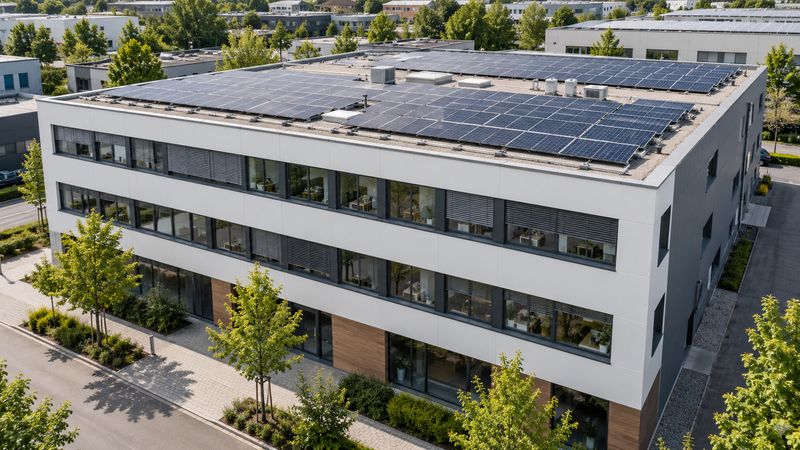
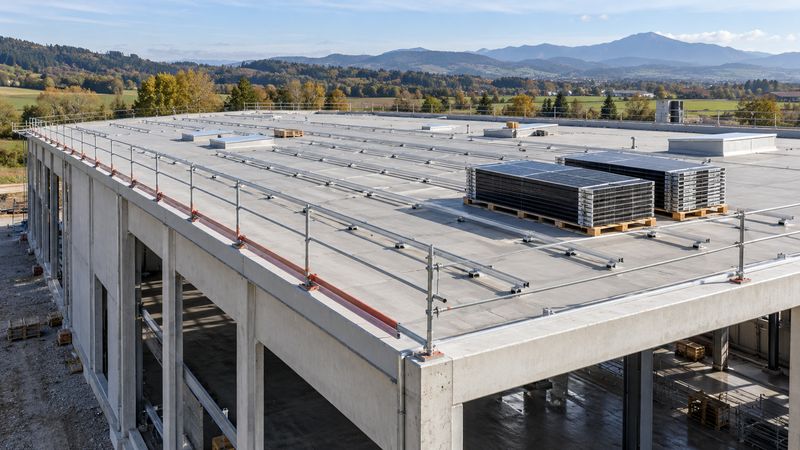
For photovoltaic systems of 100 kW or more, the Confederation pays the large one-off payment (GREIV). A mounted 150 kW system commissioned in 2026 receives CHF 44’300, around a quarter of the usual investment. You can submit the application to Pronovo even before construction.
Key points at a glance
- GREIV applies to systems with self-consumption and a capacity of 100 kW or more. Below 100 kW, the small one-off payment (KLEIV) applies.
- In 2026, there is no base contribution, only a capacity-based contribution: CHF 360, 300 and 250 per kW, applied pro rata by capacity band (mounted systems).
- Bonuses come on top, for example CHF 250 per kW above previously uncovered car parks.
- Once the commitment has been issued, a rooftop system must be commissioned within 12 months. You report commissioning within 3 months.
- As of 25.10.2026: Energy Promotion Ordinance (EnFV), Annex 2.1, version of 01.07.2026. The draft for 2027 only increases the band below 30 kW.
- As of 25.10.2026
- Sources at the end of the article
Who is eligible for GREIV?
You are eligible if you operate a new photovoltaic system with a capacity of 100 kW or more and consume all or part of the electricity yourself. What counts is the DC peak output of the modules, not the output of the inverters.
The applicant is the operator of the system. This can be the owner of the property or a third party, such as a contractor. If you do not own the land, you need the landowner’s consent.
Three special cases are worth knowing:
- Extensions: If you extend an existing system by 100 kW or more, GREIV applies to the extension. An extension of less than 100 kW counts as a small system, even if the total capacity then exceeds 100 kW.
- Waiver: If you waive the capacity-based contribution for the capacity above 100 kW, your system is treated as a small system.
- Minimum size: An extension is only subsidised if it increases the capacity by at least 2 kW. It then receives only a capacity-based contribution for the additional capacity.
How the one-off payment works in general is explained in the guide to Pronovo subsidies for photovoltaics. For an overview aimed at businesses, see Solar panels for business.
KLEIV, GREIV and HEIV compared
Which one-off payment applies depends on two questions: how large is the system, and do you consume the electricity yourself?
| Programme | For which systems | Amount in 2026 | Application |
|---|---|---|---|
| Small one-off payment (KLEIV) | 2 to under 100 kW, with or without self-consumption | Capacity-based contribution CHF 360 and 300 per kW (mounted) | after commissioning |
| Large one-off payment (GREIV) | 100 kW or more, with self-consumption | as KLEIV, plus CHF 250 per kW from 100 kW | before or after commissioning |
| High one-off payment (HEIV) | 2 to 149.99 kW, without self-consumption | CHF 450 per kW | below 100 kW after commissioning, from 100 kW also before |
| HEIV by auction | 150 kW or more, without self-consumption | own bid, 4th round 2026: maximum CHF 620 per kW | bid before construction, project ready to build |
HEIV only pays off if you genuinely do not use the electricity yourself. You commit to feeding the entire output into the grid for 20 years. For businesses that consume electricity during the day, GREIV is almost always the better choice, because every kilowatt hour consumed on site replaces grid electricity.
For systems of 150 kW or more without self-consumption, there is no fixed rate. Pronovo awards the subsidy by auction, with four bidding rounds in 2026. In the round closing on 01.08.2026, 57 of 67 bids were successful, totalling 22.95 MW. The fourth round runs from 18.10. to 01.11.2026 with a volume of 50 MW. After the award, you have 24 months to commission the system. When a system that feeds all its output into the grid pays off is explained in the guide Photovoltaic power plants for business and industry.
How much is the one-off payment for large systems?
In 2026, the one-off payment consists solely of a capacity-based contribution per kW. It is calculated pro rata across three capacity bands: the rate is highest for the first 30 kW and lowest for capacity from 100 kW.
| Capacity share | Mounted or free-standing system | Integrated system |
|---|---|---|
| below 30 kW | CHF 360 per kW | CHF 400 per kW |
| 30 to under 100 kW | CHF 300 per kW | CHF 330 per kW |
| 100 kW or more | CHF 250 per kW | CHF 250 per kW |
| Base contribution | CHF 0 | CHF 0 |
The rates apply to systems commissioned from 01.04.2025. What counts is the commissioning date, not the application date. Integrated systems replace the roof covering, for example as in-roof systems. Large integrated systems have only had their own rates since 01.04.2025; before that, they received the rates for mounted systems.
The law caps the one-off payment for systems with self-consumption at 30% of the investment costs of reference systems. According to the explanatory report of the Federal Department of the Environment, Transport, Energy and Communications (DETEC), the subsidy currently covers 20–25% for larger systems.
What changes in 2027?
From 15.04. to 15.07.2026, DETEC put an amendment to the Energy Promotion Ordinance out to consultation. The explanatory report is titled “Änderung vom November 2026” (amendment of November 2026). The ordinance is due to enter into force on 01.01.2027.
The plan: for systems commissioned from 01.04.2027, the capacity-based contribution for the share below 30 kW rises by CHF 40 per kW, to CHF 400 (mounted) and CHF 440 (integrated). The rates from 30 kW stay the same. A large system therefore receives at most CHF 1’200 more.
As of 25.10.2026, it was not yet clear whether the Federal Council had adopted the amendment in this form. Until then, the rates in the table above apply. For a company system, this change is hardly a reason to postpone construction.
What bonuses are available for large systems?
Three bonuses increase the capacity-based contribution. They only apply to the part of the system that meets the condition.
| Bonus | Condition | Amount |
|---|---|---|
| Tilt angle bonus | Modules with a tilt of at least 75 degrees, for example on the façade | CHF 200 per kW (mounted), CHF 400 per kW (integrated) |
| Winter electricity bonus | 100 kW or more, in operation from 01.01.2026, over 500 kWh per kW in winter | CHF 2.50 per kW for each kWh per kW above 500 (with self-consumption) |
| Car park bonus | 100 kW or more, above a permanent, previously uncovered car park | CHF 250 per kW |
The winter electricity bonus is only calculated after three full winter half-years (01.10. to 31.03.), based on their average. According to DETEC’s explanatory report, a system on the Swiss Plateau achieves around 350 kWh per kW in winter and receives no bonus. A winter-optimised system in the Pre-Alps producing 600 kWh per kW receives CHF 250 per kW. You cannot combine the winter electricity bonus with the tilt angle bonus.
If you apply for the winter electricity bonus, you must submit a detailed statement of construction costs after the first full year of operation.
Application: before or after commissioning?
With GREIV, you have the choice. You submit the application online via the Pronovo customer portal, either yourself or through an authorised specialist installer.
Application before construction: You submit the planned capacity, category, planned production, commissioning date and a land register extract no more than one year old. If funds are available, Pronovo grants the one-off payment in principle. The following commissioning deadlines then apply.
- 12 months for systems on or attached to a building.
- 48 months for systems not attached to a building.
- 6 years if spatial planning has to be amended for the system.
Application after construction: If the system is already in operation, Pronovo sets the remuneration directly once the complete commissioning notification has been received.
In both cases, you report commissioning within three months. This includes the acceptance report or the safety certificate with measurement and test report, and the certified system data. Pronovo only calculates the amount afterwards, based on this data.
Applications are processed in order of submission date. If funds are insufficient, your project is placed on a waiting list for large systems. Applying early therefore secures you a better place in the queue.
After payment, the system must be operated for 20 years. If you dismantle or downsize it before then, Pronovo reclaims part of the remuneration.
Can GREIV be combined with cantonal subsidies?
In many cases, yes. Cantons, municipalities and energy suppliers run their own programmes, for example for battery storage, façade systems or winter electricity. The conditions vary widely. Many programmes require you to apply before construction starts.
Two points apply to all businesses:
- VAT: Pronovo pays the one-off payment without VAT. It counts as a cost compensation payment.
- Profit tax: Each canton decides how the remuneration is treated in the accounts and for depreciation. Clarify this with your fiduciary or accountant.
What the system itself costs and how the subsidy affects the payback period is explained in the guide Solar system costs for businesses.
Worked example: one-off payment for a 150 kW system
A commercial business installs a mounted 150 kW system on its flat roof. It consumes part of the electricity itself. Commissioning in 2026, no bonus.
| Capacity share | Calculation | Capacity-based contribution |
|---|---|---|
| 0 to under 30 kW | 30 kW × CHF 360 | CHF 10’800 |
| 30 to under 100 kW | 70 kW × CHF 300 | CHF 21’000 |
| 100 to 150 kW | 50 kW × CHF 250 | CHF 12’500 |
| One-off payment (EIV) | CHF 44’300 |
For comparison, the investment: according to the SwissEnergy price monitoring study, a 150 kW rooftop system costs around CHF 178’000 excluding VAT (2025 cost curve). GREIV therefore covers around 25%.
How the amount changes in other cases:
- Integrated system: 30 × 400 + 70 × 330 + 50 × 250 = CHF 47’600.
- Above a car park: an additional 150 kW × CHF 250 = CHF 37’500, total CHF 81’800.
- Commissioning from 01.04.2027, if the Federal Council adopts the draft: CHF 1’200 more, total CHF 45’500.
- Without self-consumption: at 150 kW, the system falls under the auction scheme. At 149.99 kW, HEIV applies at CHF 450 per kW, i.e. around CHF 67’500. In return, you sell all the electricity at the feed-in tariff and save no grid electricity.
You only receive the one-off payment after commissioning. Plan your financing for the full amount.
| Value | |
|---|---|
| 0 to under 30 kW | CHF 10’800 |
| 30 to under 100 kW | CHF 21’000 |
| 100 to 150 kW | CHF 12’500 |
| Total one-off payment | CHF 44’300 |
The one-off payment is made up of three capacity shares: CHF 360 per kW up to 30 kW, CHF 300 per kW up to 100 kW and CHF 250 per kW for the rest. Calculated for a mounted system commissioned in 2026, without bonus.
Source: Own calculation by solar-guide.ch based on the 2026 rates of the Energy Promotion Ordinance, Annex 2.11
Frequently asked questions and answers
Can I apply for GREIV after construction?
Yes. For large systems, you can apply before or after commissioning. After construction, you submit the application together with the complete commissioning notification. Applying before construction secures your place in the queue earlier, but commits you to commissioning within 12 months.
How long does it take for the one-off payment to be paid?
Pronovo processes applications in the order received, as soon as funds are available. The latest information on Pronovo’s website concerns 2025: all applications submitted in full by 31.10.2025 were to be approved and paid in the same year. Pronovo gives no deadline for 2026 (retrieved 25.10.2026).
Does GREIV also apply to extensions above 100 kW?
Yes, if the extension itself comprises at least 100 kW. Only the additional capacity is then subsidised, without a base contribution. An extension of less than 100 kW counts as a small system, even if the total capacity then exceeds 100 kW.
Should I wait until April 2027 to build?
For company systems, usually not. The draft only increases the rate for the first 30 kW. A 150 kW system would receive CHF 1’200 more, just under 3% of the remuneration. Half a year of solar electricity is usually worth more.
Who receives the one-off payment under contracting?
The operator of the system, which under contracting is usually the contractor. The contractor factors the remuneration into its electricity price. Find out more in the guide Solar contracting and roof leasing.