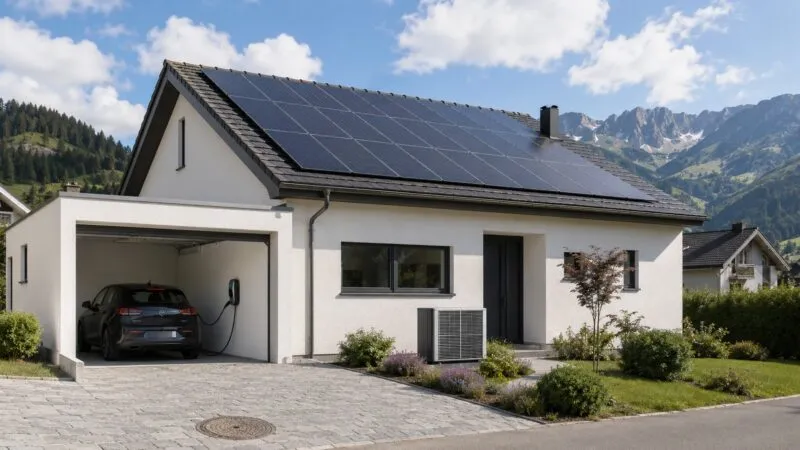
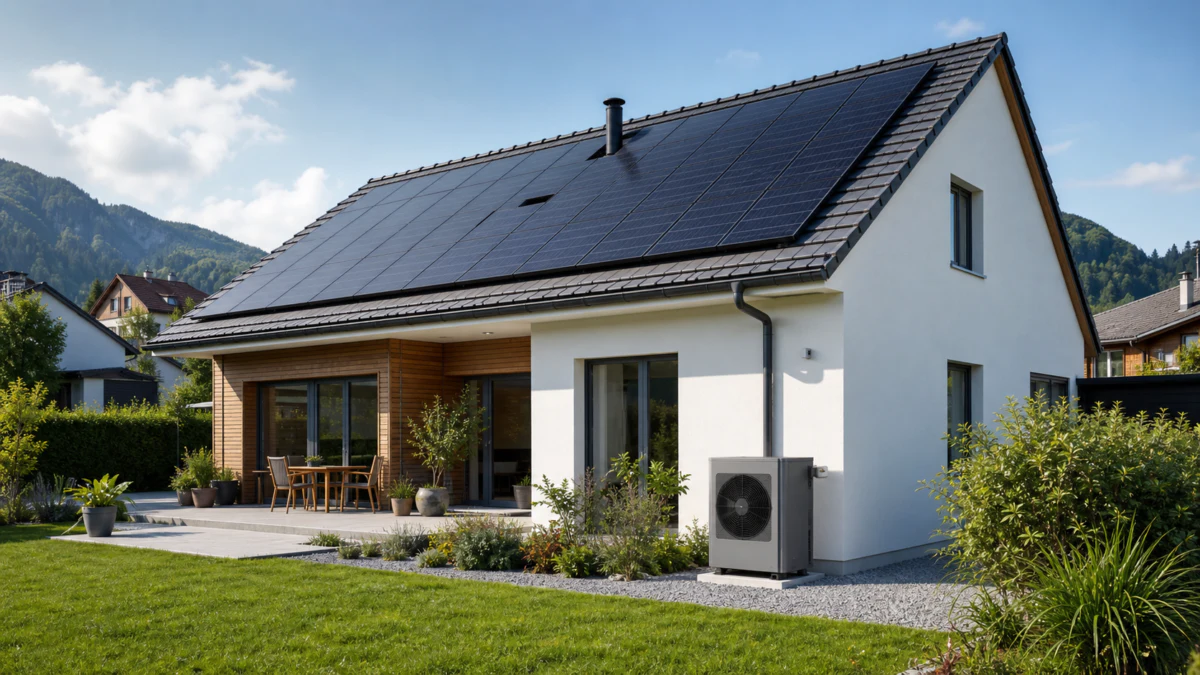
A solar system with heat pump can be a very sensible combination. The photovoltaic system produces electricity on your own roof. The heat pump uses electricity to provide heat for heating and hot water. This allows part of the self-produced solar power to be used directly in your own home.
This combination is particularly interesting for owners who want to renew their heating, increase the self-consumption of the photovoltaic system or reduce long-term energy from fossil sources. However, it is important: A solar system does not automatically fully supply a heat pump all year round. Especially in winter, the electricity demand of the heat pump is high while the photovoltaic system produces less.
Therefore, good planning, appropriate sizing and a realistic view of the building, consumption, roof area, battery storage and control system are essential. Those who would like to put the basics of photovoltaic systems in Switzerland into context again will find a suitable overview there.
Key points at a glance
The most important points can be summarised as follows:
- A heat pump increases the electricity consumption in the house but also offers more opportunities for self-consumption.
- Solar power can be partially used for heating and hot water.
- The more solar power is consumed directly, the better the photovoltaic system can perform economically.
- In summer and during the transition period, this combination is particularly suitable.
- In winter, grid electricity usually remains important.
- A hot water storage tank or heating buffer can help store solar electricity indirectly as heat.
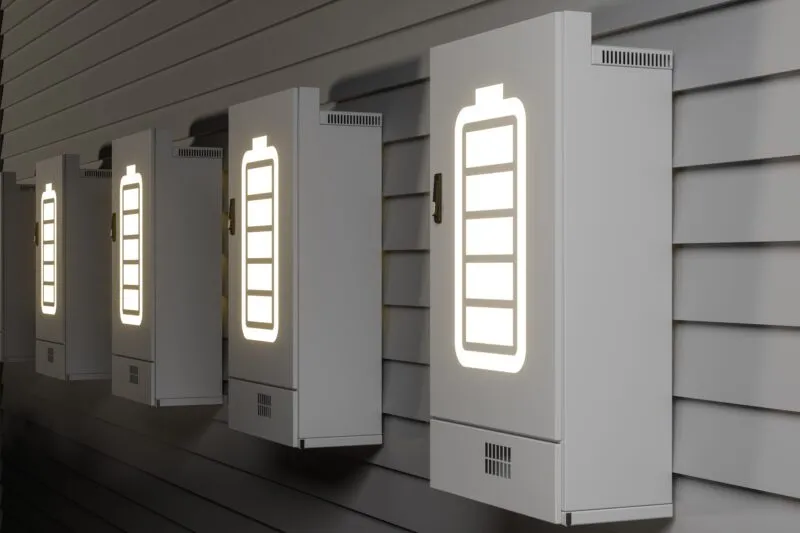
- A battery storage system can complement the setup but is not automatically necessary.
- Building condition, insulation, flow temperature, roof area, control system and quote are important.
These points already show: the combination is not a single product, but a complete system comprising power generation, heat, consumption, and control.
- As of 13.07.2026
Why a solar system and a heat pump work well together
Photovoltaics and heat pumps complement each other well technically. The photovoltaic system generates electricity. The heat pump requires electricity to make use of environmental heat from air, soil or water for heating and hot water.
The central advantage lies in self-consumption. Solar electricity does not have to be used only for household appliances or fed into the grid. It can also help generate heat. This increases self-consumption and better integrates the photovoltaic system into the entire energy system of the house.
The combination is particularly sensible when the heat pump, hot water preparation, and photovoltaic system are planned together. The control can then be designed so that the heat pump preferentially operates when a lot of solar power is available.
The main advantages of a solar system with a heat pump
The combination offers several advantages, which vary in strength depending on the building:
| Advantage | Explanation |
|---|---|
| Higher self-consumption | More solar power is used directly in your own home. |
| Less grid electricity consumption | Depending on consumption and season, less electricity needs to be purchased. |
| Less fossil energy | Oil or gas heating systems can be replaced by a renewable heating solution. |
| Better use of the roof area | Solar electricity is used not only for household purposes but also for heat. |
| Hot water with solar power | Especially in summer, hot water can be produced well with own solar power. |
| Greater planning certainty | Part of the energy demand is covered by your own system. |
| Good foundation for e-mobility | PV, heat pump and wallbox can be planned together. |
The combination is particularly interesting when a heating renovation is already planned. Anyone replacing an old oil or gas heating system can significantly reduce fossil fuel energy consumption with a heat pump. The photovoltaic system provides part of the required electricity.
How does the combination work technically?
A photovoltaic system generates direct current on the roof. This is converted into usable household electricity by the inverter. The electricity can then be consumed directly in the house.
Typical consumers in the building are:
- Household appliances
- Lighting
- Heat pump
- Domestic hot water preparation
- Battery storage
- Wallbox for the electric car
- other electrical consumers in the house
If the photovoltaic system produces more electricity than is currently being consumed, the surplus can be fed into the grid or stored in a battery storage unit. Additionally, the heat pump can be controlled so that it preferentially charges hot water or a buffer tank when there is plenty of solar power available.
From an energy efficiency perspective, it is usually more sensible to convert solar electricity into heat via a heat pump than to generate heat purely electrically. However, the key factor is that the control system must be compatible with the installation, the storage unit, and the consumption profile.
Self-consumption: The major advantage of the heat pump
For a photovoltaic system, self-consumption is particularly important. Self-consumption means: The solar electricity produced is used directly in the own building.
Without major electricity consumers, a portion of the solar power is frequently fed into the grid. With a heat pump, the electricity demand in the house increases. This can improve the self-consumption ratio, provided that the heat pump is integrated intelligently.
This works particularly well for these applications:
- Domestic hot water preparation during the day
- Charging the heating buffer with surplus solar power
- Operation during the shoulder season
- Combination with energy management
- Coordination with battery storage or electric car
However, realistic expectations are important. A heat pump does not automatically run exactly when the sun shines. Therefore, appropriate control and a sensibly planned storage concept are required.
Summer, winter and transitional period
The combination of a solar system and a heat pump works differently depending on the season:
| Season | PV production | Heat pump requirement | Assessment |
|---|---|---|---|
| Summer | high | low to medium | very good for hot water |
| Spring | medium to high | medium | often a very good combination |
| Autumn | medium | medium | Self-consumption well possible |
| Winter | low | high | Grid power usually remains important |
In summer, the photovoltaic system produces a lot of electricity, while the heat pump is mainly needed for hot water. This combination works well together.
During the transition period, the combination can be particularly interesting because heating is still being used and at the same time relevant amounts of solar electricity are already or still being produced.
In winter, the situation is different. The heat pump requires more electricity, while the photovoltaic system produces less. Therefore, no quote should suggest that a PV system will fully supply the heat pump in winter. A calculation over the entire year is more reliable.
Heat pump, hot water tank and battery storage
When combining a solar system and a heat pump, it is not just about storing electricity. Heat can also be stored.
A hot water storage tank or heating buffer can make surplus solar power indirectly usable. The heat pump generates heat when solar power is available, and this heat is stored for later use. This can be cheaper and simpler than a very large battery.
The main types of storage can be categorised as follows:
| Storage type | Function | When is it worthwhile? |
|---|---|---|
| Hot water storage tank | stores heat for hot water | often very relevant |
| Heat buffer | stores heat for heating | dependent on the heating system |
| Battery storage | stores electricity | check for evening consumption or a low feed-in tariff paid by the grid operator |
| Electric car | flexible electricity consumer | interesting for planned charging |
A battery storage unit can complement the combination. However, it is not automatically necessary. For many buildings, it should first be checked how much self-consumption is already possible through the heat pump, hot water, electric car, and load management.
Which heat pump suits the solar system?
For the combination with photovoltaics, various heat pump types are suitable:
| Heat pump type | Typical application | Note |
|---|---|---|
| Air-to-water heat pump | common in renovations | relatively easy to implement |
| Brine-to-water heat pump | use of geothermal energy | efficient, but more permit-intensive |
| Water-to-water heat pump | Use of groundwater | strongly location-dependent |
| Domestic hot water heat pump | Domestic hot water preparation | Interesting addition to PV |
Which heat pump is suitable in individual cases depends on the building, the plot of land, the existing heat distribution and the cantonal regulations. In practice, the air-water heat pump is common for renovations because it is relatively easy to implement.
What you should pay attention to during planning
A solar system with a heat pump should not be planned in isolation. The overall system is what matters.
Important questions for planning are:
- How well is the building insulated?
- How high is the heating demand?
- What supply temperature does the heating system require?
- Is there underfloor heating or radiators?
- How large is the usable roof area?
- What is today’s electricity consumption?
- How much does the electricity consumption increase due to the heat pump?
- Should hot water run through the heat pump?
- Is an electric car or a wallbox planned?
- Is a battery storage system worthwhile?
- Is there a hot water storage tank or heating buffer?
- Which feed-in tariffs apply with the grid operator?
- Which subsidies are applicable?
The flow temperature is particularly important. A heat pump operates more efficiently if the building can be heated with low flow temperatures. This is often easier with underfloor heating than with old radiators. During renovations, the condition of the building should therefore also be checked.
New build or renovation: Where is the combination particularly sensible?
Depending on the initial situation, the planning differs significantly:
| Situation | Assessment |
|---|---|
| New build | very easy to plan, systems can be coordinated from the start |
| Heating renovation | often sensible when replacing oil or gas |
| Roof renovation | ideal time for photovoltaics |
| existing photovoltaic system | A heat pump can be added later |
| existing heat pump | Photovoltaics can increase the share of self-generated electricity |
| poorly insulated building | Check the condition of the building first |
In new construction, photovoltaics, heat pump, hot water, storage and e-mobility can be planned together particularly well. In a renovation, the combination is also interesting if the roof and heating are being renewed anyway.
If the building is poorly insulated or requires very high flow temperatures, it should first be checked whether additional measures to the building envelope or heat distribution are sensible.
Subsidies for solar system and heat pump
For photovoltaic systems, the one-off payment via Pronovo is central in Switzerland. Subsidies for heat pumps, on the other hand, vary by canton and municipality. Energy suppliers may also offer their own programmes. Therefore, subsidies should always be checked on a location-specific basis.
A good starting point is the overview of the Pronovo subsidy and the summary of photovoltaic subsidies in Switzerland. For cantonal and municipal programmes, the specific location should also be checked.
Important: Subsidies are often subject to conditions, deadlines and applications. Therefore, they should be checked before implementation.
Typical errors with solar system and heat pump
Common errors are:
- Plan PV system and heat pump separately
- Selecting a heat pump without building analysis
- Underestimating the flow temperature
- Planning a hot water storage tank that is too small or unsuitable
- do not provide for intelligent control
- Oversizing the battery storage
- Underestimating winter electricity demand
- Do not check the feed-in tariff paid by the grid operator
- Submit subsidy applications too late
- Obtain only one quote
Especially when combining several systems, a careful comparison is worthwhile. The cheapest individual solution is not automatically the best overall system.
When is a solar system with a heat pump particularly worthwhile?
A solar system with a heat pump is particularly worth considering if several of these points apply:
| Situation | Assessment |
|---|---|
| Oil or gas heating is to be replaced | very interesting |
| sufficient roof area available | Good prerequisite |
| heat pump operates efficiently | important for cost-effectiveness |
| Hot water can be generated during the day | Good for self-consumption |
| An electric vehicle is present or planned | Plan the overall system sensibly |
| Building is well insulated | The heat pump operates more efficiently |
| Roof renovation is due | good time for PV |
| very high winter demand | calculate more precisely |
| small photovoltaic system | Self-sufficiency limited |
The best solution is not always the largest possible system or the biggest battery storage. What matters is that photovoltaics, heat pump, consumption, roof area and control work together.
Comparing quotes: What should be included?
A good quote should not just list individual components. It should show how the overall system works.
Important details are:
- planned PV output in kWp
- expected annual yield
- assumed self-consumption
- Heat pump type
- Heating output
- Hot water concept
- Battery storage or buffer tank
- battery storage, if planned
- Energy management and control
- Inverter
- Metering concept
- Grid connection
- Subsidy assumptions
- Warranties
- Service and maintenance
- Schedule
When several specialist installers create quotes, differences become visible: in sizing, components, storage solution, control, warranties and total price. A good orientation is also provided by the article on the Photovoltaic quote comparison.
Request quotes for a solar system with heat pump
Are you planning a solar system with a heat pump? Then coordinated planning is worthwhile. Via solar-guide.ch, you can submit your request free of charge and without obligation. Your request will be forwarded to a maximum of three suitable specialist installers in your region.
This allows you to receive individual quotes and compare costs, self-consumption, battery storage solutions, and technical recommendations: Compare solar providers.
Conclusion: A strong combination if planned correctly
A solar system combined with a heat pump can be a very sensible solution. The photovoltaic system supplies electricity, and the heat pump uses part of it for heating and hot water. This increases self-consumption, can reduce grid electricity intake and can replace fossil heating energy.
The combination is particularly strong in new construction, during a heating renovation, or when the roof, heating, and energy system are modernised simultaneously. In summer and during the transition period, solar power can be used particularly well for hot water and heating support. In winter, grid electricity usually remains important.
Anyone planning the combination should therefore not only compare individual devices, but consider the entire system: roof area, building condition, heat pump, hot water, battery storage, control, subsidy and quote.
Request quotes free of charge and without obligation
Frequently asked questions and answers
Is a solar system with a heat pump worthwhile?
Often yes. The combination is particularly sensible if there is sufficient roof space, the heat pump operates efficiently, and as much solar power as possible can be used directly in the house.
Can a solar system fully power a heat pump?
Not year-round. In summer and during the transition periods, the photovoltaic system can contribute significantly. In winter, solar production is lower, while the heat pump requires more electricity.
Do you need battery storage for PV and a heat pump?
Not necessarily. A hot water tank or heating buffer can already help to use solar power indirectly as heat. Battery storage may additionally be sensible but should be calculated individually.
Is a heat pump with photovoltaics also sensible during a renovation?
Yes, often the renovation is a good time. However, it is important that the building condition, flow temperature, roof area and existing heat distribution are checked.
When should the heat pump run if solar power is available?
Ideally, it is controlled so that hot water or a buffer tank is preferentially charged during solar power surplus. This improves self-consumption, but does not replace year-round grid power supply.
Should you request a quote for the PV system and heat pump together?
If both systems are planned, a coordinated quote makes sense. This allows performance, storage, control, hot water, grid connection, and subsidy options to be assessed together more effectively.
Average: 5 out of 5 stars (1 rating)