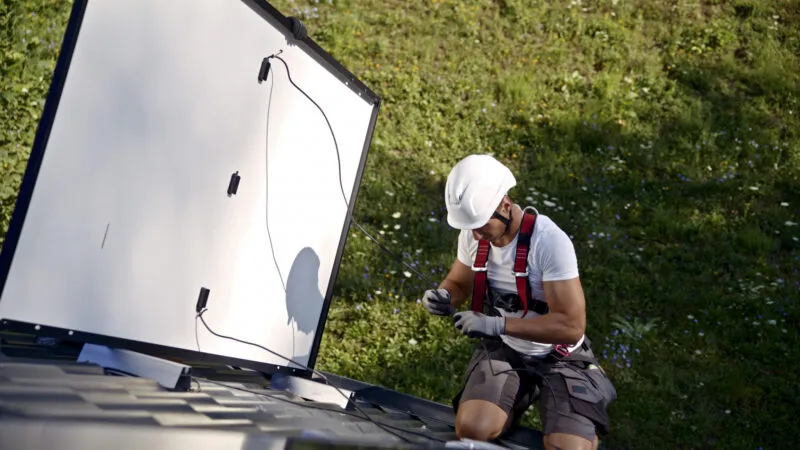
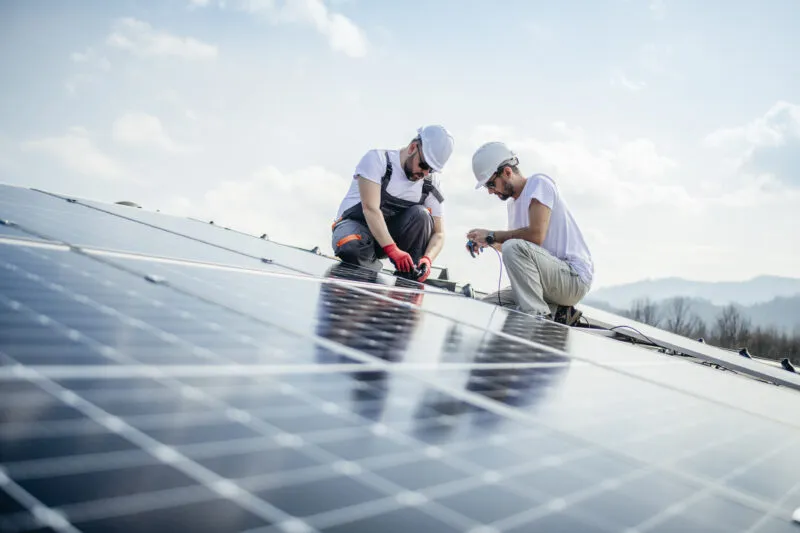
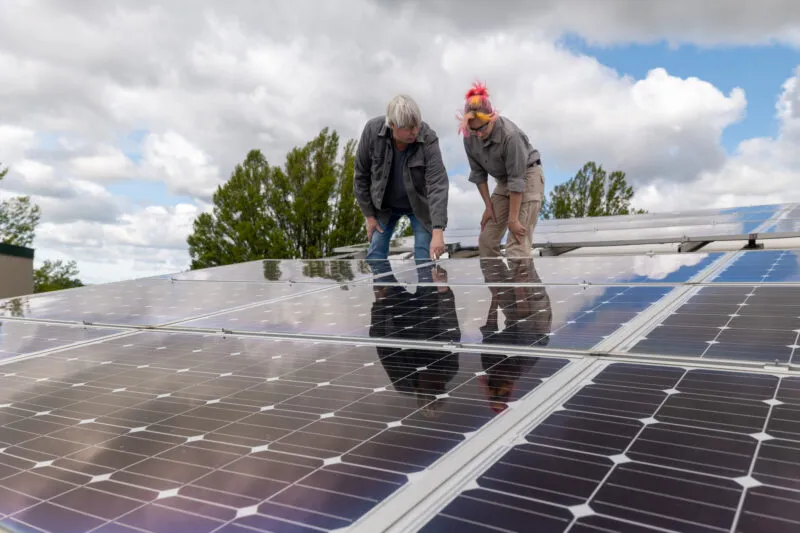
The installation of a photovoltaic system is a long-term investment that should be carefully planned. From selecting the right provider to the final installation, there are numerous aspects to consider. To ensure you are well informed when choosing a photovoltaic company and make an optimal decision, we have compiled seven important points for you. It is worth comparing quotes from different providers to find the best offer.

1. General approach to photovoltaic quotes
Plan your photovoltaic system with sufficient lead time – at least three months for single-family homes and commercial properties, ideally even longer. For apartment buildings, a positive decision from the condominium owners and a correspondingly longer deadline are helpful.
Attach basic information to your quote request, such as the type of roof, desired financing, and the address. Detailed information, such as the year of construction of the house and the age of the electrical installations, is usually requested by the providers after initial contact. Your details give the providers the opportunity to create a precise quote tailored to your needs.
Give the providers sufficient time (2-3 weeks) to prepare a quote. If a building application is required for your system, plan sufficient time for this as well.
2. Qualification and experience of the provider
It is essential to choose a provider that has the necessary know-how and relevant experience.
References and consultation
Ask for references and check the projects implemented by the company so far. A competent provider will not only offer high-quality products, but also ensure professional advice, planning and installation. This usually requires at least two appointments on site. Furthermore, a serious provider does not pressure you to sign, but gives you time to decide.
Membership “Swissolar”
Photovoltaic companies can voluntarily join “Swissolar”. Swissolar is the Swiss professional association for solar energy and sets (minimum) standards for the quality of photovoltaic providers. To become a member of Swissolar, businesses must meet specific requirements: these include a solid professional training, proof of practical experience in the field of solar energy, and a commitment to continuous further education. In addition, companies must adhere to the Swissolar code of conduct, which ensures professional advice, high-quality installation, and fair customer treatment. For their membership, participating businesses must pay an annual fee, which is assessed based on company size.
For those interested, membership of Swissolar can offer advantages: you can be confident that you are relying on a specialist installer certified by Swissolar, who is not only technically proficient but also offers a certain level of service quality. Membership thus serves as a seal of quality and aims to strengthen trust in the provider’s competence and reliability.
In the past, there have also been members who violated Swissolar’s rules and were excluded from the professional association. Newly established companies often cannot take care of certification directly. Please feel free to ask the provider whether they are Swissolar-certified and, if not, what measures they take to ensure a high quality of service.
3. Carefully review and compare quotes
When obtaining quotes for photovoltaic systems, you should always compare at least three different offers. This allows you to better understand the pricing and evaluate the services of the providers in a differentiated manner. Ensure that the quotes are clearly structured and contain no hidden costs. Be particularly cautious if a quote is significantly cheaper than expected.
Check carefully which services are included in the quote and which are not. In case of doubt, have the provider explain any open questions.
4. Warranty terms and service offerings
A reputable provider will offer you comprehensive warranties on both the modules and the installation work. Check which warranties are granted for the individual components (modules, inverter, mounting system). It is also important that the provider remains reachable after the installation of the system and offers service such as maintenance and upkeep. This ensures a long-term reliable operation of your system.
Product warranty
The product warranty refers to the quality of solar modules and other components such as inverters. As a rule, manufacturers of solar modules offer a product warranty of 10 to 15 years. This warranty covers defects or malfunctions in the modules that are attributable to material or manufacturing errors. For inverters, the warranty is typically 5 to 10 years but can often be extended for a fee.
Performance warranty
The performance guarantee secures the minimum efficiency of the solar modules over a specific period. Typically, manufacturers guarantee a minimum output of 90 % of the rated power for the first 10 years and approximately 80 % for a lifespan of 25 years. This means that after 25 years, the modules should still deliver at least 80 % of the originally promised performance.
Installation warranty
In Switzerland, most installation companies offer a warranty on the work performed. This installation warranty is often 2 to 5 years and covers assembly errors or problems caused by improper installation.
Additional warranties
Some providers offer extended warranties or maintenance contracts that cover additional services such as regular inspections, cleaning, or component replacement. These extended warranties may be offered at an extra cost depending on the provider.
5. Transparency of costs
The quote should break down all relevant cost items, such as material costs, installation costs, any additional costs for grid connection, and ongoing costs. Ensure that scaffolding and any work on the roof or electrical connection are clearly defined. A transparent cost breakdown provides you with planning security and helps you better assess the economic viability of your investment.
Costs of a photovoltaic system
6. Down payments, financing options and subsidy funds
Down payment
When purchasing a photovoltaic system in Switzerland, it is often customary for the solar installer to request a financial advance payment. The advance payment serves the provider to finance the materials for the solar system and should not exceed one third of the total investment. In addition, the payment should be linked to a specific consideration, e.g. the delivery of goods to the customer at a specific time. There are also providers who waive an advance payment.
Payment dates and security
- Down payment: The down payment is usually due upon contract signing or shortly thereafter, often together with the planning fee.
- Final payment: You usually only pay the final instalment after successful acceptance and commissioning of the system.
- Risk mitigation: For high down payments, request a down payment guarantee (bank or insurance-backed guarantee) to minimise your risk in the event of delivery failures and/or check the debt enforcement register.
During the quote process, you must definitely discuss what level of down payment is agreed upon and how this affects possible financing or subsidy models. A transparent payment arrangement demonstrates reliability and creates planning security.
Subsidies
In Switzerland, there are state subsidies, which can vary depending on the canton and municipality. Let the provider advise you on this point. It is best to inform yourself in advance about the current subsidy programmes available in your municipality. Check whether the provider takes these subsidies into account when preparing the quote.
Financing
Good advice on financing options shows that the provider is familiar with the circumstances and wants to offer you the most cost-efficient solution possible.
In general, there are the following options:
Purchase of the photovoltaic system: When purchasing a photovoltaic system, you acquire the system entirely and bear the costs for acquisition, installation, and maintenance yourself, but benefit long-term from savings and state subsidies.
Rent: In the case of a rental, you pay a monthly fee for the use of the system, while the provider remains the owner and is responsible for installation, maintenance and any repairs.
Contracting: In contracting, an external service provider takes over the financing, installation, and maintenance of the system, while you purchase the generated solar power at a contractually agreed price and may have the option to buy the system after a certain term.
7. Consider future developments
A reputable provider will not only discuss the current planning of the photovoltaic system with you, but also consider possible future developments. These include, for example, expansion options for the system, a storage system for self-consumption, or the integration of charging stations for electric vehicles. Forward-looking planning ensures that your system can be flexibly adapted to future requirements.
Extensions for photovoltaic systems
Conclusion
The decision to install a photovoltaic system is a forward-looking investment. To ensure that you make the right choice, it is advisable to carefully compare the offers from various companies. A structured process, qualified specialists, and transparent quotes are the basis for a smooth implementation of your project. Use the provider comparison and the option to obtain multiple photovoltaic quotes – this makes your project more secure and leads to a sustainable investment in your own power supply.
Average: 4.6 out of 5 stars (20 ratings)