An electric car is one of the largest electricity consumers in the household – and at the same time one of the most flexible. Charging it during the day with electricity from your own roof reduces charging costs and increases the self-consumption of the PV system. This page shows how a wallbox and photovoltaics work together, what PV surplus charging means, what costs are incurred, and what to consider during installation.

Key points at a glance
The following points summarize the most important information:
- For charging at home, a wallbox is the safer and more efficient solution than a regular socket.
- With photovoltaics, part of the electricity for an electric car can come from your own roof – as a guideline: an electric car requires on average around 3’000 kWh per year.
- PV surplus charging increases self-consumption and reduces charging costs.
- Charging times, driving profile, PV size and control via an energy management system are decisive.
- A battery storage system is not strictly necessary – the electric car is itself a large, flexible consumer.
- The wallbox should be compatible with the inverter, smart meter and energy management system.
This makes the direction clear: The specific subsidy always depends on address, system size, building type and grid operator.
- As of 11.07.2026
- Sources at the end of the article
Why do wallbox and photovoltaics go well together?
Solar yield occurs during the day – and an electric car parked at home during the day can absorb this electricity directly. Instead of feeding the surplus into the grid at the lower feed-in tariff paid by the grid operator, you charge it into the vehicle, thereby replacing more expensive charges from the grid or at public stations.
The combination works particularly well in the following cases:
- Home office – the car is parked when the sun shines.
- Second cars that do not drive long distances daily.
- Planned charging times, for example on weekends or days off.
Anyone whose car is exclusively at home at night can still benefit from solar power – then via battery storage or time-controlled charging. However, these cases require different planning.
How does PV surplus charging work?
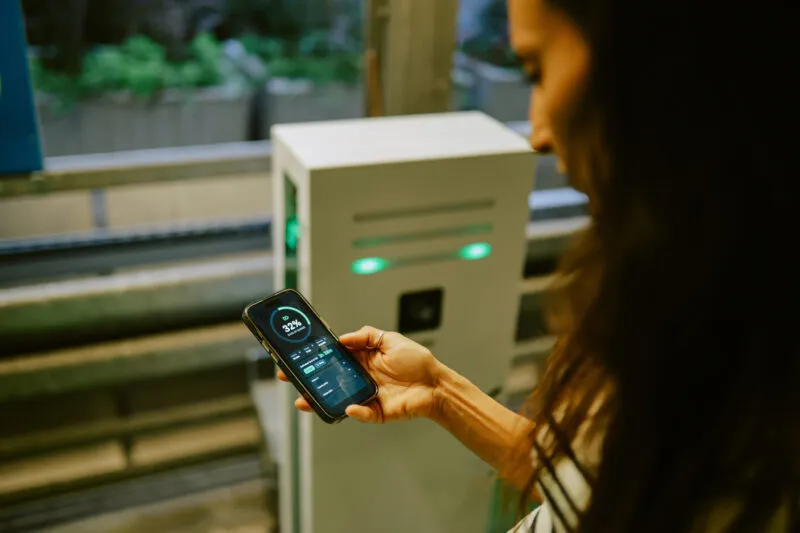
With surplus charging, only (or primarily) the electricity that the household does not currently need flows into the car. The energy management system continuously measures production and consumption and dynamically adjusts the Wallbox’s charging power. If the surplus is insufficient, grid electricity can be added depending on the settings – or the charge pauses:
| Charging mode | Explanation | Suitable for |
|---|---|---|
| Fast charging | The car charges directly with the set or technically available charging power | When the car needs to be charged quickly |
| PV surplus charging | Charging only/primarily with solar surplus | Plannable charging times, car at home during the day |
| Mixed loads | Solar power plus grid power as needed | Everyday use with guaranteed minimum charge |
| Time-controlled charging | Charging at defined times | Favourable tariffs, home office rhythm |
The overview serves as a guide and should be checked against your specific project conditions.
How large should the PV system be for an electric car?
The starting point is electricity demand: With an annual mileage of around 15’000 km and consumption of about 20 kWh per 100 km (including charging losses), an electric car requires approximately 3’000 kWh per year – this roughly corresponds to the annual yield of 3 kWp additional PV capacity in the Swiss Plateau.
Important: Do not plan the car in isolation, but the overall system. Household electricity, a potential heat pump and the electric vehicle together determine the sensible system size. The page Calculating a solar system shows how this can be estimated; the basics for sizing are on the page Solar system for a single-family home.
How much does a wallbox with photovoltaics cost?
The costs consist of several items – blanket statements are too simplistic. Regarding the structure:
- Wallbox (device, 11 kW or 22 kW, PV-capable)
- Installation and electrical installation (high-voltage connection, cable route)
- Protection (RCD protection, circuit protection)
- Meter / Smart Meter depending on the measurement concept
- Energy management for surplus charging
- Load management with multiple charging points
- App / backend depending on the manufacturer
- Notification to the grid operator (depending on output, subject to notification or permit requirements)
- Optional: bidirectional wallbox (significantly more expensive, a future topic)
As a guideline for an 11-kW wall box including installation, around CHF 2’000–3’000 are considered in Switzerland; PV surplus charging and more complex cable routes can increase the amount. The specific figure belongs in the quote.
What should be considered when installing a wallbox?
The following list summarizes the key points regarding What to consider when installing a wallbox?:
- Three-phase power connection: A wallbox requires a 400-V connection with its own fuse.
- Cable length and location: garage, carport or exterior wall – the cable route influences the costs.
- Charging power: 11 kW is sufficient for most households in everyday use. 22 kW should only be planned if the vehicle, house connection, and grid operator allow it; depending on the grid operator, a permit may be required for this.
- Notification and permit requirements: Wallboxes must be reported to the grid operator; a permit is required above a certain power output.
- Load management: With multiple charging points (or a wallbox plus heat pump), it prevents overloads.
- Safety: Type B RCD protection or integrated DC fault current detection are part of the standard.
For the binding assessment, the specific situation of the building and the practice of the responsible authority ultimately count.
What role do the wallbox, battery storage and electric car play as storage?
Three concepts that are often confused:
- E-car as a flexible consumer: The car absorbs surplus electricity but does not feed it back. This is the standard case today and requires no battery storage.
- Classic battery storage: Shifts solar power to the evening – for household and car. Particularly sensible if the car charges in the evening. Details: PV system with storage.
- Bidirectional charging (V2H/V2G): The electric vehicle stores surplus solar electricity and feeds it back into the house or grid later. This requires a special charging station and a compatible vehicle – the market is developing but still small. Those planning today should mention the option but not assume it as standard.
For the binding assessment, the specific situation of the building and the practice of the responsible authority ultimately count.
When is a wallbox with photovoltaics particularly worthwhile?
The most important situations can be classified as follows:
| Situation | Assessment |
|---|---|
| Car is parked at home during the day | Very good – high solar share possible |
| Home office | Good PV share, predictable charging times |
| Electric car only at home at night | Which is more important: storage or grid electricity |
| large photovoltaic system | Good for surplus charging |
| Additional heat pump | Plan the complete system with energy management |
| Several electric cars | Load management is important |
| Apartment building / condominium ownership | More complex – check ZEV/vZEV and basic installation |
For apartment buildings, it is worth looking at the Association for self-consumption (ZEV) – charging infrastructure in the underground garage can significantly increase communal self-consumption.
What mistakes are frequently made with a wallbox combined with photovoltaics?
The following list summarises the key points regarding Which errors frequently occur with a wallbox combined with photovoltaics?:
- Planning the PV system too small and not factoring in the electric car.
- Choose a wallbox without PV compatibility – surplus charging is then not possible.
- Forgetting about energy management that coordinates production and charging power.
- Plan for surplus charging, even if the car is never at home during the day.
- Only looking at 22 kW, although 11 kW are sufficient in everyday use.
- Forgetting to notify the grid operator.
- Multi-party buildings are underestimated – a comprehensive concept is required there.
For the binding assessment, the specific situation of the building and the practice of the responsible authority ultimately count.
solar-guide.ch recommends: Choose the wallbox based on your driving profile, not the maximum charging power. If you are at home during the day, you benefit most from PV surplus charging – this requires a PV-compatible wallbox and an energy management system that connects both systems. Have the wallbox and solar system offered to you by a single provider: This ensures compatibility, metering concept, and notification to the grid operator are clarified from the start.
What should be included in the quote?
Before requesting a quote, this information should be available so that the subsidy and cost-effectiveness can be checked properly:
- Wallbox model and manufacturer
- Charging power (11 kW / 22 kW)
- Is PV surplus charging possible?
- Is energy management included?
- Smart meter / measurement concept
- Cable routes and installation location
- Protection (RCD)
- Notification to the grid operator included?
- Load management (with multiple consumers)
- App / Backend
- Compatibility with the inverter
- Expandability (second charging point, bidirectional)
How to compare quotes in a structured way can be read on the page Photovoltaic system offer.
What ultimately matters when it comes to wall boxes and photovoltaics?
A wallbox and photovoltaics make a powerful duo – provided the car is at home at the right times and the systems are coordinated with each other. Charging with PV surplus significantly increases self-consumption without necessarily requiring battery storage. The key factors are a PV-compatible wallbox, energy management, and a clean installation with correct notification to the grid operator.
Do you want to charge your electric car with solar power? Via solar-guide.ch, you can submit your request free of charge and without obligation. Your request will be forwarded to a maximum of three suitable specialist installers from your region.
Request quotes free of charge and without obligation
Frequently asked questions and answers
Can I charge my electric car with photovoltaics?
Yes. With a PV-compatible wall box and energy management, the car charges preferentially when the system produces surplus. How high the solar share will be depends on the driving profile and standing times.
What is PV surplus charging?
A charging mode in which only (or primarily) the electricity that the household does not currently need flows into the car. The energy management system continuously adjusts the charging power to match production.
Do I need a battery storage for the wallbox?
No. The electric car itself is a large, flexible consumer. A battery storage unit becomes interesting if the car charges mainly in the evening or if the household has high evening consumption.
How much does a wallbox with photovoltaics cost?
As a guideline, 11-kW wall boxes including installation cost around CHF 2’000–3’000. PV surplus charging, longer cable runs or load management increase the total. The specific price belongs in the quote.
Is 11 kW or 22 kW better?
For most households, 11 kW is sufficient for everyday use. 22 kW should only be planned if the vehicle, house connection, and grid operator allow it; depending on the grid operator, a permit may be required for this.
Can I use my electric car as a battery storage?
With bidirectional charging, this is fundamentally possible: Excess solar power is stored in the car and later returned to the house. This requires a special charging station and a compatible vehicle – the offer is growing but still limited.
Sources and further information
The following official bodies provide further information:
- EnergieSchweiz: E-mobility
Average: 4.7 out of 5 stars (10 ratings)