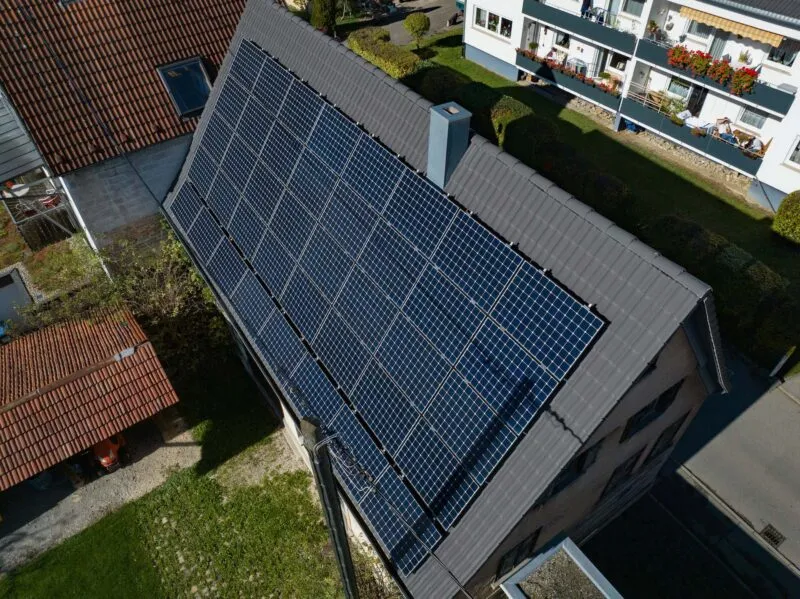
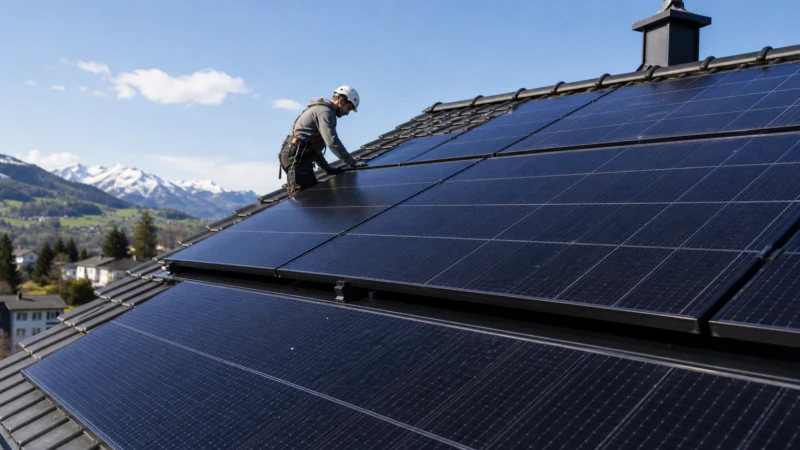
With an integrated (in-roof) system, the solar modules replace the roof tiles and form the roof covering themselves, carrying the rainwater away. Solar roof tiles and solar façades work on the same principle. Per kW, integrated systems cost about the same as on-roof systems in 2025: a median of CHF 1’817 compared with CHF 1’911 (10–30 kW, excl. VAT), although this excludes the sub-roof, counter-battens and roofing metalwork. In return, Pronovo pays more for integrated systems: CHF 400 instead of CHF 360 per kW for the share of output below 30 kW.
Key points at a glance
- A system counts as integrated if, besides producing electricity, it also provides weather protection, thermal insulation or fall protection.
- Integrated systems pay off above all for a new build or a roof renovation that is due anyway, because the modules then replace tiles.
- Similar prices per kW do not mean that the whole roof costs the same. Compare quotes for the complete roof build-up.
- Integrated systems receive more subsidies: CHF 400 instead of CHF 360 per kW for the share below 30 kW. From 30 to under 100 kW, it is CHF 330 instead of CHF 300. Integrated parts of a system with a tilt of 75 degrees or more receive an extra CHF 400 per kW.
- Sufficiently adapted solar systems on roofs, and since 01.01.2026 also on façades, do not need a building permit in building and agricultural zones; a notification is enough. On cultural and natural monuments of cantonal or national importance, a permit is always required.
- As of 03.11.2026
- Sources at the end of the article
What is the difference between on-roof, in-roof, solar roof tiles and a solar façade?
The difference lies in what the modules do for the building. An on-roof system sits on rails above the tiles. An integrated (in-roof) system replaces the tiles across the area it covers, with a sub-roof underneath.
Solar roof tiles are small solar elements the size of roof tiles or shingles and are laid like a roof covering. A solar façade replaces the outer layer of the façade, usually as a ventilated curtain wall.
All three are forms of building-integrated photovoltaics and count as integrated for subsidy purposes if they take on the role of the building envelope. The guide Solar modules and solar panels explains the different module types.
How do the four types compare?
The table shows what can be documented for Switzerland.
| Feature | On-roof | Roof-integrated | Solar tiles | Solar facade |
|---|---|---|---|---|
| Construction | Modules on rails above the roof covering | Modules replace the roof covering | Small elements as roof covering | Modules replace the facade cladding |
| Yield per kWp and year | around 1’000 kWh (Swiss Plateau, south-facing) | depends on rear ventilation and roof structure | no Swiss figure available | 447–621 kWh measured on south-west façades in Zurich (2020) |
| Costs | CHF 1’911 per kW (median 10–30 kW, 2025) | CHF 1’817 per kW (median 10–30 kW, 2025, excluding sub-roof, counter-battens and roofing metalwork) | no reliable Swiss figure | no current Swiss figure available |
| One-off payment for the portion under 30 kW | CHF 360 per kW | CHF 400 per kW | CHF 400 per kW if integrated | CHF 400 per kW if integrated; from 75 degrees, plus a CHF 400 bonus |
| Service life | Modules: 30 years or more | Modules: 30 years or more | no Swiss figure available | Modules: 30 years or more, warranty depends on the product |
| New build | good | very good | very good | very good |
| Renovation | on suitable roofs, after checking load-bearing capacity, fixings and roof condition | when the roof covering is replaced | when the roof covering is replaced | when the facade is renewed |
| Townscape | visibly mounted on top | flush, calmer appearance | barely recognisable as a solar system | free design, colours possible |
Source: Swiss Federal Office of Energy and EnergieSchweiz, price monitoring study 2025; Energy Funding Ordinance, as at 01.07.2026; EnergieSchweiz publications 2019 to 2022
Costs excl. VAT. The façade yields are measurements from individual buildings, not averages. The service life is not a guarantee: check the product and performance guarantees for the system you are offered.
- On-roof
- Roof-integrated
| On-roof | Roof-integrated | |
|---|---|---|
| 2 to 10 kW | CHF 2’497 (on-roof)CHF 2’362 (integrated) | |
| 10 to 30 kW | CHF 1’911 (on-roof)CHF 1’817 (integrated) | |
| 30 to 50 kW | CHF 1’577 (on-roof)CHF 1’722 (integrated) |
In 2025, the integrated systems recorded had similar prices per kW to on-roof systems. The sub-roof, counter-battens and roofing metalwork are not included. The number of integrated systems is small (25, 33 and 3).
Source: Swiss Federal Office of Energy and EnergieSchweiz, Photovoltaic market: price monitoring study 2025, figure 18, final report of 03.08.20261
What does a roof-integrated system cost?
Per kW, about the same as an on-roof system, but not necessarily for the whole roof. The 2025 figures do not show that complete roof solutions cost the same, and the study still assumes integrated systems are generally more expensive. In previous years they were. Suspected reasons for the change: a more mature market and shared site-safety costs on new builds and roof renovations.
Bear three caveats in mind when reading these figures:
- Not included are the sub-roof, counter-battens and roofing metalwork around the module area.
- Limited data: Across the three output classes compared, 61 integrated systems stand against 1’388 on-roof systems, and 40 % of the integrated records come from a single company source. The results can only be generalised to a limited extent.
- Design costs extra: Coloured modules, solar roof tiles or hidden cabling can add considerably to the cost.
For a renovation, therefore, compare a new tiled roof plus an on-roof system with an integrated system including sub-roof, counter-battens and roofing metalwork, each of which should be listed separately in every quote. Ask for quotes for both options and Compare quotes.
There is no reliable Swiss price for solar roof tiles. You will find general prices in the guide What does a photovoltaic system cost?, and figures per area under Photovoltaic costs per m².
When does a roof-integrated system make sense?
When your roof is being re-covered anyway. The modules then replace tiles, and the scaffolding serves both jobs. Typical cases:
- New build: Planning, structural design and roof build-up can be matched to the system from the outset.
- Roof renovation: If the roof covering has reached the end of its life, the integrated system replaces some of the new tiles.
- Townscape: In historic centres or where design rules are strict, a flush-mounted system looks calmer. Solar roof tiles are even less noticeable.
- Listed buildings: A permit is always required on protected buildings. Check early with the heritage conservation office which solution is possible.
If your tiled roof is intact and suitable, an on-roof system is usually the simpler and cheaper choice. The specialist installer checks load-bearing capacity, fixings and roof condition beforehand. The guide Solar system for the single-family home shows how to approach a project for your home.
Does a roof-integrated system produce less electricity?
That depends on the rear ventilation. Under integrated modules, the air gap is often smaller than with on-roof systems, so the modules get warmer and can produce less. Measurements in southern Switzerland from 2014 to 2018 show the order of magnitude: ventilated modules were usually at around 40 °C, fully insulated ones usually at around 55 °C. At peak values the difference was around 25 °C, which is the worst case without rear ventilation.
For each extra degree of module temperature, the modules studied lost around 0.37 to 0.43 % of their output. This is a measured value for the modules, not a flat annual reduction. Plan the rear ventilation carefully and have the annual yield calculated for your roof build-up.
How much electricity does a solar facade generate?
In the buildings studied, the façades delivered less electricity per kWp over the year than the roof systems, but a larger share in winter. Measurements on five apartment buildings show this: in Zurich, south-west façades achieved 447 and 621 kWh per kWp in the 2020 measurement year, while the roof systems on the same buildings reached 1’129 and 1’189 kWh. The big difference between the façades is explained by shading in the city.
In the winter half-year, south façades delivered around 40 % of their annual yield, compared with around 26 % for the roof system on one of the buildings. These shares depend on location and orientation. A solar façade is therefore a good match for a heat pump, which needs the most electricity in winter. For new builds with more than 300 m² of eligible floor area, a façade system can also meet the solar obligation, subject to exceptions and cantonal rules.
What subsidy is available for integrated systems?
A higher one-off payment (EIV) from Pronovo than for attached systems. The table shows the rates for commissioning from 01.04.2025. There is no longer a basic contribution.
| Capacity share | Attached or freestanding | Integrated |
|---|---|---|
| below 30 kW | CHF 360 per kW | CHF 400 per kW |
| 30 to below 100 kW | CHF 300 per kW | CHF 330 per kW |
| 100 kW or more | CHF 250 per kW | CHF 250 per kW |
| Bonus for a tilt of 75 degrees or more | CHF 200 per kW | CHF 400 per kW |
Source: Energy Funding Ordinance, as at 01.07.2026; Pronovo, Photovoltaic Guideline, version 4.2, October 2026
The calculation is tiered: the lower rate applies only to the additional share of output. Since 01.04.2025, large integrated systems also receive the integrated rates for these shares. The rates apply on 03.11.2026; they are not guaranteed for later commissioning.
What matters:
- Minimum size: The one-off remuneration is available from 2 kW.
- Mixed systems: If only part of the system is integrated, the higher rate applies only to the output of that part.
- Tilt angle bonus: At this level, it has applied since 01.01.2025 to parts of a system with a tilt of at least 75 degrees, mainly façades and railings. It cannot be combined with a winter electricity bonus.
- Photos: For integrated systems, Pronovo requires photos taken during construction and after completion that show the integration. Ask your specialist installer to take these photos.
How to calculate it: An integrated system of 10 kW receives 10 × CHF 400 = CHF 4’000; as an on-roof system it would be CHF 3’600. An integrated system of 50 kW receives 30 × CHF 400 + 20 × CHF 330 = CHF 18’600. An integrated south façade of 6 kW with a tilt of at least 75 degrees receives 6 × (CHF 400 + CHF 400) = CHF 4’800. If the same façade is only attached, it is 6 × (CHF 360 + CHF 200) = CHF 3’360.
For small systems, you submit the application after commissioning. The guide Pronovo subsidy explains how this works.
Does a roof-integrated system need a building permit?
In most cases, no. Sufficiently adapted solar systems on roofs do not need a building permit in building and agricultural zones, and since 01.01.2026 this also applies to façades. You notify the responsible authority of the project before construction starts; the canton sets the deadline and the documents required.
On a roof, a system counts as sufficiently adapted if it:
- protrudes no more than 20 cm from the roof surface at right angles,
- does not extend beyond the roof surface when viewed from above,
- is low-reflection and compactly arranged.
An integrated system usually meets the first two points by itself. On façades, a continuous rectangular area meets one of the integration criteria. In addition, the following generally applies:
- The system does not cover any structural or decorative elements.
- It does not protrude beyond the facade edges.
- It stands no more than 20 cm from the façade, parallel to it.
- It is uniform in colour and material and low-reflection.
Cantons can set different requirements. Clarify these before you plan.
Exceptions: On cultural and natural monuments of cantonal or national importance, every solar system needs a permit, for example on sites in the Federal Inventory of Swiss Heritage Sites (ISOS) with conservation objective A. The system must not significantly impair the monument. Cantons can also require a permit in clearly defined protection zones. Otherwise, the interest in solar energy generally takes precedence over aesthetic concerns. Ask your municipality at the start whether your building is protected or lies in a protection zone.
Frequently asked questions and answers
Is a roof-integrated system watertight?
Yes, if it is properly built. An integrated construction includes a suitably planned sub-roof and clean connections to the chimney, roof windows and edges. This roofing metalwork should be listed separately in the quote.
What is the difference between solar roof tiles and integrated modules?
Integrated modules are large-format and form an entire roof surface. Solar roof tiles are small elements in tile format and are less noticeable. Such design wishes can, however, add considerably to the cost.
Is a solar roof worthwhile without renovating the roof?
Usually not. If the roof covering is intact, the integrated system replaces tiles that would last for years yet. In that case, an on-roof system is usually more economical. The specialist installer will work this out for your roof in the quote.
Do I have to report an integrated system to my building insurer?
Yes. Report the system to the insurer responsible for your building. Not every canton has a cantonal building insurance. Clarify in writing whether the system is covered and whether the insured value needs to be adjusted.
How do I find a specialist installer for an integrated system?
Ask for references with integrated systems. With one request, you receive up to three quotes from vetted specialist installers in your region. This lets you Compare quotes, free of charge and without obligation.