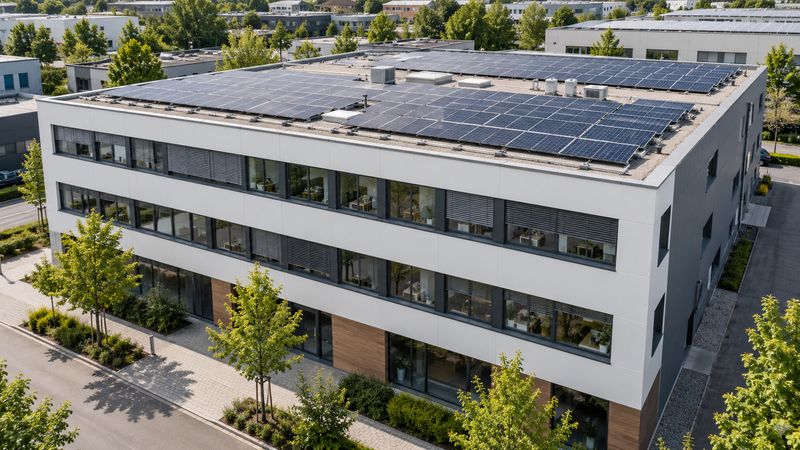
Anyone in Switzerland constructing a new building with a chargeable floor area of more than 300 m² must install a solar system on the roof or façade. This has been required by Art. 45a of the Energy Act (EnG) since 01.10.2022, and without a time limit since 01.01.2025. The cantons regulate the required size of the system in very different ways: for the same commercial hall, the obligation ranges from around 18 to around 180 kW.
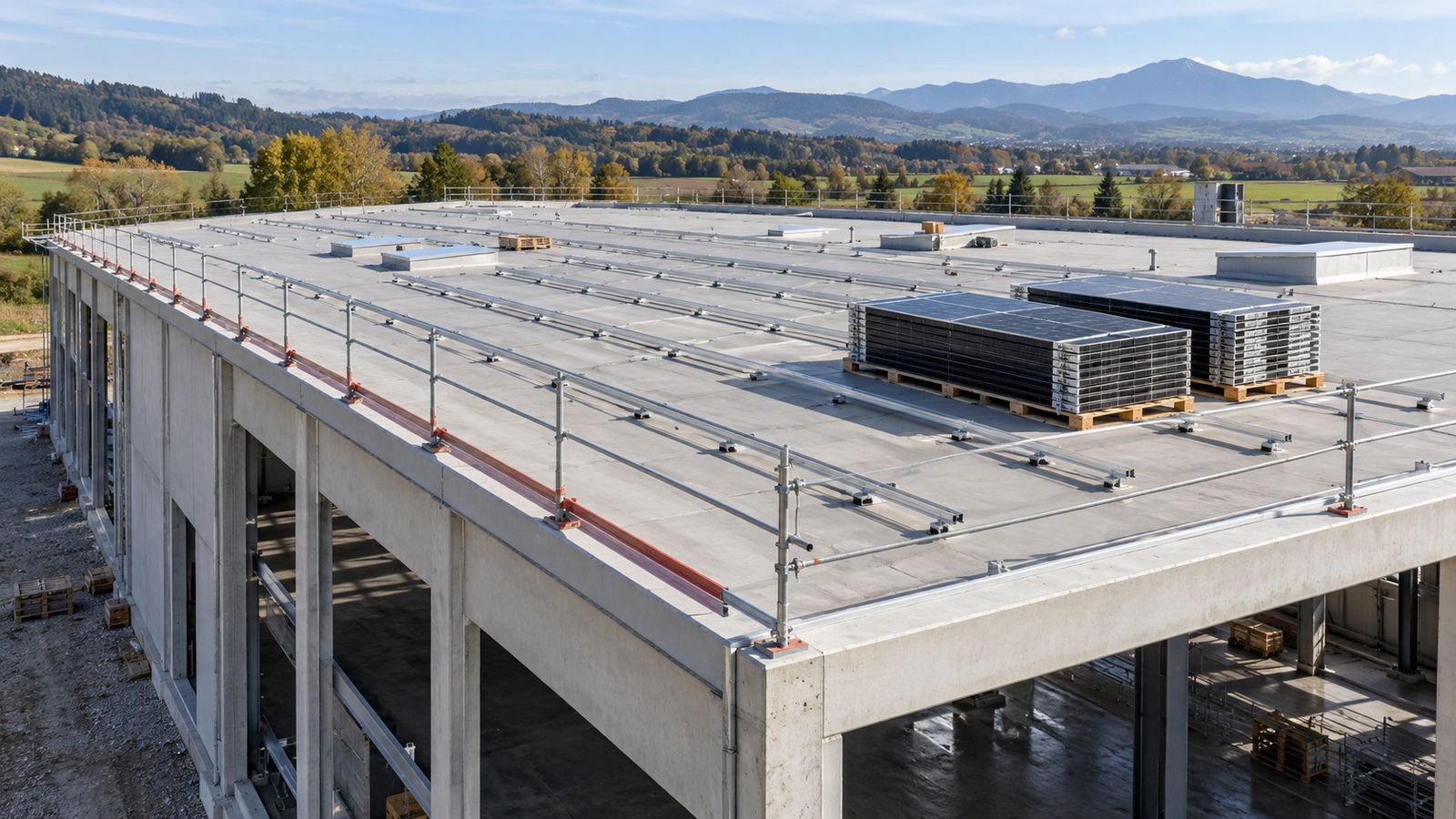
Key points at a glance
- The federal obligation applies to new buildings with a chargeable floor area of more than 300 m². Both photovoltaics and solar thermal count.
- Cantons that had introduced their own rules on on-site electricity generation by 01.01.2023 apply these, for example Zurich, St. Gallen, Schwyz and Lucerne.
- Aargau and Solothurn apply the federal rule; Bern has had its own, stricter rule since 01.01.2026.
- The cantons regulate exceptions, for example for listed buildings, technical impossibility or disproportionate costs.
- As of 25.10.2026: Energy Act (EnG), version of 01.04.2026, and cantonal legislation with the status for each canton given in the table.
- As of 25.10.2026
- Sources at the end of the article
What does federal law require?
Art. 45a of the Energy Act (EnG) is titled “Pflicht zur Nutzung der Sonnenenergie bei Gebäuden” (obligation to use solar energy in buildings). Paragraph 1 reads, in translation:
> When new buildings with a chargeable floor area of more than 300 m² are constructed, a solar system, for example a photovoltaic or solar thermal system, must be installed on the roofs or façades. The cantons may also provide for this obligation for buildings with a chargeable floor area of 300 m² or less.
The other paragraphs provide as follows:
- Paragraph 2: The cantons regulate the exceptions, in particular where a solar system conflicts with other public-law provisions, is technically impossible or is economically disproportionate.
- Paragraph 3: Until cantonal laws are enacted, the cantonal governments regulate the exceptions in an ordinance.
- Paragraph 4: Cantons that had introduced rules on on-site electricity generation for new buildings by 01.01.2023 in line with the cantons’ model energy regulations (MuKEn 2014, Part E), or stricter rules, are exempt from paragraphs 1–3.
Since when has the obligation applied? Parliament introduced Art. 45a in the urgent act of 30.09.2022, valid from 01.10.2022 and initially limited until the end of 2025. Under the Federal Act on a Secure Electricity Supply from Renewable Energy Sources, the article has applied without a time limit since 01.01.2025, with the same wording. It covers building applications submitted from 01.01.2023.
Federal law sets no minimum system size and no compensatory levy. Nor does it cover car parks. In simple terms, the chargeable floor area is the area within the façade line, i.e. the building’s footprint. For businesses, this means almost every new commercial hall is subject to the obligation.
What applies in the cantons?
The cantons implement the obligation in two ways. Some apply the federal rule and set a minimum area. Others already had their own rule based on the model regulations (MuKEn 2014): at least 10 W per m² of energy reference area (ERA), up to a maximum of 30 kW. The ERA is the sum of all heated or cooled floor areas.
| Canton | Legal basis and since when | Minimum requirement | Compensatory levy | Status of source |
|---|---|---|---|---|
| Aargau | federal rule, § 26a Energy Ordinance, since 01.01.2023 | modules or collectors on at least 20% of the chargeable floor area; single-family homes exempt | none | ordinance as of 01.01.2026, information sheet 09/2025 |
| Bern | own rule, Art. 39a–39e cantonal Energy Act, since 01.01.2026 | all new buildings: 10% of the chargeable floor area; suitable roofs 60% covered | none | act as of 01.01.2026 |
| Lucerne | own rule, § 15 cantonal Energy Act | usable roof area fully covered (50% of the usable area); half of this for roof renovations, since 01.03.2025 | CHF 1’000 per kW | act and ordinance as of 01.03.2025 |
| Schwyz | own rule, § 8c cantonal Energy Act, since 2022 | 10 W per m² ERA, maximum 30 kW | not possible | legislation as of 01.02.2025; consultation until 31.01.2027 |
| Solothurn | federal rule, implementing ordinance, since 01.01.2023 | guidance: modules on 20% of the chargeable floor area | none | ordinance as of 01.01.2023, guidance 12/2022 |
| St. Gallen | own rule, Art. 5b–5c Energy Act, since 01.07.2021 | 10 W per m² ERA, maximum 30 kW per building | CHF 2’700 per kWp | legislation as of 01.07.2021 |
| Zurich | own rule, § 10c Energy Act, since 01.09.2022 | 10 W per m² ERA; no more than 70% of the chargeable floor area is required | none | ordinance as of 01.07.2026 |
Key details by canton:
- Aargau: Buildings in the same building application are added together. For extensions, only the new area counts.
- Bern: Roofs with at least 1’000 kWh per m² of solar irradiation count as suitable. The obligation lapses if the solar system costs more than 5% of the other construction costs. When a roof is renovated, only a notification requirement applies. New public car parks with 80 or more spaces need a solar canopy.
- Lucerne: The calculation is based on 200 W per m² of module area. Since 01.03.2025, the obligation has also applied when a roof is re-covered or re-sealed.
- Schwyz: The canton intends to bring its own rule back into line with the federal rule. The consultation has been running since 14.10.2026 and ends on 31.01.2027; the amendment is not yet in force.
- St. Gallen: Instead of installing a system, the weighted energy demand can be reduced by 5 kWh per m² per year. The compensatory levy funds tenders for new photovoltaic systems.
- Zurich: In November 2025, the cantonal government proposed to the cantonal parliament that suitable roofs of 300 m² or more be fully covered, including when roofs are renovated (bill 6062). As of 25.10.2026, it was unclear whether and when the cantonal parliament would decide.
If you are building in another canton, ask the cantonal energy office. The 2025 model regulations (MuKEn 2025), adopted by the Conference of Cantonal Energy Directors on 29.08.2025, will recommend 20 W per m² ERA for new buildings and 10 W for roof renovations. They only apply once a canton adopts them into its legislation.
What exceptions are there?
Federal law names three grounds, which the cantons specify in more detail:
- Other regulations: protection of monuments, townscapes or landscapes, for example in Aargau, Solothurn and Lucerne.
- Technically impossible: in Solothurn, for example, if the roof is needed for operationally essential equipment and the façade is not an option.
- Economically disproportionate: in Solothurn with irradiation below 700 kWh per m², in Schwyz below 1’120 kWh per m². In Aargau, if the system does not pay for itself within 25 years or delivers less than 70 kWh per m² of module area. In Bern, if the additional costs exceed 5% of the other construction costs.
Further exceptions concern small extensions under 50 m², air-supported halls and greenhouses. The burden of proof usually lies with the developer, so prepare the justification together with the building application.
What counts as meeting the solar obligation?
Under federal law, any solar system on the roof or façade is sufficient, whether photovoltaic or solar thermal. The cantons allow further options:
- Façade instead of roof: in Bern, a façade system reduces the roof area that must be covered.
- System on the site: in Lucerne, a system on another building on the same site counts; in Zurich, a system on the plot.
- Self-consumption association (ZEV): Zurich, Schwyz and St. Gallen allow the obligation to be met jointly within a ZEV.
- Third parties: in Bern, third parties such as a contractor may build and operate the system.
- Compensatory levy: Lucerne and St. Gallen allow a levy to be paid instead of installing a system.
The solar obligation does not rule out subsidies. Mandatory systems also receive the federal one-off payment via Pronovo if they meet the conditions. For systems of 100 kW or more, see the guide One-off payment for large photovoltaic systems (GREIV).
Worked example: a commercial hall in seven cantons
A business builds a heated hall with offices. Chargeable floor area 1’500 m², energy reference area 1’800 m², flat roof of 1’500 m², good sun exposure. Assumption: 200 W per m² of module area. Investment based on SwissEnergy’s 2025 price study, one-off payment (Pronovo) based on the 2026 rates for mounted systems.
| Canton | How the obligation is calculated | Mandatory system | Investment | One-off payment (EIV) |
|---|---|---|---|---|
| Zurich, Schwyz, St. Gallen | 1’800 m² ERA × 10 W | around 18 kW | around CHF 35’000 | CHF 6’480 |
| Aargau, Solothurn | 20% of 1’500 m² = 300 m² of modules | around 60 kW | around CHF 103’000 | CHF 19’800 |
| Lucerne | 50% of 1’500 m² = 750 m² of modules | around 150 kW | around CHF 178’000 | CHF 44’300 |
| Bern | 60% of 1’500 m² = 900 m² of modules | around 180 kW | around CHF 199’000 | CHF 51’800 |
If you do not build a system in St. Gallen, the compensatory levy costs 18 kWp × CHF 2’700 = CHF 48’600. That is more than the system itself. In Lucerne, it would be CHF 150’000 for 150 kW.
In economic terms, a larger system often makes more sense than the minimum system. Larger systems cost significantly less per kW: around CHF 1’920 for 18 kW, around CHF 1’100 for 180 kW. If your business needs the electricity during the day, it usually pays to cover as much of the roof as is sensible. The costs are explained in the guide Solar system costs for businesses.
| Value | |
|---|---|
| Zurich | around 18 kW |
| Schwyz | around 18 kW |
| St. Gallen | around 18 kW |
| Aargau | around 60 kW |
| Solothurn | around 60 kW |
| Lucerne | around 150 kW |
| Bern | around 180 kW |
For the same hall with 1’500 m² of chargeable floor area and 1’800 m² of energy reference area, Bern requires around ten times as much capacity as Zurich, Schwyz and St. Gallen. Assumptions: a flat roof with good sun exposure and 200 W per m² of module area; exemptions are not taken into account.
Source: Own calculation by solar-guide.ch based on cantonal regulations4–10
What should developers of commercial buildings plan now?
Planning the solar system early saves money. SwissEnergy’s price study shows that, for new buildings, site safety and scaffolding can be shared with other work.
- Clarify the obligation: Ask the municipality or the cantonal energy office which rule applies and what proof must accompany the building application.
- Structural load: Design the roof for the additional load, including ballast on a flat roof.
- Keep roof space free: Arrange ventilation, skylights and building services so that large contiguous areas remain.
- Grid connection: Clarify connection capacity and costs with the grid operator early. According to the price study, a new distribution board can account for up to 30% of the system budget.
- Plan for self-consumption: Match the heat pump, cooling and charging stations to the solar electricity. With tenants, a ZEV is possible.
- Choose the financing: Buying or solar contracting. You only receive the one-off payment after commissioning.
How to plan a large system technically is explained in the guide Photovoltaic power plants for business and industry. All topics for businesses can be found on the page Solar panels for business.
Frequently asked questions and answers
Does the solar obligation also apply to roof renovations?
Not under federal law. Since 01.03.2025, Lucerne has required half the new-build requirement when a roof is re-covered or re-sealed. Bern requires notification for comprehensive roof renovations, but no system. In Zurich, such an obligation has been proposed but is not in force.
Does a solar thermal system count?
Yes. Art. 45a EnG explicitly mentions photovoltaics and solar thermal. The cantons count collector area differently. In Aargau, it counts the same as module area.
Does the obligation apply to car parks?
Not under federal law. Since 01.01.2026, Bern has required solar canopies for new public, managed outdoor car parks with 80 or more spaces. For large systems above previously uncovered car parks, the Confederation pays a car park bonus of CHF 250 per kW.
Is a stricter federal solar obligation on the way?
The Solar Initiative aims to use all suitable surfaces on buildings and infrastructure. It was submitted on 10.12.2025. The Federal Council rejects it without a counter-proposal and intends to present its dispatch in December 2026. Until Parliament and the people decide, Art. 45a applies in its current version.
What happens if I do not meet the obligation?
Without proof of compliance or an approved exception, you will generally not receive a building permit. In Lucerne and St. Gallen, you can pay a compensatory levy instead; in Aargau, Bern, Solothurn, Schwyz and Zurich, you cannot.