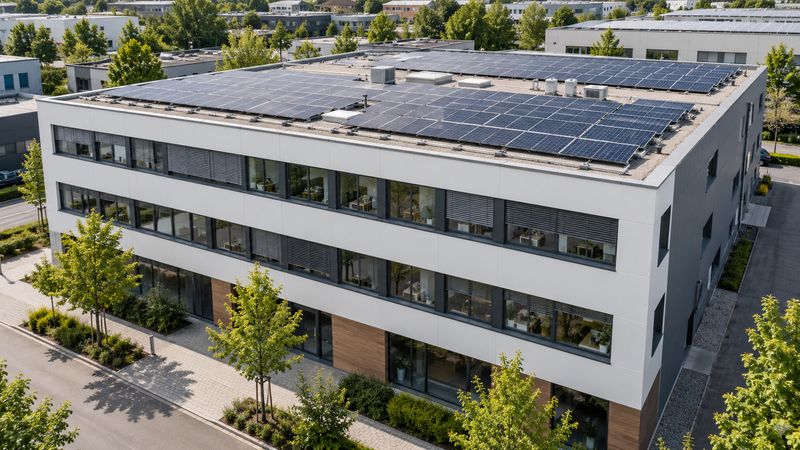
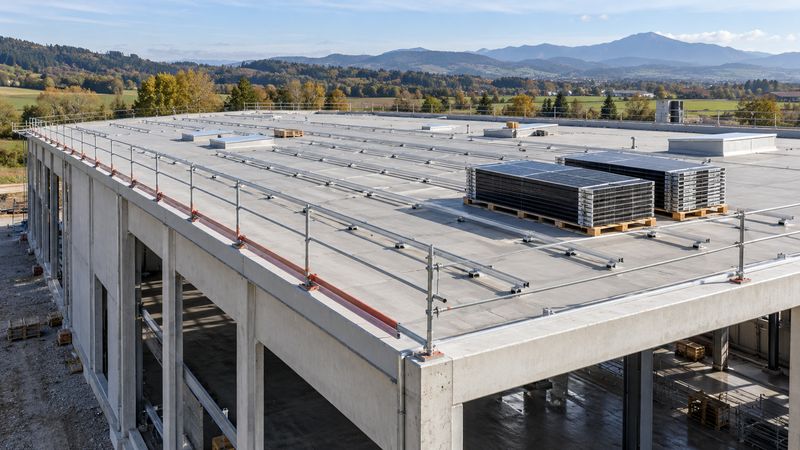
With solar contracting, a specialist provider finances, builds and operates the solar system on your roof. You buy the solar electricity from them for less than grid electricity; in published models, for 80–85% of the grid tariff. With roof leasing, you receive a fee for the space instead. Contracts usually run for 25 years.
Request no-obligation quotes for your company roof
Key points at a glance
- Contracting pays off mainly where self-consumption is high; roof leasing suits roofs with no significant consumption (SwissEnergy).
- Large providers usually require 1’000–2’000 m² of roof area; some start at 400–500 m².
- Term: 25 years with most providers, usually 25–35 years according to SwissEnergy. After that, the system often passes to you free of charge.
- In the worked example, buying yields three to four times as much as contracting over 20 years and initially requires CHF 212’000 of capital, or CHF 155’200 once the subsidy has been paid.
- As of 25.10.2026. Most providers do not publish prices in centimes (Rp.) per kWh; they calculate them per project.
- As of 25.10.2026
- Sources at the end of the article
What are the three models?
Three models are common in Switzerland. They differ in who uses the solar electricity and what you pay for.
| Model | Who owns the system? | What you pay or receive | Suits |
|---|---|---|---|
| Energy supply contracting | Contractor | You pay per kWh of solar electricity you consume | high self-consumption |
| System leasing | Contractor | You pay a fixed annual fee and use the electricity yourself | predictable consumption |
| Roof leasing | Contractor | You receive a fee; the electricity goes into the grid | low self-consumption |
Energy supply contracting: The contractor plans, finances, builds and maintains the system. You buy the solar electricity at an agreed price and the rest from the grid as before. The contractor sells the surplus.
System leasing: Instead of paying per kWh, you pay an annual fee. An energy supplier offers this model in its grid area: an annual contracting fee over 25 years, with feed-in credited to you; after that, the system is yours.
Roof leasing: You only provide the space. The operator feeds the electricity into the grid and pays you a fee, either annually or as a one-off payment in advance. You continue to buy your own electricity at the full tariff. SwissEnergy therefore does not count roof leasing as classic contracting.
What do you pay or receive per kWh and per year?
Hardly any provider in Switzerland publishes fixed prices in centimes per kWh or rents in CHF per m². Prices depend on roof size, self-consumption and grid connection. These examples are public (retrieved 25.10.2026):
| Provider or project | Model | Price or fee | Term |
|---|---|---|---|
| Large energy supplier in German-speaking Switzerland, from 2’000 m² | Contracting or roof leasing | constant price per kWh, not published; roof leasing as a fixed annual amount | 25 years |
| Municipal electricity utility, roof leasing from 6’000 m² | Contracting or roof leasing | low fixed price, not published; annual rent | 25 years |
| Cantonal energy supplier, from 1’000 m² | Contracting or roof leasing | fixed electricity price or roof leasing, annual or one-off | typically 30 years |
| Large energy supplier in French-speaking Switzerland, from 2’000 m² | Contracting or space rental | fixed price for 25 years | 25 years |
| Municipal utility in western Switzerland, from 400 m² | Contracting | stable price, purchase for at least 10 years | 25 years |
| Valais energy supplier | Contracting | indicatively 50% below the normal electricity price | 10–25 years |
| Specialised contracting provider, from around 45 kW | Contracting | 80% of the grid purchase price, no roof rent | 20–25 years |
| School building in a Zurich municipality | first roof leasing, then electricity purchase | Roof rent CHF 1’500 per year; now 85% of the grid tariff | not stated |
The SwissEnergy guideline distinguishes three pricing models:
- Fixed electricity price over the entire term. The contractor bears the risk of fluctuating electricity prices.
- Fixed discount on your energy supplier’s price, for example 15 or 20%. If the grid tariff rises, so does your solar electricity price.
- Indexed price, linked to the feed-in tariff, self-consumption, inflation or the reference interest rate.
The guideline’s rule of thumb: the higher the self-consumption, the lower the contracting price. According to Swissolar, contractors currently receive around 8 to over 12 centimes/kWh for the surplus, including guarantees of origin. For your own calculation, however, what you pay for grid electricity matters most. What a system of your own costs is explained at Solar system costs for businesses.
How long do contracts run, and what happens at the end?
Most providers conclude contracts for 25 years. SwissEnergy’s 2024 fact sheet mostly cites 25–35 years. Some energy suppliers cite 30 years or 10–25 years. According to Swissolar, the modules last more than 30 years.
At the end of the contract, there are three options:
- Reversion: The system passes to you, usually free of charge. This is how several large energy suppliers handle it, for example.
- Continued operation: The contract is extended or renewed. Some providers also offer the option of buying the system.
- Dismantling: The contractor removes the system. According to SwissEnergy, this is rarely agreed.
If you want to take over the system earlier, a residual value table sets the price for each year. Several energy suppliers explicitly provide for this takeover at residual value.
Contracting, roof leasing or buying: what suits your business?
Buying brings the greatest return, contracting the lowest burden. Roof leasing makes sense if you hardly use the electricity yourself.
| Criterion | Buying | Contracting | Roof leasing |
|---|---|---|---|
| Own capital | yes, full amount | no | no |
| One-off payment from the federal government | to you | usually to the contractor | to the operator |
| Electricity savings | full grid tariff | difference from the contracting price | none |
| Risk of defects and yield | with you | with the contractor | with the operator |
| Freedom over the building | full | restricted during the term | restricted during the term |
| Effort | planning, applications, maintenance | low | low |
Contracting is particularly suitable if your capital is needed in your core business or you do not want to build up expertise in-house. In a commercial property with tenants, the contractor can also supply the electricity to a self-consumption association (ZEV). You may then charge tenants a flat rate of at most 80% of the price they would pay without taking part.
Checklist for the contracting agreement
You usually conclude two contracts: a roof use agreement and an electricity supply agreement. Swissolar offers a model roof use agreement, developed with the major contracting providers. Check these points before you sign:
- Price and indexation: Fixed price, discount or index? How does your price develop if the grid tariff falls?
- Purchase volume: Do you have to take a minimum quantity? What applies if your consumption falls?
- Roof condition: If the roof will need renovating during the term, it is better to renovate first. Some providers contribute to the cost.
- Alterations and removal: Who pays for removing and reinstalling the system during roof work? Pro rata compensation should be agreed.
- Land register: The contractor usually secures its position with an easement. If the property is sold, the buyer takes over the contract.
- Contractor insolvency: Who takes over the system? A contractual right of takeover protects you.
- Dismantling and security: Who dismantles the system, and is there a security deposit for it?
- Residual value table: At what price can you take over the system early?
- One-off payment and guarantees of origin: Who is entitled to them, and are they factored into the price?
- Insurance and liability: Who insures the system? Building insurance rules differ from canton to canton.
Have the contract reviewed by a lawyer before signing. Clarify tax questions with your fiduciary or accountant.
Comparison: buying or contracting over 20 years
A commercial property has a 2’000 m² flat roof and consumes 500’000 kWh of electricity a year. The roof can take a 200 kW system. The business consumes 70% of the solar electricity itself.
Assumptions:
- Yield of 950 kWh per kW, i.e. 190’000 kWh per year, of which 133’000 kWh is used on site.
- Avoided variable grid purchase price 23.7 centimes/kWh as our own calculation assumption; fixed tariff components do not automatically fall away.
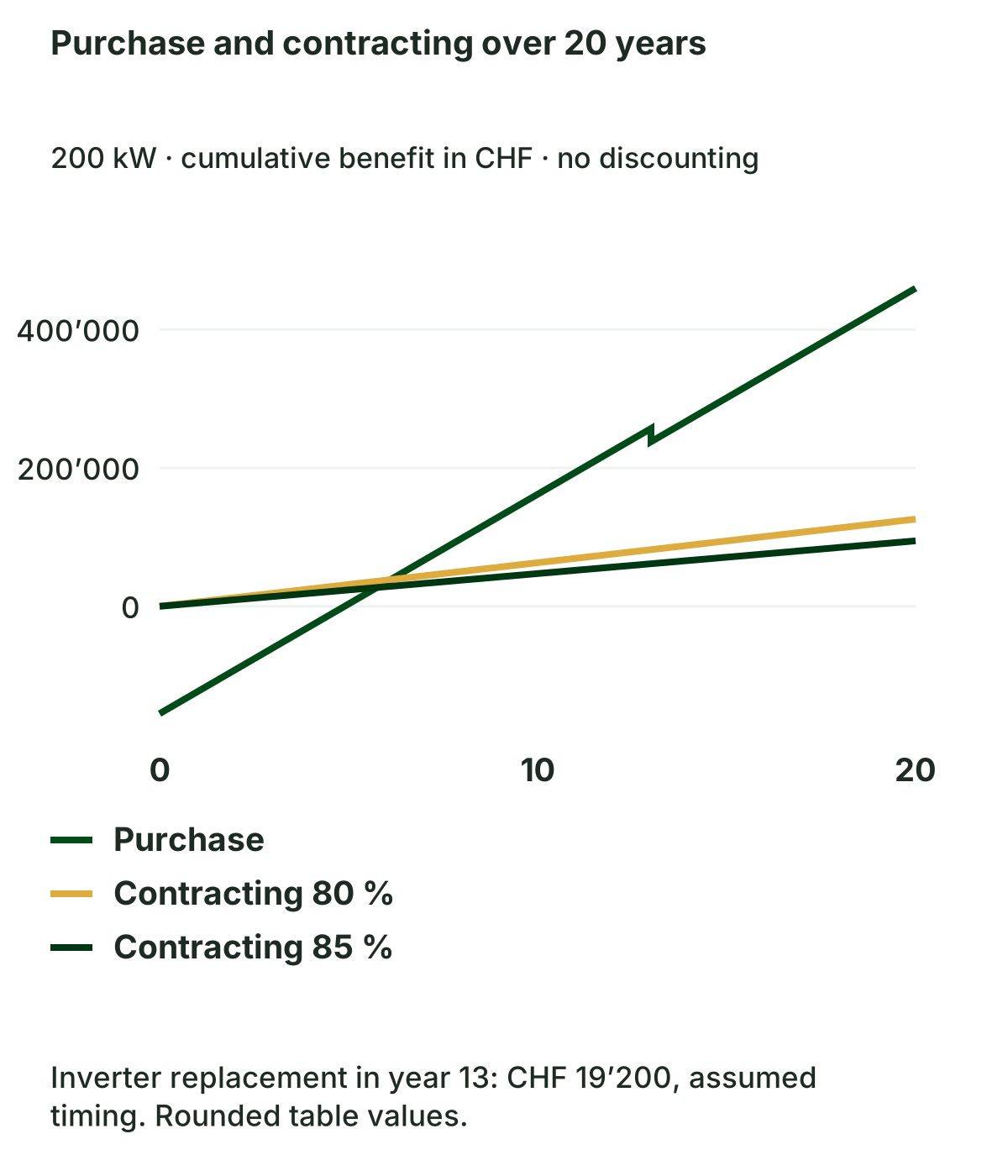
- Buying: investment of CHF 212’000 based on SwissEnergy’s 2025 cost curve, one-off payment of CHF 56’800, surplus at 7 centimes/kWh, operation at 2 centimes/kWh, one inverter replacement at CHF 19’200. For the progression chart, the replacement is assumed in the 13th year of operation; this is a calculation assumption, not a service-life guarantee.
- Contracting: solar electricity price at 80% or 85% of the grid tariff, no own costs.
- Without inflation. Interest only for buying, as only buying ties up capital.
| Over 20 years | Buying | Contracting at 80% | Contracting at 85% |
|---|---|---|---|
| Own capital | CHF 212’000 (after subsidy CHF 155’200) | CHF 0 | CHF 0 |
| Benefit per year | CHF 31’710 | CHF 6’300 | CHF 4’730 |
| Benefit after 20 years, without interest | around CHF 460’000 | around CHF 126’000 | around CHF 95’000 |
| Net present value | not calculated | not calculated | not calculated |
This is how the figures for buying are derived: 133’000 kWh × 23.7 centimes gives CHF 31’520 of grid electricity saved. Add 57’000 kWh × 7 centimes = CHF 3’990 for the surplus. Deduct CHF 3’800 for operation. After 20 years, that comes to CHF 634’200, less CHF 155’200 investment and CHF 19’200 for inverters.
With contracting, you save 20% of 23.7 centimes, i.e. 4.74 centimes per kWh, on 133’000 kWh. After 25 years, many providers transfer the system to you free of charge. From then on, you save as if you had bought it.
The result depends heavily on the electricity price. If you pay a demand charge and save only 18 centimes per kWh, buying yields around CHF 308’000 without interest and contracting at 80% around CHF 96’000. Buying remains the better option as long as you have the capital and can organise operation.
Request no-obligation quotes for your company roof and compare buying with contracting
Frequently asked questions and answers
Who receives the one-off payment under contracting?
Usually the contractor, as it operates the system. It factors the remuneration into its electricity price and bears the payment risk. The amount is explained in the guide to the one-off payment for large photovoltaic systems.
Is roof leasing worthwhile if I use hardly any electricity?
Often, yes. SwissEnergy recommends it for roofs with no significant self-consumption, such as warehouses. You receive a fee without risk and without investment. As an alternative, consider a system of your own without self-consumption with the high one-off payment (HEIV).
What happens if I sell the property?
If the contract is entered in the land register as an easement, the buyer takes over the rights and obligations. Clarify this with the contractor before the sale.
Can I take over the system before the contract ends?
With most providers, yes, at residual value. Have the residual value table for each contract year written into the contract.
Is contracting also available in French-speaking Switzerland?
Yes. A large energy supplier in French-speaking Switzerland offers contracting from 2’000 m² of space with a fixed price over 25 years. A municipal utility in western Switzerland starts at 400 m² of roof area. Contracting is also available in Valais, with contracts over 10–25 years. For agricultural roofs, see the guide Solar systems in agriculture; for an overview of all options, see the page Solar panels for business.
Sources
- SwissEnergy: fact sheet “Was ist Solar-Contracting?”, February 2024
- SwissEnergy: guideline on solar contracting, 01.11.2022 (pricing models, contracts, reversion, insolvency, one-off payment)
- Swissolar: roof leasing and solar contracting (revenue, maintenance, term, service life, model agreement), retrieved 25.10.2026
- Offer pages of seven Swiss energy suppliers on solar contracting and roof leasing (minimum area, pricing model, term, end of contract), including a 2025 factsheet, retrieved 25.10.2026
- Information from a Swiss solar contracting provider on pricing logic, retrieved 25.10.2026
- Media report, roof leasing and solar electricity for a school building in a Zurich municipality, 22.07.2026
- Swiss Federal Office of Energy SFOE and SwissEnergy: “Photovoltaikmarkt, Preisbeobachtungsstudie 2025”, final report of 03.08.2026 (cost curve, inverter costs)
- Federal Electricity Commission ElCom: tariff guidelines 2026, consumption categories C2–C4; electricity prices in the worked examples are our own assumptions, not confirmed medians.
- Energy Promotion Ordinance (EnFV, SR 730.03): Annex 2.1, section 2.9, version of 01.07.2026
- Energy Ordinance (EnV, SR 730.01): Art. 16b (internal costs in a ZEV), version of 01.07.2026
Request no-obligation quotes for your company roof